SWIFT blogpost | Policy Dialogue; “A competitive Europe demands a gender-sensitive Common Agricultural Policy.”

By Georgia Diamanti, with Jessica Duncan, Lucia Demicheli

On the chilly, sunny morning of October 2nd 2025, a team from RSO, including Jessica Duncan, Jasmijn Bakker, Lucia Demicheli, and Georgia Diamanti, boarded a train to Brussels together with Lotte Opdam, from Toekomstboeren.

We were headed to the SWIFT project’s fourth and final policy dialogue, to be held at the Spanish National Research Council, in the center of Brussels. Three such policy dialogues had already taken place at the national level of different EU member states; in Spain, Austria and Poland (read the SWIFT policy brief here). Only the EU-level policy dialogue remained.

We arrived with a few hours to spare before the start of the event, and so we went about helping with the small tasks that remained; such as setting the interpretation devices to the different language channels. For the food sovereignty movement, there is no revolution without interpretation and indeed, having professional interpretation was critical to ensuring participants could engage effectively.  

Georgia, Lucia and Jasmijn help set up the interpretation devices

Upon re-entering the main space where the dialogue was to take place (and in whose empty space we had previously sat, fidgeting with the interpretation devices) we now encountered a much livelier sight. This time the room was filled with people, chattering away. Soon Louise Legein (our SWIFT partner from Oxfam Solidarité) took the floor, and, welcoming us all to Brussels, signaled the start of the event.

Louise Legein presenting the SWIFT project ©Tineke Dhaese/Oxfam

Following a brief overview of the SWIFT project from Louise, Brussels-based journalist, Natascha Foote, took the floor. Here, Natasha took us along on a quick dive into the draft proposal for the upcoming CAP (an impressive feat to take on in 15 minutes – one which she nevertheless took on with an exceedingly engaging and humorous demeanor). Though she outlined various aspects of the CAP that are set to change (among the biggest of them, the scrapping of the Rural Development pillar and an overall drop in the EU CAP budget compared to the last programming period) it was also emphasised that this is only the first draft, which will serve as the basis for upcoming negotiations and that as such, “the road ahead is still a long one”.

Having by now warmed up, it was time to break out into rooms and proceed with the dialogue. And so, we were split into five groups; the aim was to have stakeholders representing different points of view in each group (farmers, policymakers and representatives of EU institutions, civil society,  researchers). We had just over an hour to discuss the following question: “What are the opportunities in the CAP (and related policies) to better support gender equality?”
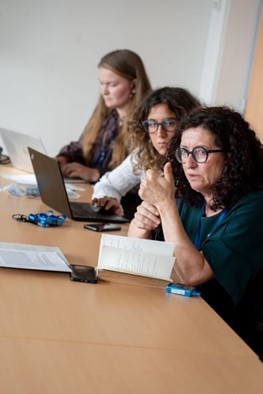
Break out group discussion ©Tineke Dhaese/Oxfam

Lively conversations ensued, the dialogues were a precious opportunity for farmers to engage with people on the policy side of the CAP.15 minutes left. 5 minutes left. The Oxfam facilitators discreetly slipped in and out of the breakout rooms, holding up signs that silently informed us that discussions were nearing their end. And so we reconvened back into the main room to share the fruits of our discussions.

Common themes that permeated discussions between the different groups were; generational renewal, social security, social conditionality, and the divide between EU policy and farm-level reality. Within multiple discussion groups, farmers were clear that if the CAP failed to address structural inequalities and area based payments, there would be no opportunities for them.

Finally, groups highlighted the tension between the EU trying to address critique that it governs from Brussels by renationalizing many responsibilities and the concern that the EU should be the moral compass and upholding broader values and standards like gender equality and environmental protection, but that this seems to be less and less the case.

After the dialogue, there was a social gathering. Reflecting on the event, we spoke of mixed feelings; on the one hand, the inspiration and hope that came from sharing this space, on the other hand, feeling overwhelmed at the work ahead if we are to really move towards a Common Agricultural Policy for Europe that respects the diverse way women and non-binary people farm.

Sharing discussion results ©Tineke Dhaese/Oxfam


Meet Our Visiting Scholar: Andrea Rizo Barroso, Universitat de Barcelona

We are delighted to welcome Andrea Rizo Barroso, a PhD candidate from the Universitat de Barcelona’s Food Action and Research Observatory (FARO), as a Visiting Scholar at RSO. Andrea’s work sits at the intersection of gender, food systems, and social inequality—an area of growing importance in contemporary food studies.


Research Focus

Andrea’s research explores how gender inequalities shape urban food environments and influence food security, particularly among vulnerable communities in Spain. Centering women’s lived experiences, her work seeks to build a critical and situated understanding of how urban food systems operate within broader structures of gender, access, and vulnerability. Her ambition is to shed light on the often-overlooked gendered dimensions of food insecurity and to contribute to more just and equitable food system transformations.


Current Work at RSO

During her stay at RSO, Andrea is focusing on advancing her paper, “Exploring Gender Dimensions in Urban Food Environments: A Systematic Scoping Review.” She is also refining the analytical framework for her PhD thesis and immersing herself in participatory methodologies such as photovoice—tools that will allow her research to more fully reflect the realities and perspectives of the women she works with.

Her work resonates strongly with collaborative initiatives like SWIFT, a project dedicated to equitable, gender-responsive food system transformation, creating rich opportunities for synergy and shared learning.


Why RSO and Wageningen?

Andrea chose RSO for its international reputation in research on power, inequality, and food systems—themes central to her own scholarly focus. The Rural Sociology Group’s commitment to equity and social justice aligns closely with her values and the communities she aims to represent in her work. Wageningen, with its vibrant academic environment, provides the ideal setting for interdisciplinary engagement and critical dialogue.


Beyond Research

Outside her academic pursuits, Andrea brings great energy and creativity to her life. She loves dancing salsa and bachata, enjoys hiking, and is always ready to explore new places through travel. Her passion for movement, nature, and discovery enriches both her personal and professional journey.


We are excited to have Andrea with us and look forward to the insights her research will bring to ongoing conversations about gender and food system transformation.

Publicatie | Gebiedsgericht werken: hoe maken we transitie écht werkbaar? 

“Erken het politieke karakter van transities, combineer actie en leren, want blauwdrukken zijn er niet voor. Ken de mensen en hun emoties, en probeer wat zij doen, ook als is het klein, te zien als zaaigoed voor grotere verandering”  – Marleen Buizer (Rurale Sociologie, Wageningen University & Research)

Hoe geef je gebiedsgericht werken vorm in de complexe transities van het Zuid-Hollandse landelijk gebied? Dit rapport biedt houvast met zeven principes, gebaseerd op twee jaar actie-onderzoek. De inzichten komen voort uit intensieve samenwerking met mensen uit beleid en praktijk die werken aan opgaven op het gebied van water, natuur, stikstof, klimaat en landbouw.

Gebiedsgericht werken vraagt om een samenhangende en context-specifieke aanpak, waarbij de kracht en kennis in gebieden centraal staan. In de praktijk blijkt dit uitdagend: de focus ligt vaak op juridisch-technische maatregelen, sectorale beleidsdoelen en win-win oplossingen, terwijl er in beleid en recht een schijnbare tegenstelling is ontstaan tussen landbouw en natuur.

Dit rapport pleit voor het serieus nemen en voortvarend ondersteunen van gebiedssamenwerking en de mogelijkheden daarvan voor een duurzamere toekomst van het landelijk gebied. Het  biedt handvatten voor beleid en praktijk. Elk principe wordt toegelicht met concrete voorbeelden uit de provincie Zuid-Holland, waar gebiedsgericht werken in de praktijk wordt gebracht.

Dit rapport is het resultaat van het project ‘Actieleren gebiedsgericht werken’, een samenwerking tussen ACCEZ, de provincie Zuid-Holland en diverse kennisinstellingen.

Lees het volledige rapport:

Auteurs: Marleen Buizer (WUR), Mara de Pater (DRIFT, EUR), Saskia Ruijsink (TU Delft/LDE), Tobias Hofland (ACCEZ).

Publication | Relational autonomy highlights how interdependencies shift in the transformation of food provisioning

In a recent study published in JASFC, Margriet Goris, Daphne Schoop, Dirk Roep, and Jan Hassink explore the growing movement of values-based territorial food networks (VTFNs) in the Netherlands. These networks seek to transform conventional food systems by fostering stronger connections between farmers, citizens, and natural resources.

Abstract
In the past decade, there has been a surge in the Netherlands in food initiatives that seek to trans­form the prevailing agro-industrial model of food provisioning. This has evolved into a wide range of values-based territorial food networks (VTFNs). This article aims to understand the evolving diver­sity in VTFNs by looking more deeply into how community, circular, and territorial-based food net­works operate. In doing so, the article examines how citizens, rural workers, and farmers cooperate to change and create connections between live­stock, land, water, and other resources. Further­more, it aims to assess to what extent the evolving food provisioning practices of these VTFNs are re-embedded in the territory, how their collective capacity to transform food provisioning practices has expanded, and the impact that the expanded capacity has on the degree of relational autonomy over their operations. Twelve participatory obser­vations and 16 interviews with farmers and citizens engaged in three different VTFNs are analyzed by identifying themes that emerged from the data, and themes that originate from the concept relational autonomy. Relational autonomy is introduced by feminist scholars and entails that autonomy is not an individual matter but is created in relationships. The concept allows for a deeper understanding of how a transformation of relations can raise the autonomy of all living beings, both human and non-human. The analysis demonstrates how rela­tional autonomy in the three VTFNs studied is emerging along the three interdependent and co-evolving dimensions identified by Catriona Mackenzie (2019): determination, governance, and authorization. All three VTFNs studied crafted their own pathway toward relational autonomy by creating opportunities and building capacities. A relational autonomy lens enables us to articulate the interconnectedness between human and non-human systems; for example, phasing out agro­chemicals increases our reliance on natural pro­cesses. This necessitates farmers and rural workers’ ability to mimic these processes and requires a rear­ranging of market relations to share risks more equitably with citizens.

https://www.foodsystemsjournal.org/index.php/fsj/article/view/1341

Video | Rural Sociology vs. Sociology of Development and Change Explained

Video | Are you a student interested in Rural Sociology (RSO) and wondering how it compares to Sociology of Development and Change (SDC) at Wageningen University & Research?

At Rural Sociology, we study societal change, inequality, and power with a focus on food, agriculture, and rural development. In this video, we explore how RSO and SDC approach these topics differently and what that means for your studies and research opportunities.

How does this relate to your interests? Our PhD researchers take you to Fruitproeverij Zandberg, an alternative agriculture site, to show how both groups conduct real-world research—helping you discover which themes and methods resonate with you.

Watch now to explore your options for courses, theses, or future research. Still unsure? Reach out to our education coordinator or drop by our hallway for a chat. A special thanks to Fruitproeverij Zandberg for allowing us to film at their inspiring location!