A politics of appearance

Hanne Wiegel successfully defended her minor thesis “A politics of appearance: a theoretical exploration of private accommodation initiatives for refugees”. Hereby a summary of the thesis, which received qualifications such as “well-structured””, “good logical reasoning”  and “theoretically sophisticated” .

“Publicly organized asylum seeker accommodation in Germany often involves a strict spatial and social segregation of asylum seekers from the wider society, which contributes to turning individuals who seek asylum into an abstract, impersonal category. For the individual asylum seeker, this creates a situation of harmful visibility vis-à-vis the state and harmful invisibility vis-à-vis the receiving society. Against this background, this paper will theoretically discuss the socio-political implications of recently developed civil society initiatives that organize the accommodation of asylum seekers in private housing arrangements in which asylum seekers live side-by-side non-refugees. Drawing on the approach of autonomous migration, Rancière’s disruptive politics and Butler’s performative theory of appearance, I argue that these civil society initiatives can be understood as providing spaces of appearance for asylum seekers to become visible as individuals amongst non-refugees. This can be considered as a performative act of disruption, changing the spatial and social ordering of asylum (accommodation) policies. Far from glorifying the effects of private accommodation for asylum seekers, however, I argue that these do not affect the legal status of the asylum seeker, but that nevertheless living side-by-side non-refugees can change asylum seekers’ invisibility vis-à-vis the civil society, and allows for personal encounters and individuation which might enhance their social emplacement.”

Key-words Germany, asylum seeker accommodation, ordering, civil society, dissensus, appearance

Thesis on Knowledge production, Agriculture and Commons

soutrik_commonsSoutrik Basu successfully defended his dissertation on Knowledge production, Agriculture and Commons. The discourse on knowledge production is in constant transformation: on the one hand, there is the emergence of instrumental knowledge production based on scientific utility and socio-economic relevance and marked by property regimes, while on the other hand, there is another form of knowledge production based on cooperation, communication and the sharing of knowledge often entitled the open-source production or commons-based peer production (CBPP) mode. Both these trends are reflected partially or in full measure within the agrarian knowledge production programme called Generation Challenge Programme (GCP).

soutrik_1Created by the Consultative Group of International Agricultural Research (CGIAR), the GCP is an international knowledge production platform that aims to use plant genetic diversity to develop technologies to support plant breeders in developing countries. In this work, it employs advanced genomic science and comparative biology in order to develop improved plant varieties for harsh, drought-prone environments. It focuses both on conducting advanced upstream researches with the help of genomics, molecular biology and bioinformatics and also on facilitating the downstream delivery of this research result to the farmers’ field. GCP’s knowledge production is organised in an international network that consists of CGIAR research centres, National Agricultural Research Systems (NARS) institutes, Advanced Research Institutes (ARIs) and other developmental organisations. The overall framework of GCP’s knowledge production is embedded in a global public goods framework, although the GCP also uses open source software to share knowledge regarding different biotechnological tools that usually comes within the purview of intellectual property rights (IPR).

Clearly, GCP’s knowledge production is mediated through a variety of patterns that may compete as fundamentally contradictory. It becomes important to study the knowledge production process of GCP, therefore, so as to understand the type of knowledge production that has emerged there and the implications of this for the wider debates on agrarian knowledge production. Three theoretical concepts are employed to frame analysis of the knowledge production of the GCP in this thesis: instrumental and non-instrumental discourse, CBPP and commons. And to this end, drought-tolerant rice research in the Indian context is used as a case study.

It is concluded that although this rice research community is situated in an overlapping institutional sphere of state, business and international institutions, it is itself neither public nor private in nature. This research community cannot be demarcated as a legal entity or identified through the state vocabulary. It exists as a confluence of plural activities through collective action towards a common goal, and it can be seen as a shared enterprise in which shared action generated the process through which the unpatented or otherwise owned Sahbhagi Dhan variety was developed and from which simultaneously actors benefited through participating in that shared process. Thus, the product that comes out from this process is neither public nor private in nature, but it is a common. It has been developed through shared action, as a process of commoning, and no single institution can claim exclusive right over it. Therefore, the non-state and non-market character of the research community becomes an essential feature.

His full thesis is accessible under this link http://edepot.wur.nl/377889

The Tiny House Movement: A progressive movement or a reactive defense of place?

Isabelle van Acquoy wrote an essay on the Tiny House Movement for the course RSO-55306 A Global Sense of Place. Is the Tiny House Movement a progressive movement reaching out or a reactive sense of place, she asked herself? Below a condensed version of her essay.  

The Tiny House Movement is an upcoming ‘social and architectural trend that advocates living simply in small spaces’ (Anson, 2014). A tiny house is on average between 10 and 40 square meters and is originally a mobile house, however they exist in different sizes and shapes. The movement became booming in the United States as a result of the housing market crash in 2007 and 2008 in which a lot of people lost their homes due to the inability to pay their enormous mortgages. Quite recently, the movement also became of interest in the Netherlands where different pioneers are experimenting with this alternative way of housing and living. Continue reading

Geographies of connectivity: a relational perspective on ‘autonomous’ Eco-villages in Romania

Flora Sonkin, MSc. International Development Studies at Wageningen University, followed the course of Global Sense of Place (RSO-55306) of the Rural Sociology Group. For the course, she wrote an essay on Eco-villages. Below, a summary of her essay.

IMG_7978.JPGDebates in contemporary social theory and political geography on the use of relational theory as a conceptual framework (found in the works of Escobar, Harvey, Massey and others), have generated a fertile ground to the deconstruction of the concept of place as bounded space. Through the use of a relational approach, space is seen as a social construction (Harvey, 1994). Consequently, it becomes a result of interactions, which are neither static nor limited to boundaries. In other words, thinking space relationally means that place is not defined as a locality or mere geographic position, but as a complex network of relations, a product of multiple trajectories and practices (Massey, 2004).
The aim of the paper I wrote on eco-villages is to contribute to the academic and activist discussion on the creation of different realities or “other worlds” in the present, using the case of eco-villages and the Global Ecovillage Network to illustrate the possibility to live within alternative forms of socio-economic organization without withdrawing from mainstream connections and social relations. Here, eco-villages and the global network are first characterized as a social movement which aims for self-sufficient living, being also put into the category of an ‘autonomous geography’ (Pickerill & Chatterton 2006). Continue reading

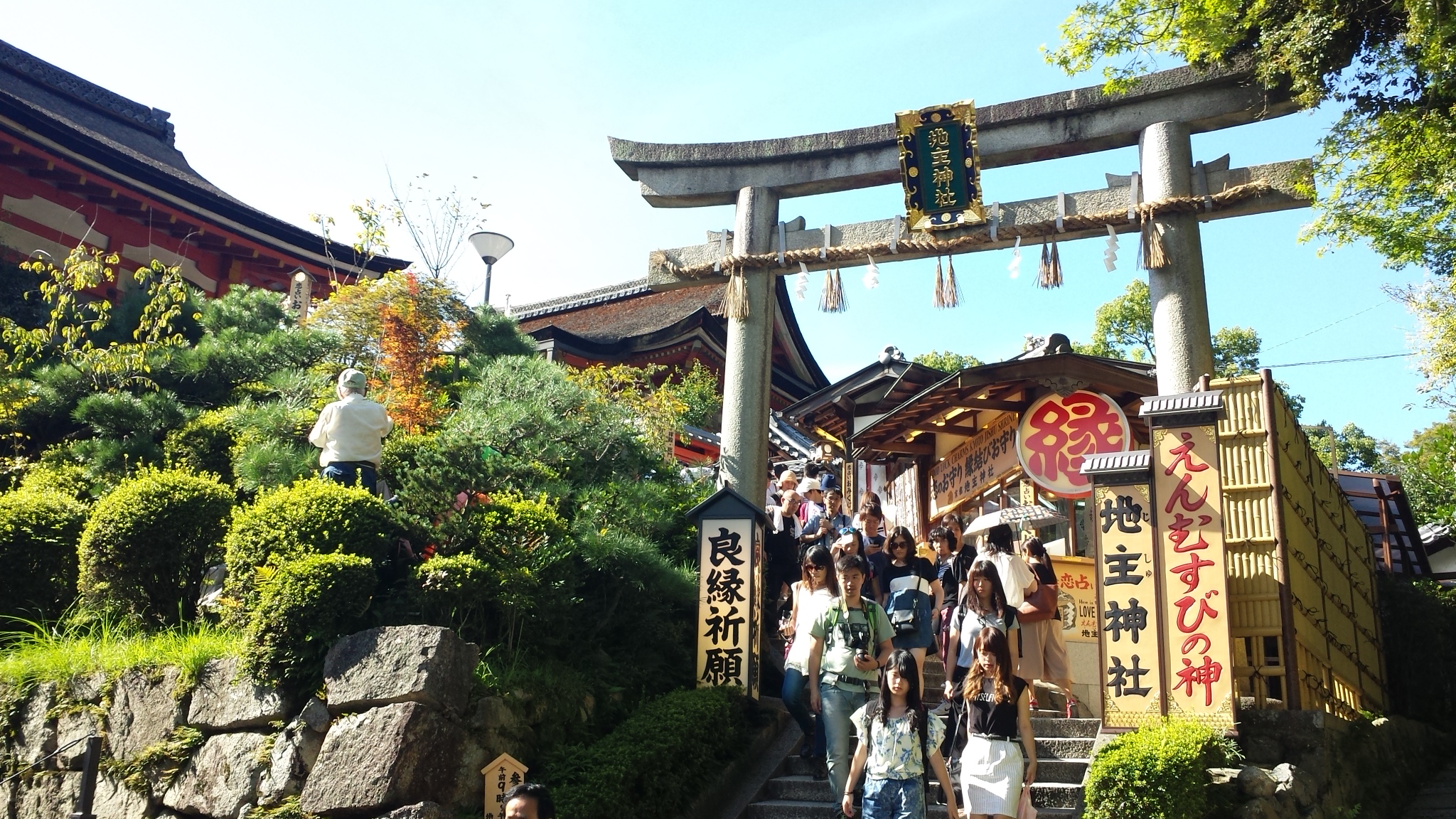
RSO Students at Summer school at Kyoto University in Japan

20150914_144117On the fifth day of our program of the 2015 Kyoto Graduate Seminar on Economic Development and Sustainability Studies we went on a field trip excursion on food, agriculture and environment. The bus from Kyoto University brought us into the beautiful foresty hills just outside of Kyoto, where we visited Yamaguni Sakikage Center and Tagayashiuta Farm. The Yamaguni Sakikage Center makes, grows and develops various typical Japanese products such as the basic ingredient for the well known miso soup. The miso is made by fermented ecologically produced soybeans and said to have many health benefits to it. The center is a reaction to the increasing depopulation of Kyoto’s rural backyard, mainly populated by elderly  part-time farmers, and dependency on overseas import of genetically modified soybeans. Continue reading