
In the Master thesis “Working for the occupier: Palestinian youths navigating the colonial settlement”, Davide Fabris investigates how young Palestinians make it through the daily challenges and precarity of working in a Israeli settlement. The main research question of his research is: ”How are young Palestinians experiencing and dealing with labour incorporation within the Israeli settlements’ economy?”.
Continue readingAuthor Archives: Joost Jongerden
Vacature Master Thesis Onderzoek – De politiek van Nederlandse steun in Palestina en het stopzetten van de medefinanciering van een Palestijnse NGO
Nederland besloot in 2022 de financiering voor de Palestijnse NGO UAWC (Union of Agricultural Work Committees) stop te zetten. UAWC ondersteunt duizenden Palestijnse boeren, vooral in gebieden op de Westelijke Jordaanoever waar Israël een illegale kolonisatiepolitiek voert. Israël heeft lang druk uitgeoefend op donoren om de steun aan UAWC te stoppen, omdat het volgens Israël een mantelorganisatie is van de Palestijnse verzetsbeweging PFLP (People’s Front for the Liberation of Palestine).
Nederland heeft UAWC extern laten onderzoeken door een bureau dat gespecialiseerd is in veiligheidsvraagstukken. Uit het externe onderzoek zou blijken dat sommige (voormalige) medewerkers banden hebben met de Palestijnse verzetsbeweging PFLP. De UAWC reageerde geschokt op het besluit van de Nederlandse overheid en betoogde dat het externe onderzoek geen aanwijzingen had gevonden voor financiële stromen tussen UAWC en de PFLP, noch voor organisatorische banden tussen beide organisaties.
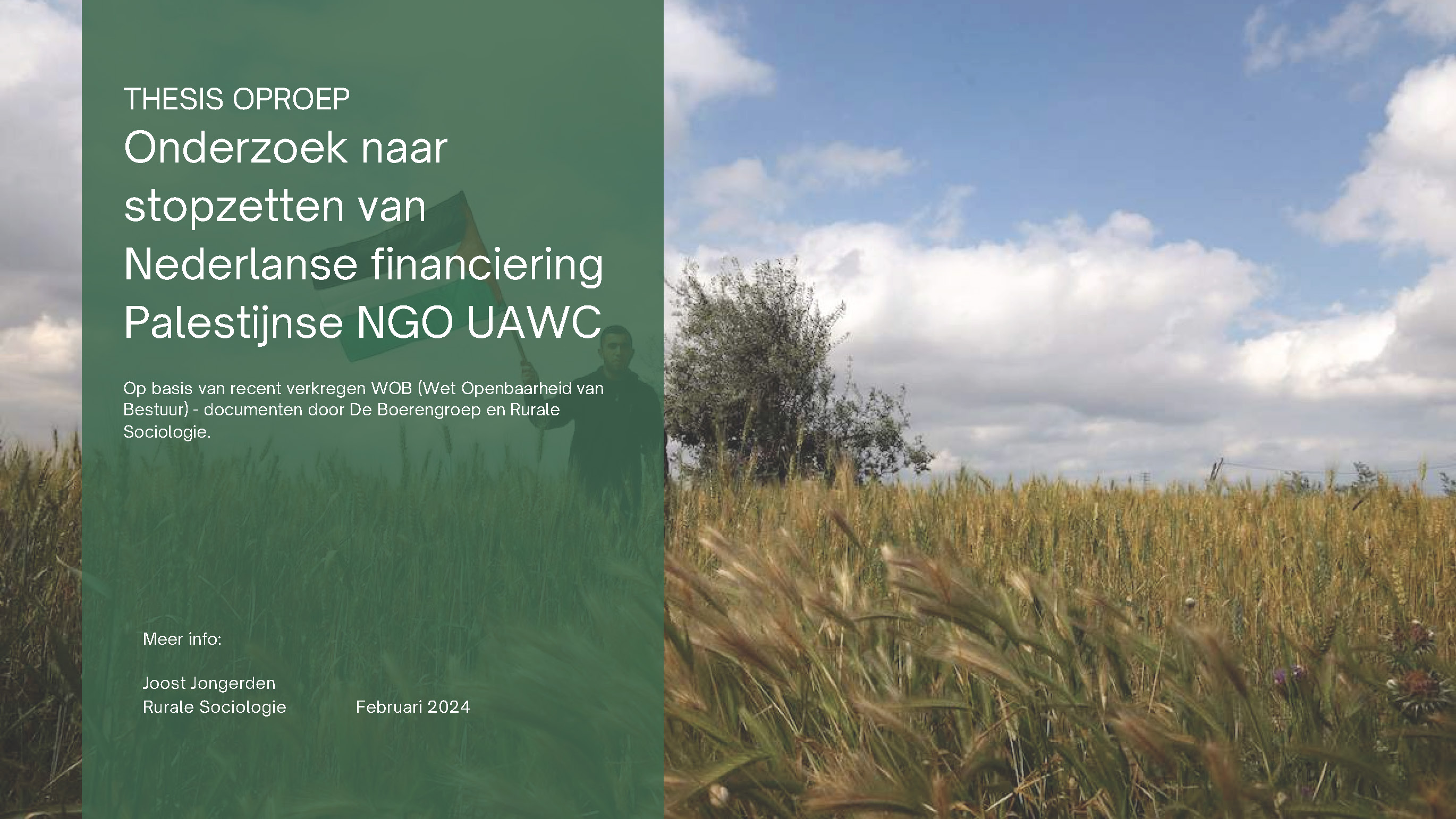
De Boerengroep en Rurale Sociologie hebben in mei 2022 met een beroep op de Wet openbaarheid van bestuur (WOB/WOO) verzocht om informatie met betrekking tot het besluit van Nederland om de financiering aan de Union of Agricultural Workers Committee (UAWC) stop te zetten. In januari 2024 is de gevraagde informatie toegestuurd, bestaande uit meer dan 600 documenten, variërend van (korte) e-mails tot notities. De WOB/WO-documenten bieden inzicht in hoe de Nederlandse overheid tot het besluit is gekomen om de financiering aan UAWC stop te zetten, en meer in het algemeen:
- De politieke context waarin een dergelijke beslissing is genomen;
- De criteria die het hanteert, en;
- De afwegingen die de overheid daarbij maakt.
Voor een kwalitatieve analyse van de documenten en het doen van vervolginterviews wordt gezocht naar een masterstudent. Deze masterstudent dient te beschikken over Nederlandse taalvaardigheid en bij voorkeur bekend te zijn met kwalitatieve onderzoeksmethoden. Het onderzoek is interessant voor die studenten die geïnteresseerd zijn in onder meer i) het politieke krachtenveld waarin overheidsbeleid en besluitvorming tot stand komen, ii) veiligheidsvraagstukken in relatie tot medefinanciering en iii) de politiek van hulp in de context van langdurig conflict. Gezien de omvang van het materiaal, is er ruimte om een eigen invulling te geven aan het onderzoek.
Voor meer informatie: Joost Jongerden (RSO) en Gemma van der Haar (SDC)
Wageningen and the Nitrogen Crisis
Join us in a collective reflection on the role of Wageningen University and Research in the formation and solution of the current nitrogen crisis, and the larger agricultural crisis in general. Jan Douwe van der Ploeg (emeritus professor agricultural sociology) shares his vision on the past, and present of the nitrogen crisis. He is accompanied by Esther Turnhout (chair of Science, Technology & Society aan de University of Twente) and Henk Oostindie (researcher at Rural Sociology of Wageningen University), who will enrich his story. With questions and discussion with the audience, we will reflect on the situation and think of lessions and steps for the future.
24 January 2024, 19:00-21:00
Venue: Wageningen Campus, Impulse, Speakers Corner (Building115)

Rebel governance without territorial control: The experiences of the PKK in 1970s Turkey
In this article published in Geoforum Francis O’Connor and Joost Jongerden discuss the politics of citizenship in Turkey – and how voices that represent “otherness” – Kurds, peasants, women – are supressed.
Insurgent movements rely on popular support using varying strategies to build supportive constituencies, including forms of rebel governance. The rebel governance literature explicitly limits its scope to insurgent cases with territorial control, excluding all groups that did not obtain territorial control, areas of weaker insurgent presence and early phases of mobilisation. This article focuses on Kurdistan Workers Party’s (PKK) use of rebel governance (1977–1980) through municipal politics prior to the launch of its insurgency. The article makes two important contributions: firstly, it demonstrates the need to broaden the scope of the rebel governance literature to include phases where insurgent movements do not control territory. Secondly, it critiques the linearity of retrospective readings of insurgent trajectories that downplay the role of interactions and contingency in early mobilizational phases. It is based on original data including primary source documents and qualitative interviews with people involved in the PKK’s municipal politics between 1977 and 1980 in Batman and Hilvan, towns marked by conflicts among (agricultural) workers, villagers, and landlords.
Read more: https://www.sciencedirect.com/science/article/pii/S0016718523002300
Welcome to the rural sociology blog
Welcome to the blog of the Rural Sociology Group at Wageningen University. Here, we share insights about people, projects, and publications within our group. Our focus lies in the exploration of food provisioning dynamics, agrarian transformations, as well as rural and regional development from a comparative perspective.
 Rural Sociology Wageningen University