Navigating Precarity:  (Un)documented immigrants in Spain’s agri-food industry

In the master thesis “Navigating Precarity:  (Un)documented immigrants in Spain’s agri-food industry” Merissa Gavin discusses the strategies employed by immigrants in navigating precarity from the perspective of the immigrants themselves and new forms of being political are being created. The main question that guided her research was: “How do undocumented immigrant workers in Spain’s agri-food industry engage in claim-making and claim-living to navigate precarity?”
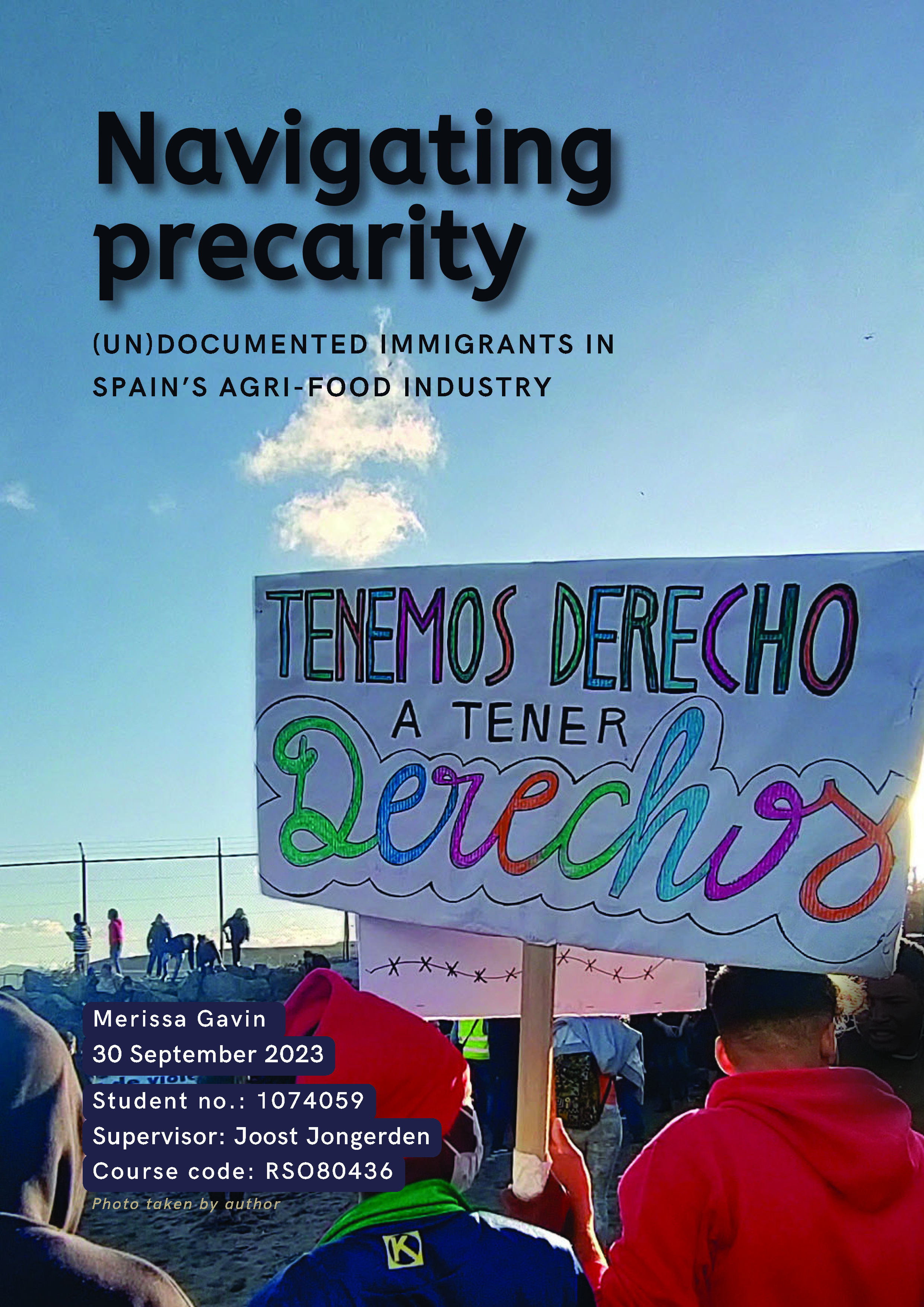
Over the last two decades, immigrant workers have become a structural element of Spain’s agri-food industry. Arriving to Spain undocumented, immigrant workers have few options other than the exploitative working conditions of the agricultural sector. The present research centres on the precarity of these workers, highlighting the multitude of ways they navigate vulnerability and uncertainty. This research is important, firstly, to raise the voice of undocumented immigrant workers and demonstrate how they exercise agency in everyday activities. Secondly, to investigate the socio-spatial conditions that facilitate, or obstruct, the emergence of a collective political being.

Continue reading

The Netherlands and the prosecution and trial of Islamic State suspects in Rojava

After the liberation of Kobani from the Islamic State (IS) in January 2015, the Dutch government repeatedly informed Parliament about assistance to the Northern Syria region, which is also known as Rojava, subsequently renamed as the Democratic Federation of Northern Syria and the Autonomous Administration of North and East Syria (AANES). This agricultural region is Syria’s breadbasket, but it endured significant suffering and destruction during the war with IS.

After the defeat of IS, a democratic and decentralized governance system was developed, and agriculture diversified, in which the Kurdish movement played a prominent role. Ministers Ploumen (2016), Koenders (2016), and Blok (2019) made commitments to provide support to the region.  However, given Turkey’s hostility, delivering aid has been a matter of political sensitivity

The government of the Netherlands made references to various forms of aid – emergency aid, humanitarian aid, reconstruction aid, assistance in political processes –  yet what support has been given to whom remains unclear. In pursuit of this information, a Freedom of Information Act (WOB-WOO) request about this aid was submitted in January 2022. Recognizing that prosecution and justice were pivotal areas of focus during this period, a question regarding these matters was incorporated in this request.

In April 2022, documents were released, but disappointingly, they contained minimal information about assistance to the region. The documents primarily revolved around endeavors to prosecute and try IS suspects. Based on the data received, this  article  delves  into  the Netherlands’  efforts   to   explore   potential collaborations with the Autonomous Administration in North and East Syria for prosecuting  and  trying IS suspects.

Read more here: https://journals.tplondon.com/com/article/view/3130

Oil, Resource Frontiers, and Unruly Spaces in Northern Kurdistan

Zeynep Oguz*

Turkish and Kurdish studies have been moving in important directions in the past decade. Studies of the importance of space and placemaking in Kurdish issue (Gambetti and Jongerden 2015) have been complemented by sustained engagements with material culture, nature, and environments in Kurdistan, as well as how they are central to colonial practices, state violence, and resistance. Today, from the study of ruins and ruination in burial sites and ghosts and, therefore, the interaction between the material and the symbolic, one can learn from anthropological and historical studies of how forests and forest fires, water and rivers, mountains, and animals have been entangled with power and resistance in Kurdistan (See Adalet 2022, Bozcali 2020, Biner 2019, Çaylı 2021, Oguz 2021, Suni 2023).

Continue reading

Politics of Difference and Land the late Ottoman Empire and French-Syria (1860-1925)

Seda Altuğ*

The scholarly debates in Ottoman /Kurdish studies regarding the Armenian and Kurdish issues from late 19th century onwards, reveals that the national question is usually viewed as a product of competing nationalisms— that is, political ideologies built around conceptions of communal belonging and statehood. The scholarship on sectarianism in the Arab Middle East, too, despite critical work in the last decade, has been dominated by rather ahistorical and primordial assumptions concerning the relationship between religion, modernity and politics in the Ottoman imperial and (post-Ottoman) colonial contexts.

Continue reading

Intersectionality and prefigurative politics in ecological & urban struggles in Northern Kurdistan

Marcin Skupiński* & Dobrosława Wiktor-Mach**

The conflicts over the land and the environment spark all across Turkey as many local communities oppose large scale development projects, often supported by the state. Yet in the Kurdish inhabited areas of Turkey, the end of the Turkish-Kurdish peace process heavily limited possibilities of action for activists  seeking to implement their ideas of ecology and autonomy. However, even in such a hostile environment many of our interlocutors adhere to the strategy of “building a new world in the shell of the old” and are seeking to build up more sustainable structures.

Continue reading