Transition towns start with food

A few weeks ago I watched the film A Farm for the Future where Rebecca Hosking investigates how to transform her family’s farm in Devon into a low energy farm for the future. One of the answers she finds is based on permaculture, a permanent and high-yielding agricultural system that minimises land use which was first developed in Australia in the 1970s. The film has been shown on the BBC and can be viewed through this link.

This was the second film evening to raise awareness about climate change and peak oil organised by the Transition Town Vallei group. Using open space methods, we collected ourselves in small groups afterwards to discuss topics of interest. One such topic was local food, a group which I joined. Not surprisingly perhaps, all nine of us already grow vegetables in allotment gardens. Equally unsurprising for Wageningen was the overrepresentation of ex-(tropical)forestry students and a strong interest in permaculture. It turned out that one of the participants had a longstanding idea to turn a piece of overgrown public green into an edible community forest. A very concrete idea for what may become a first Transition Town project.

Food is a starting point for most Transition Town initiatives it turns out. Food projects of other Transition Towns include fruit and nut tree-planting schemes; garden-share projects; restaurant-led projects to promote sustainable fishery; seed and plant swapping; awareness raising projects through local schools and allotment associations. Again hardly surprising, food appeals “as an exemplar of how basic needs can be liberated from oil dependency” (Bailey, Hopkins & Wilson in Geoforum in press p7)

Planning sustainable food systems

Planners are discovering food. Until recently, planners left food to the market. But times are changing and so are attitudes towards planning for food. This was the general notion during the first European Sustainable Food Planning conference, held last friday and saturday in Almere (see blog for program).

There is less timidity to interfere with what until recently was seen as the private sphere of consumer choice. Neoliberalism has lost its credibility and the myth of consumer choice is weakening. Food becomes part of the urban public agenda again. Jerry Kaufman, professor emeritus in Urban and Regional Planning at University of Wisconsin showed how food slowly gained the interest of the US planning community over the last ten years with many young people interested nowadays.

R0020679

Food is back in the public realm for two reasons. First the recognition that access to healthy food is a citizen right. People with low income eat less well, pay more and have less access to healthy foods. Planners have a task in changing obesogenic environments. We were reminded that the first health policies 150 years ago started with food.

And second, food is related to a large number of domains which all are facing food related problems. Transport congestion through consumer shopping and supply delivery; health and well being of a rapidly increasing obesogenic population; environmental problems related to food miles, food scares and pollution of industrial agriculture and so on.

The sustainability agenda which is now penetrating to all sectors of the economy demands a holistic view. We saw examples of how city departments can not work in isolation to this problem in a meaningful way. We need cross-department and cross-disciplinary working to bring planning, health, transport, supply, production and consumption knowledge together. “We spent 20 years defining sustainability, we now can design it”.


Pumpkin harvest and local food

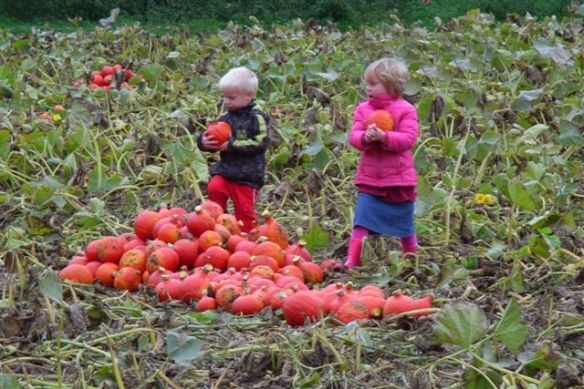
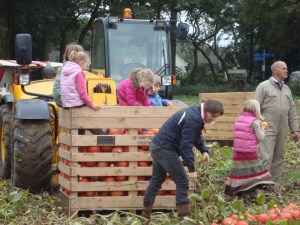
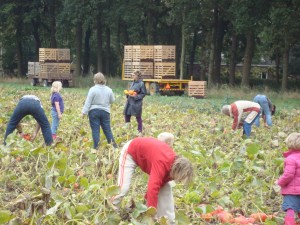
Last Saturday 30 adults and children came to help with the harvest of pumpkins of farmer André in the village of Hemmen, just four kilometers from Wageningen. We harvested around 9 thousand kilo of the approximately 15 thousand kilo on the one hectare field. The invitation to help was the first event organized by a new NGO called “Stichting Hemmens Land” of which I am a board member. This NGO aims to facilitate the cooperation between the organic farmers and organic shop in Hemmen, to engage citizens with local food and farming and to organize educative activities on and around the farms.

pompoen oogstMainly families from nearby towns and villages in the Betuwe came to help with the harvest and for the children it was great fun to stand in and fill the box in front of the tractor. The people who came were happy with the possibility to engage actively with local food and the work of the organic farmers. Some were customers of the organic box scheme, others read the announcement in the newspaper and were just drawn by the activity itself. Citizen engagement with local food is a topic of increased interest in the academic literature. Engagement with local food can strengthen regional food systems and local community and can contribute to human and environmental health. However, as has been noted, in our consumption oriented economy, ‘local’ easily becomes a new ‘brand’, a way to distinguish and create space; market space. Or ‘local’ becomes an experience, part of the cultural economy in which “harvest festivals provide an enactment of leisure activities and the urban lifestyle” (Tellstrom et al 2005: 354).

None of the Hemmen villagers came to help with the harvest or came even to look what was going on. The organic farmers and shopkeepers are newcomers, all of whom established over the last six years. Part of the reason for setting up the NGO and a real challenge is also to try to connect and integrate into the village. Local is important as a non-monetary value and at the same time it is an economic factor for entrepreneurs who are seeking multiple ways to make a sustainable living. But as Laura B. DeLind rightly argues “without an emotional, a spiritual and a physical glue to create loyalty, not to a product, but to layered sets of embodied relationships, local will have no holding power.” (2006: 126)

pompoenoogst 2

Local resilience to peak oil and climate change

Last night I went to the film. The film night and the discussion afterwards was organised by the Transition Town Vallei, a new ngo which started in June this year. Wageningen and its surrounding villages is not the only place with a Transition Town initiative. They are mushrooming all over the Netherlands at the moment. The movement which is now taking off, started in Totnes, the UK:

“It all starts off when a small collection of motivated individuals within a community come together with a shared concern: how can our community respond to the challenges, and opportunities of Peak Oil and Climate Change?”

The Transition Town website gives a guide for how to set up a Transition Town initiative, how to raise awareness around peak oil and climate change, how to connect with existing community groups, how to work with local government and how to come eventually to a “energy descent action plan” which increases the resilience of local community for times when energy is not such a self evident fact of life.

In Wageningen, we are at the awareness raising stage. We watched the film The Power of Community, How Cuba Survived Peak Oil. I can recommend this film to anyone remotely interested in the energy debate, the way forward with sustainability or more specific, the transition to local and organic food systems. After the initial shock and hunger, the Cubans massively started to farm on every square meter available. Tractors had become obsolete and the generation that still knew how to work with an ox trained a new generation. Without machinery, the conventional scale was untenable, which led to new systems of land distribution and a decentralisation of land ownership. Without chemical help, techniques of soil rehabilitation, worm composting, crop rotation, mixed planting and permaculture were adopted to “work with nature instead of against it”. “We call that ‘lazy agriculture’” somebody in the film explained. That should appeal to us all I would think.

Composting at Red hook farm NY

Composting at Red Hook urban farm NY

Education in Urban Agriculture

Urban agriculture (UA) will never substitute food production from farmland but it can contribute to make more fruits and vegetables available near our growing urban world population. This calls for interdisciplinary research, but above all for interdisciplinary education. The next generation of urban farmers and developers is currently applying to our universities. Now the potential of UA is beginning to be realized, these young people will need practical hands-on skills and interdisciplinary knowledge to design new food system solutions. How to use limited space in an intense way, using the newest technology in an ecologically sound way calls for a large number of skills (see growing power). A growing number of universities develops courses and programs on UA (Redwood in Agriculture in urban planning 2009: 236).

A good example of a course which integrates how to learn to grow food and slaughter small poultry livestock with the theoretical knowledge from various disciplines such as soil science, horticulture, (insect) ecology, sociology and biology is the Urban Agriculture course at University of California, Berkeley. According to the course description the interdisciplinarity will

“allow us to better understand the biophysical and socioeconomic opportunities for and obstacles limiting urban and peri-urban agriculture”.

With the next round of education reform towards a semester model coming up, there should be space for a course on Urban Agriculture at Wageningen University.