Urban Agriculture / Stadslandbouw

Growing food in urban gardens and allotments has a long history. In the Netherlands, allotment gardens are a marginal but natural part of the city’s infrastructure. Other European countries have their own history in urban gardening too, such as many Eastern European countries. Also in the US, urban gardening is a long standing practice.

However, in the Netherlands as well as in the US, urban gardening is moving from the fringe into the heart of a debate about health and sustainability. The manifestations look similar. For example, the Alemany Farm in San Francisco which started on a vacant lot (see story) or the Red Hook urban farm (see earlier blog). Also in Rotterdam, Proefpark de Punt started on a vacant lot and also this initiative met skeptics of urban planners and city leaders until it had proven itself.

Reading the articles and websites of initiatives related to Urban Agriculture in the US and its counterpart ‘Stadslandbouw’ in the Netherlands, there seems a striking difference too. In the US, the food production aspect of the gardening is taken far more serious as an option for providing people a significant portion of their daily food. Growing food in urban gardens is about access to fresh food. Not in the last place for those who do not have easy and affordable access.

In the Netherlands, this notion is not absent of course. But the language around the initiatives starts from a broader notion of the need for ‘green space’ for the health of the urban citizen. A green environment, education about nature and food, recreation possibilities in accessible green spaces, the improvement of mental health and social cohesion by means of gardening. These notions can also be found in the initial objective for setting up Proefpark de Punt:

‘Landleven in de Stad’, een natuurlijke speel- en recreatiemogelijkheid voor de buurt te creëren.

A trend watcher on the website of Proefpark de Punt talked about ‘squatting green space’ which is what many initiatives in the US and the Netherlands essentially do. However, the local context differs considerably which means that the connections to health and sustainability are interpreted quite differently. A call for comparative studies I guess.

Proefpark de Punt
Proefpark de Punt

A local food movement in central Finland?

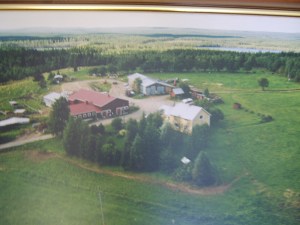
After the ESRS conference in Vaasa, I joined my friend Ella to her place in Sotkamo in the north east of Finland. In Finland Sotkamo is better know as Vuokatti, the ski and outdoor holiday area within the municipality. It makes the center of Sotkamo a rather lively exception in a region suffering from de-population and ageing rural communities. Why would a young generation of farmers take over? A real challenge for Ella’s boyfriend, a dairy farmer in the region Kainuu. Milking 16 cows on 45 hectares party under conservation agreement, he is the only dairy farmer left in his village, delivering his milk to the cooperative a hundred kilometres further. With the decreasing milk price, these are hard times to make a living from this farm.

overview of the farm

overview of the farm

Alternatives are needed, but somehow, the development of alternative food systems seems to take off very slowly in Finland. Jokinen and colleagues (Maaseudun uusi aika 2/2009) give three reasons; 1) the long distances in the sparsely populated areas; 2) the strongly consolidated food supply chain (the three largest retain chains control almost all grocery sales in the Nordic countries) and 3) the declining co-operative culture in abated rural communities. I was struck by the similarity in reasons/conditions to the American Midwest, where, especially in Iowa alternative food systems do take off – against the odds.

Farmer cooperation, consumer awareness and civic action and organisation are among the most needed ingredients for building local food systems and sustainable livelihoods in Finland. Currently, this intermediary level of organisation is lacking in many places. How to start a positive cycle of development depends on many interrelating and partly unpredictable factors. Good examples – from within Finland or from oversees – might inspire people to invest in their communities and in local food.


De-commodification for the sake of soul

New York Times columnist Nicholas D. Kristof figured out the central problem with modern industrial agriculture (global edition 24-9-09).

“It’s not just that it produces unhealthy food, mishandles waste and overuses antibiotics in ways that harm us all”, he writes, “more fundamentally, it has no soul.”

Where the rural is nothing more than an effect of capital the soul that connects people to land and nature disappears.

The soul returns in those practices which are not aimed at abstract quantities but at particular qualities. Following Robert Pirsig, quality, or soul, cannot be defined but can be mutually experienced, in this case, by both producer and consumer.

This means that we have to “de-commodify” as an invited farm couple of Country Natural Beef explained a the Iowa Regional Food Systems Working Group meeting (see earlier blog).

“We were tired of being price takers” they said. “We have learned to seek buyers and work price and quality with them. It is based on transparent costing and a reasonable return. It just is all about relationships.”

The obvious critique is that we cannot feed the world with piecemeal examples of re-connection. But our current global industrial Ag model might just stifle our imagination of what is thinkable as an alternative Larry Busch remarked in his presentation at the ESRS meeting.

What if we left conveyor-belt-linear-thinking behind and instead adopted principles of feed-back or metabolic cycles in our designs, policies and innovations and infrastructure? Rightly so, Thomas L. Friedmann argued in the same edition of New York Times that our solutions to climate change, poverty, food security and biodiversity loss need to be as integrated as nature itself.

The comeback of Action Research?

This year’s European Rural Sociology meeting in Vaasa, Finland  aired a remarkable optimism. With the crisis in the real world, the identity crisis of rural sociologists seems over. In times of crisis, there  seems more space for social change.

One of the conference themes was “the rural bites back”.  Well, “the rural never went away” Michael Bell said, “we only need to consider the political conditions of our work”. Time for the activist/scientist to stand up. This resonates very well with how I experienced the spirit of the local and sustainable food community in the US. No wonder, Michael Bell is based in Madison, Wisconsin.

In his opening keynote speech, Philip Lowe, from Newcastle University, UK, explained the history and differences between the American and European rural sociology societies. Despite the historically more distant and observant EU tradition, he too urged for us to engage and deal with the “mess” of reality. And in yet another plenary session, the comeback of action research was observed.

Although some of us never did anything different, there was a general vibe of action readiness for social change in the conference. Have the years of ‘Critique’ only passed? Certainly, new engagement and involvement urge us to take position and to be the “political scientists of the rural” as Michael Bell put it.

Home

I came home to the Netherlands last week. That is, physically, I feel in between places mentally, somewhere in the ocean of experiences. My time in the US has been an intense experience.

Confucius said: tell me and I forget, show me and I remember, involve me and I understand. Thanks to the great hospitality of Cornelia and Jan Flora and to their ability to include I was involved in so many activities and meetings. And it was great fun to try to understand.

I came to appreciate the friendliness of the Midwest, the many spontaneous conversations in shops or on the street. And the many little things which caught my surprise. The use of ice cubes, the four way stop, the vegetable kale, the garage sale, the barbeque restaurant, shotguns, raccoons or badgers, bike paths ending in corn fields. To list just a few things.

Did I see mainstream US life? Probably not. Friends that I made usually turned out to be bikers, non-tv owners and local fresh vegetable eaters…Thanks my friends for crossing my path.

I terms of agriculture, it will be nice to contrast and compare that what I saw with what´s going on in Europe. I am sure there will be a lot of inspiration at the European rural sociology meeting in Vaasa, Finland, which is about to start.