Announcing for Fall 2021: The ConvivAG LAB

Research Opportunities for PhD and Masters Students!

ConvivAG LAB is a collaborative research “lab” for scholars and students undertaking critical studies at the intersections of Convivial Conservation and Regenerative Agriculture. Together we will explore roles on ongoing projects and support for independent and thesis projects; we will meet regularly to discuss works in progress; and we will co-build bibliographies and participate in field trips to relevant agroecological projects.

Meetings will take place once or twice per month.

INTRODUCTORY MEETING: Wednesday September 29, 09.30 AM.

FIRST WORKS-IN-PROGRESS : Wednesday, October 12, 2 PM.

FEATURED PROJECTS:

  • Regenerative Agriculture: Practices, Tradeoffs, Origins, Erasures

This project is amassing an archive of cultivation practices considered to be “Regenerative” by various groups and in different places, toward a) assessing the growing diversity of practices, b) highlighting ecological and social tradeoffs among them, and c) tracing practices to indigenous and traditional origins.

  • Genealogies of Sustainability

This project is mapping the terminology of Regenerative Agriculture in conversation with discourses of sustainability in various regions over the past century, toward better understanding social, political, economic ramifications of sharing and discarding language of advocacy. Data collection includes literature review; interviews with farmers, soil scientists, indigenous community leaders, and policymakers; as well as a virtual questionnaire. We are also collecting data from social media, documentary film, podcasts, and interviews, asking how is multispecies conviviality and the act of cultivating greater biodiversity in agriculture depicted in media, by whom, and to what end, with particular attention on the movement of symbols and tropes across advocacy and corporate advertising spheres.

  • Soil Carbon Banking: Markets, Technologies, and Conviviality in Agriculture

Postdoctoral researcher Serena Stein’s focus project, this project accompanies “new/old” possibilities for soil carbon sequestration or “soil carbon banking,” across southern Africa, the United States, and The Netherlands, as they both repeat and diverge from past experiments in carbon trade, commodifying nature, and foreign aid interventions in agrarian landscapes. It involves investigations into changing soil relations; land use and access in racialized settler colonial landscapes; emerging blockchain technology for auditing soil carbon and opportunistic industries; as well as development politics of conservation.

Contact Serena Stein: serena.stein@wur.nl for a link to the first meeting to see about possibilities, ask questions, and find out upcoming meetings.

Our Education Coordinators can also provide information on thesis and internships, thesis rings, and much more: thesis.sdc@wur.nlthesis.rso@wur.nl

Thesis / stage vacature: Regionale initiatieven voor de transitie naar een duurzaam voedselsysteem

Achtergrond

Ons voedselsysteem is verre van duurzaam. De huidige voedselconsumptie en -productiepatronen dragen sterk bij aan een aantal urgente duurzaamheidsopgaven op het gebied van de gezondheid en welzijn van mens, dier en planeet. Deze duurzaamheidsopgaven zijn geen losstaande problemen; het zijn gerelateerde symptomen van een niet-duurzaam voedselsysteem. In de Nederlandse agrofood sector en daarbuiten zijn vele innovatieve ondernemers, burgers, coalities en andere partijen al actief bezig met de verduurzaming van het voedselsysteem, bijvoorbeeld in het realiseren van korte ketens, het verbinden van stad en platteland, de eiwittransitie, regeneratieve, natuur-inclusieve landbouw en true cost accounting. Daarin is er een groeiende beweging naar gebiedsgericht werken met regionaal georganiseerde netwerken die aansluiten op landschappelijke kenmerken, biodiversiteit, de culturele eigenheid en sociale verbanden van een regio. In een landelijk project gefinancierd door de NWO gaan we in kaart brengen wat voor soort initiatieven in verschillende regio’s zijn ontwikkeld die kunnen bijdragen aan de gewenste transitie en hoe ze aan hun ambities werken.

De thesis/stage opdracht

Je kunt binnen dit landelijke project bijdragen aan de analyse van de verschillen en overeenkomsten tussen initiatieven in doelen, aanpak, betrokken partners en belemmeringen en kansen. Er is een vragenlijst opgesteld waarmee de kenmerken van een groot aantal regionale initiatieven in kaart worden gebracht. Als vervolgstap kun je regionale initiatieven benaderen en met hen verder in beeld brengen wat  hun doelen en ambities zijn, welke kansen en belemmeringen zij ervaren, wat hun strategie is om bij te dragen aan veranderingen en wat hun impact zij willen bereiken op sociaal, ecologisch en economisch gebied.

Je kunt je ook richten op één of enkele regionale initiatieven en met  hen in een vorm van co-creatie verkennen hoe succesvol hun aanpak is, wat het initiatief tot dusver heeft bereikt op sociaal, ecologisch en economisch gebied,  hoe de impact van het initiatief versterkt kan worden en hoe belemmeringen kunnen worden opgelost.

Periode: voorjaar, zomer of najaar 2021

Meer informatie: Henk Oostindie (RSO): henk.oostindie@wur.nl; Jan Hassink: jan.hassink@wur.nl;

Webinar: Migrant labour in agriculture

In the Webinar 3 of our 75th Anniversary Rural Sociology Series we are pleased to present two presentations addressing the research theme ‘migrant labour in agriculture’.

Deniz Duruiz, Northwestern University:
Kurdishness, Race-Making, and Political Subjectivity on Turkish Farms

Seth Holmes, UC Berkeley:
The Extended Time and Space of Migrant Farmworker Injury: Indigenous Mexican Farmworkers in the USA

Date: Wednesday 19th May 2021 – Time: 15:00-17:00 (CET)

Register online via this link
Or check out the YouTube streaming link

YouTube streaming:

MSc thesis opportunity: A multi-method approach to assess the sustainability of the quinoa value chain in France

Duration: 6 months

Languages: English and French

Credits: 33-36 ECTS (programme dependent)

Start Date: As soon as possible

Quinoa is experiencing a global expansion of cultivation all around the world. France is one the most important producers of quinoa in Europe. Yet the sustainability of French quinoa production systems remains under-researched. This includes familiar debates of organic versus conventional production, as well as the viability of ‘farm to fork’ transportation and distribution systems.

The MSc candidate will assess the sustainability of the quinoa value chain in France. The candidate will conduct interviews with members of the cooperative “Quinoa d’Anjou” assessing the sustainability combining quantitative and qualitative approaches.

Following the current restrictions, the interviews will be conducted online.

Objectives:

  • Combining quantitative and qualitative data to assess the sustainability of quinoa value chain of the cooperative of Anjou in France.
  • Conduct a Life Cycle Assessment testing the MEANS program. Training will be provided.

Supervision team:

  • Mark Vicol, Assistant Professor in RSO
  • Federico Andreotti, PhD Candidate in GRS

Advisors:

  • Didier Bazile, researcher at CIRAD, France
  • Cécile Bessou, researcher at CIRAD, France

Relevant literature:

  • Alandia, G., Rodriguez, J. P., Jacobsen, S. E., Bazile, D., & Condori, B. (2020). Global expansion of quinoa and challenges for the Andean region. Global Food Security, 26, 100429.
  • Bazile, D., Jacobsen, S. E., & Verniau, A. (2016). The global expansion of quinoa: trends and limits. Frontiers in Plant Science, 7, 622.
  • Jouini, M., Burte, J., Biard, Y., Benaissa, N., Amara, H., & Sinfort, C. (2019). A framework for coupling a participatory approach and life cycle assessment for public decision-making in rural territory management. Science of the Total Environment, 655, 1017-1027.

Requirements:

  • Interest in Agroecology studies, value chain studies and/or sustainable development
  • Interests and/or knowledge of food value chains: production, processing, distribution
  • Skills for conducting interviews remotely and data analysis
  • French language fluency is required.

If interested please contact federico.andreotti@wur.nl

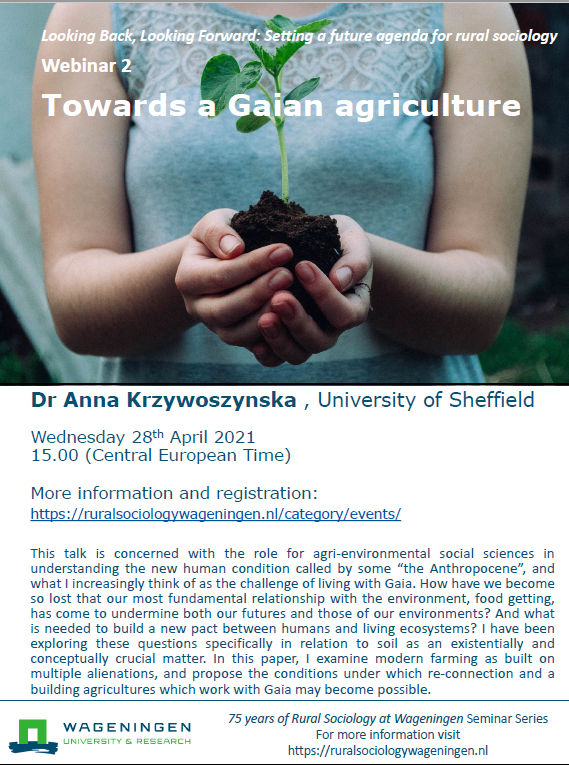
Webinar: Towards a Gaian agriculture

‘Towards a Gaian agriculture’ – Dr Anna Krzywoszynska.

Date: 28th April 2021Time: 15.00 CET

This talk is concerned with the role for agri-environmental social sciences in understanding the new human condition called by some “the Anthropocene”, and what I increasingly think of as the challenge of living with Gaia. How have we become so lost that our most fundamental relationship with the environment, food getting, has come to undermine both our futures and those of our environments? And what is needed to build a new pact between humans and living ecosystems? I have been exploring these questions specifically in relation to soil as an existentially and conceptually crucial matter. In this paper, I examine modern farming as built on multiple alienations, and propose the conditions under which re-connection and a building agricultures which work with Gaia may become possible.

Register online via this link
Or check out the YouTube streaming link

This talk is the second in Wageningen University Rural Sociology Group’s 75 years anniversary seminar series “Looking back, Looking Forward: Setting a future agenda for rural sociology”. For more information see our full agenda here.


YouTube streaming link: