Re-making of place in Maramures, Romania – MSc-thesis reserach

By Anthonet Baijense, MSc-student International Development Studies (Research Master Variant).

Currently, I stay in Romania were I will spend my summer to learn the language, visit friends, do some traveling and last, but most importantly: to gather data for my master thesis. I am pleased to write once and a while about my experiences and research here and I hope you enjoy to read it!

Some students visited Romania last February as part of the Intensive Programme, and wrote some blogs with their reflections: e.g. on Traditional food. It was very nice to read about your experiences! Indeed, the Romanian saying goes that ‘my favorite vegetable is meat’ and for a vegetable freak as me, it was a change of diet! Amazing what people here eat for breakfast! It took me some time to get adapted! I stay in the North of Romania, in the district called the Maramureş, which is on the border with Ukraine. Because traveling around here is –let’s just say- complicated, my research focuses mainly on one village: Poienile Izei (see photo’s).

Let me now introduce you to my research as well. If you go on Google to find some pictures of the area where I stay, you will gain the impression that the Maramureş is indeed –as often described- a rural area overflowing of traditions and with a traditional style of life and architecture.

Continue reading

Learning about the role of agriculture and natural resources in sustainable rural development – student’s reflection (3)

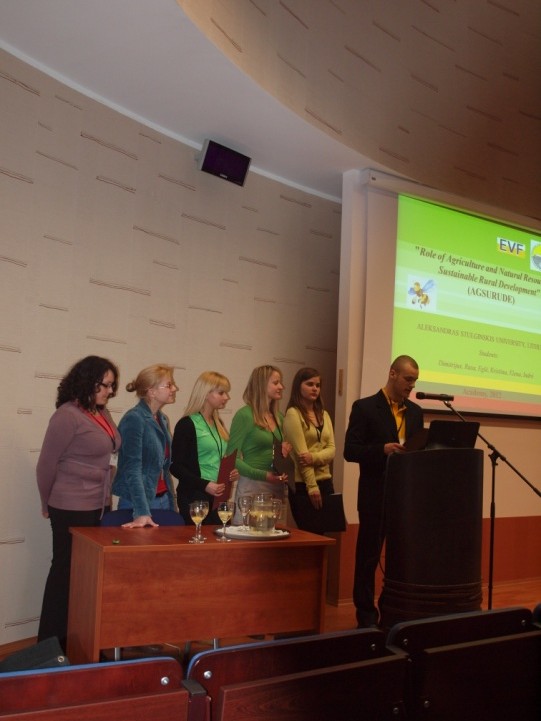
Together with four students of Wageningen University, I spend two weeks in Kaunas, Lithuania to represent Wageningen University, and the Rural Sociology Group, at this years’ ‘Intensive Programme’ on rural development. In a series of posts, the participating students reflect on the programme and share their experiences.

By Tikva Kooima (student Regional Development and Innovation at Van Hall Larenstein University of Applied Sciences (part of Wageningen UR):

In April, we went with a group of five people of Wageningen University to Lithuania to participate in an intensive international conference about rural development, hosted by the Aleksandro Stulginskio University of Kaunas. Without knowing the details, I went quite open-minded to this conference, and filled with lots of ideas, experiences and impressions, I went home.

The first days

The first two days  were filled with lectures which were more or less associated with rural development in Lithuania. It was exciting to follow classes with about 50 international students from all over Europe with totally different backgrounds. In the evening we were introduced to the countries. The different countries presented themselves with a presentation followed by delicious national food specialties.

The trip

Continue reading

Learning about the role of agriculture and natural resources in sustainable rural development – student’s reflection (2)

Together with four students of Wageningen University, I spend two weeks in Kaunas, Lithuania to represent Wageningen University, and the Rural Sociology Group, at this years’ ‘Intensive Programme’ on rural development. In a series of posts, the participating students reflect on the programme and share their experiences.

By Woutine Pauw (student Master Agricultural & Bioresource Engineering):

On forehand, I did not have the objectives of the Intensive Programme (IP) clear in mind. What would be the program, the methods and the results? What people and cultures will we meet and work together with? What are we going to learn about rural development? I did not know what to expect, but I did know: whatever I would expect was not going to happen – and the other way around. I decided to pretend my brains to be a sponge and let them soak everything I saw around me. So here it is:

Continue reading

Learning about the role of agriculture and natural resources in sustainable rural development – student’s reflection (1)

Together with four students of Wageningen University, I recently spend two weeks in Kaunas, Lithuania to represent Wageningen University, and the Rural Sociology Group, at this years’ ‘Intensive Programme’ on rural development. In the following series of posts, the participating students reflect on the programme and share their experiences.

By Malou Heidekamp (student Master International Development Studies):

The last two weeks of April I got the opportunity to participate in an Intensive Program (IP) in Lithuania. It is a yearly study program of two weeks to bring students from over whole Europe together to discuss a topic. This year theme was: “Role of Agriculture and Natural Resources in Sustainable Development”. The program consisted of presentations, field excursions in smaller and larger groups, social evenings, group work in international setting and country presentations. In total there were about 40 participants and 20 tutors, a mixed group from different universities, countries and cultures.

Continue reading

A day in researching sense of place in the National Park “Galicica” in Macedonia

By Bojan Rantasa, MSc-student International Master of Rural Devleopment (IMRD)

Earlier I introduced my thesis research regarding the ‘Sense of place in Galicica national park‘. My research is coming to an end, but I am still cautious to speak of results prematurely. So I will share how my research days look like. Embarked on the mission to do a field research in the National Park “Galicica” in Macedonia, I begun packing my backpack: 

  • Field audio recorder. I will do open interviews with people, and writing notes whilst doing interviews is out of the question. First, if I write, I will have to pause the conversation and that will take a lot of time, and the person might forget what he or she was talking about, but most important, I am too lazy to write.
  • Photo camera. I am researching sense of place, and having visual records of the places is a must. At least this is how I see it.
  • Video camera. Photography is beautiful and my favourite art, but sometimes it does not say enough. Image and sound is compelling to more senses than just image.
  • Handheld GPS. I should not get lost, but it will also come handy in marking those places that people see important, and making a map of what I’ve researched, as places reside in locations.
  • Replacement batteries. I do not think that I will bump into a MediaMarkt shop behind that mountain peak.
  • Walking stick. It is a mountain, dogs wondering around, thorny bushes, and my left knee is not really in a good shape. Besides, this one has a ¼” screw on the top, so I can use it as a monopod for the camera.
  • Some snacks. I will spend a full day out.
  • Sun tan cream. I hope that there will be some sun today.
  • Toilet paper. No need to stress this importance.

Well, if people are not scared from my looks, I figure that means that they are open for a conversation on their sense of place. So I’m off on the first bus to the next village on my list. I arrive there around mid day. At this time only retired people are in the village. I walk around and I meet an old granny. But she refuses to speak with the recorder on. She says that afterwards someone might come to look for her. I, on the other hand, refuse to talk to her without the recorder. It is not only the issue of not noting all the detail of the conversation, but it is the issue that at a later stage of my research I will see some interesting correlation, something I might use to build a theory on. Now if I have only my written notes, I will not have this new thing noted. But if I have an audio recording of the conversation, I can check if there is really a pattern or something to relate to my new discovery in the interviews I’ve did in the past. Additionally, people that refuse to talk with the recorder on are people that have something to hide. So those people will tell me less or even lies, thus I can consider them as a misleading factor, or simply a waste of time. So I go my way. The granny did give me a boiled egg, as it was Eastern just yesterday, it will come in handy for my lunch later.

Continue reading