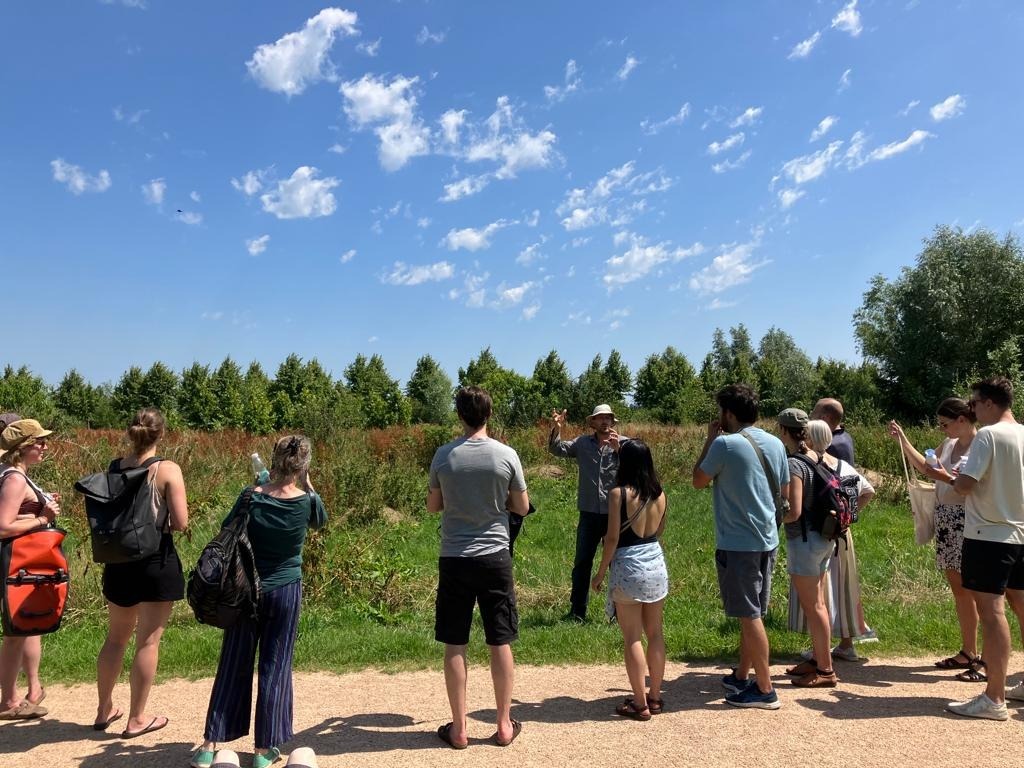
Food Commons – Summer School 2025

This June, the Rural Sociology Group (RSO) hosted its first ever Food Commons Summer School. In a new blog, Rohit Dash shares his experiences and insights from the event.

What if food could be shared like stories. What if, we could build the truly proverbial village in our communities to raise a farm of delicious, cared for and nutritious food. Imagine a world, where food systems were entirely “Commoned” stripped from the materialist notions of private ownership, instead nurtured by care and collective stewardship. How do we get to this utopia? Was there ever a precedent to such an utopia? or are there examples of islands of utopia that remain hidden in plain sight?

Continue reading

The harm supply chain: food, agriculture and colonialism in Kurdistan[1]

Joost Jongerden

Introduction
Food is not the first thing that comes to mind when thinking about politics. Yet the political does not always present itself explicitly as political (Day 2022). This is certainly the case for food. While food is essential for the reproduction of biological life and an important cultural and economic artefact, various authors have shown it is political too. Single food products, such as sugar (Mintz 1985), palm oil (Csevár and Rugarli 2025) and soy (Hiraga 2025), have been shown to be inseparable from the histories of capitalism and colonialism. Their examples illustrate how food is entangled with broader systems of power, exploitation, and domination. Similarly, in the development of a food supply chain in Kurdistan, we see that food can both foster life and community, and foil it, serving as a vehicle for the deliberate destruction of political and socio-economic existence.        

Continue reading

NRC: Drie zij-instromers begonnen een duurzame boerderij: ‘We willen bijdragen aan de voedselproductie én gemeenschapszin’

De NRC publiceerde op 1 september een achtergrondartikel over de Biesterhof, een boerderij die mede is opgericht door RSO-medewerker Howard Koster, samen met Claudi Rudorf en Eline Wilememaker. Met z’n drieën startten zij een regeneratief landbouwbedrijf dat gezonde voeding wil verbouwen, de bodem wil verbeteren, de biodiversiteit wil bevorderen en een gemeenschap wil opbouwen. “Er zijn momenten dat ik de natuur vervloek.”

Lees het volledige artikel hier: https://www.nrc.nl/nieuws/2025/09/01/drie-zij-instromers-begonnen-een-duurzame-boerderij-we-willen-bijdragen-aan-de-voedselproductie-biodiversiteit-en-gemeenschapszin-a4904642

Publication | With whom do you want to be interdependent in producing food?

JAFSCD article by Margriet Goris (Wageningen University & Research) Daphne Schoop (Wageningen Research), Dirk Roep (Wageningen University) en Jan Hassink (Wageningen Research)

Intentionally shifting interdependencies through territorial food networks

Values-based territorial food networks (VTFNs) hold immense potential for reshaping our food supply, but little is known about how they bring about change. In a new JAFSCD article, “Relational autonomy highlights how interdependencies shift in the transformation of food provisioning,” Goris, Schoop, Roep and Hassink present findings from narrative interviews and observations during fieldwork in three different VFTNs in The Netherlands.

They aimed to understand how shifts in interdependencies in VFTNs come about and what this means for autonomy in food provisioning. The scholars show how mutual autonomy is promoted in relations among farmers, livestock, soil life, plants, citizens by creating opportunities, rights, respect, trust, and capacities amongst others. They state that autonomy is not an individual matter but is created in relationships of interdependency.

This helps us explain how people and nature depend on each other. For example, when we stop using agrochemicals, we depend more on natural processes and other market relations. To make this work, farmers and rural workers need to be able to mimic those natural processes, and to be able to create a fairer food market where everyone shares the risks, acknowledging mutual vulnerabilities and interdependencies.

Visit members VOKO Utrecht to food forest by VOKO Utrecht

Advanced Metropolitan Solutions: Cultivating the Future of Urban Gardening 

What can a city’s gardens tell us about its people?

Our colleague, Antonia Weiss, is shedding light on a novel approach to urban gardening through her research on the Wereldgroentetuinen (World Vegetable Gardens) in Amsterdam’s Nieuw-West neighborhood. This project taps into the gardening expertise and culinary heritage of immigrants, offering an inspiring model for inclusive and sustainable urban food systems.

Here’s what makes it remarkable:
>> 𝗧𝗿𝗮𝗻𝘀𝗳𝗼𝗿𝗺𝗶𝗻𝗴 𝗦𝗽𝗮𝗰𝗲𝘀: A disused commercial greenhouse has become an oasis of diverse crops—sopropo, okra, tajerblad, peppers, melons, and more—thanks to the hands-on knowledge of residents whose food cultures span the globe.
>> 𝗕𝗿𝗶𝗱𝗴𝗶𝗻𝗴 𝗚𝗲𝗻𝗲𝗿𝗮𝘁𝗶𝗼𝗻𝘀: By honoring the agricultural traditions of immigrant communities, the project connects the past and future, highlighting how these skills can redefine urban food landscapes.
>> 𝗕𝘂𝗶𝗹𝗱𝗶𝗻𝗴 𝗖𝗼𝗺𝗺𝘂𝗻𝗶𝘁𝘆: Beyond the harvest, these gardens are places of connection, where residents share stories, tips, and seeds of cultural exchange.

𝗪𝗵𝘆 𝗶𝘁 𝗺𝗮𝘁𝘁𝗲𝗿𝘀: In the global push for sustainable urban food systems, cultural diversity is often overlooked. As Antonia’s work reveals, cities like Amsterdam hold a wealth of food knowledge rooted in migration histories. Recognizing and mobilizing this heritage is essential to building resilient, inclusive, and innovative foodscapes.

𝗔 𝗰𝗮𝗹𝗹 𝘁𝗼 𝗮𝗰𝘁𝗶𝗼𝗻: To policymakers and urban planners—let’s embrace the culinary heritage and creativity of immigrant communities as key drivers of the food transition. Together, we can grow a future where cities thrive on the diversity of their people.

📚 Read more about this groundbreaking research, supported by the AMS Institute, Wageningen University & Research, and Cascoland, and see how it’s cultivating a greener, more inclusive Amsterdam.