Seriously Sustainable Week 2017 is coming up and Wageningen University’s Green Office has organised an entire week, packed with all kinds of activities, from fun to serious, from small to big.
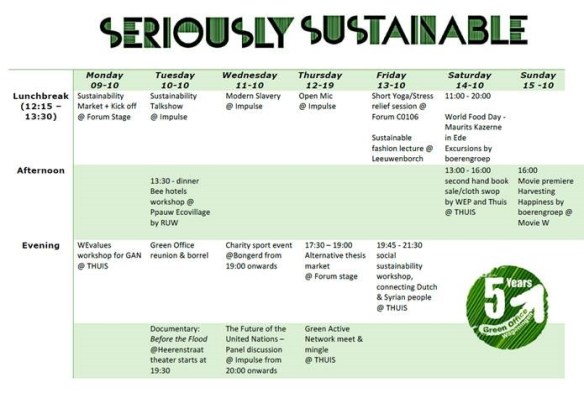

Seriously Sustainable Week 2017 is coming up and Wageningen University’s Green Office has organised an entire week, packed with all kinds of activities, from fun to serious, from small to big.
On June 27th 2017, the Rural Sociology Group (in collaboration with SUSPLACE and in conjuction with the CSPS Conference ‘The Value of Life’) organised a masterclass on Performative Practices for Diverse Economies with prof. Katherine Gibson (Western Sydney University).
The masterclass was well attended, with more than 25 PhDs, researchers and professors joining, from a diversity of geographical and disciplinary backgrounds.
Prof. Gibson opened the meeting with a short presentation of her work on Diverse Economies. Next, we engaged in dynamic ‘fishbowl’ conversations in which 3 participants at a time discussed about a topic or question of joint interest, with prof. Gibson stepping in and helping to advance the thinking.
We thus actively ‘performed thinking’ on diverse economies!
00:19 – 27:06 Family Economies & Gender (with Maria Borras Escayola, Shivani Kaul and Zulfa Utami Adiputri)
27:10 – 42:42 Participation, Activation & Motivation (with Veerle Boekenstijn, Esther Veen and Inez Dekker)
43:00 – 58:28 Food Economies, prosumers and community gardens (with Sungwoong Jung, Lucie Sovova and Alberto Serra)
Thanks to MSc student Veerle Boekestijn, both prof. Gibson’s keynote and all the fishbowl conversation have been captured on video. We are happy to share them here, with all those that weren’t able to attend the masterclass in person.
 In period 2, from October 30 till December 22, we’ll be teaching again RSO-55306 A Global Sense of Place: Place-based approaches to development. Registration for the course is open until October 1, 2017.
A Global Sense of Place is an optional interdisciplinary course on sustainable place-based development for students from various master programmes (e.g. MDR, MES, MID, MLP, MUE, MOA, MFN). The course builds on the BSc course RSO-56806 Sociology and Anthropology of Place-shaping providing an introduction to place-based approaches in development. Knowledge of this introductory course is an advantage, but is not assumed. The course aims to make students acquainted with an interdisciplinary and place-based approach to development.
A relational place-based approach is seen as key to the understanding of interrelated rural and urban transformation processes and ergo sustainable development. In a relational approach places are considered as contingent,but in time and space differentiated outcomes of three interrelated interdependent and unbounded transformative processes: political-economic, ecological and social-cultural. Places are time and space specific constructs, like their boundaries and connections.
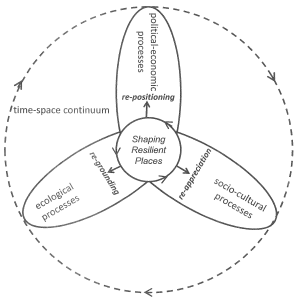
Shaping resilient places. Source: Roep, D., Wellbrock, W, Horlings, I, 2015. Raising Self-Efficacy and Resilience in the Westerkwartier: The Spin-off from Collaborative Leadership, In: J. McDonagh, B. Nienaber, M. Woods (Eds.), Globalization and Europe’s Rural regions. Ashgate, Surrey, pp.41-58
By means of this course students will achieve profound understanding in key-concepts and methods on place-based sustainable development. Work from key thinkers in sustainable place-making will be critically discussed and examined on the basis of various cases. Guest speakers are invited to reflect on place-based approaches to sustainable development and illustrate these through case studies. Ultimately students will acquire a place-based perspective on development.
Language of instruction and examination is English. Classes are taught on Mondays, Tuesdays and Thursdays from 10.30 -12.30.
Key lecturers: Dr. ir. Joost Jongerden (RSO), Dr. Ir. Dirk Roep (RSO) and dr.ir. Martijn Duineveld (GEO).
For more information, please contact Anke de Vrieze, anke.devrieze@wur.nl.
 Voltaire once said that “no problem can withstand the assault of sustained thinking”.
In this book, we put that statement to the test. The problems plaguing food systems are well researched and well known. But how can we support transformation towards sustainable and just food systems?
One thing is clear, the objective of future food systems can no longer be to simply maximise productivity
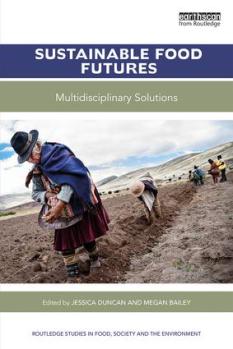
We are very pleased to announce that our new book, Sustainable Food Futures: Multidisciplinary Solutions, has just been published. The book includes proposals for solutions to move us toward more sustainable food futures. The solutions, which are based on concrete cases, are organised around 4 themes:
The solutions proposed in this book can be read as an atlas of possibilities.
There are multiple roads we can, and must, travel to bring us towards our…
View original post 410 more words
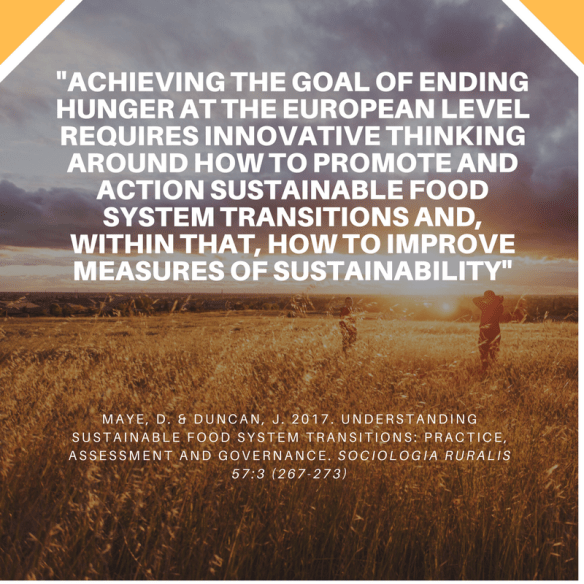
I am very pleased to share that a new special issue of Sociologia Ruralis edited by Damian Maye and me is now online: Understanding Sustainable Food System Transitions: Practice, Assessment and Governance.
The Special Issue provides theoretical insights and advancements into sustainability transitions through empirically grounded and informed investigations of food system practices. The papers confirm, following Hinrichs (2014, p. 143), that ‘numerous opportunities exist to forge more productive links between work on food systems change and the broad and growing sustainability transitions field’.
The Special Issue brings together 8 articles grouped together around two themes:
Taken as a whole, the Special Issue advances discussions and thinking on alternative food practices and sustainability, opening up the debate not only on how to identify and analyse ‘alternative food practices’ in Europe, and beyond…
View original post 209 more words


