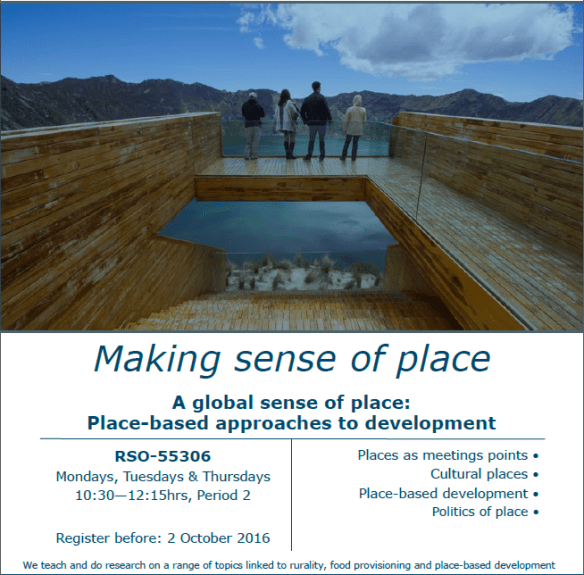
In period 2, from October 31 till December 19, we’ll be teaching again RSO-55306 A Global Sense of Place: Place-based approaches to development. Registration for the course is open until October 2, 2016.
A Global Sense of Place is an optional interdisciplinary course on sustainable place-based development for students from various master programmes (e.g. MDR, MES, MID, MLP, MUE, MOA, MFN). The course builds on the BSc course RSO-56806 Sociology and Anthropology of Place-shaping providing an introduction to place-based approaches in development. Knowledge of this introductory course is an advantage, but is not assumed. The course aims to make students acquainted with an interdisciplinary and place-based approach to development.
A relational place-based approach is seen as key to the understanding of interrelated rural and urban transformation processes and ergo sustainable development. In a relational approach places are considered as contingent,but in time and space differentiated outcomes of three interrelated interdependent and unbounded transformative processes: political-economic, ecological and social-cultural. Places are time and space specific constructs, like their boundaries and connections.
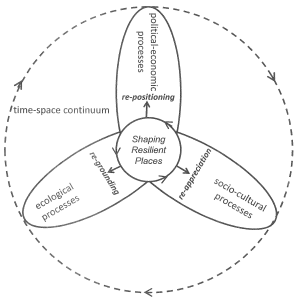
Shaping resilient places. Source: Roep, D., Wellbrock, W, Horlings, I, 2015. Raising Self-Efficacy and Resilience in the Westerkwartier: The Spin-off from Collaborative Leadership, In: J. McDonagh, B. Nienaber, M. Woods (Eds.), Globalization and Europe’s Rural regions. Ashgate, Surrey, pp.41-58
By means of this course students will achieve profound understanding in key-concepts and methods on place-based sustainable development. Work from key thinkers in sustainable place-making will be critically discussed and examined on the basis of various cases. Guest speakers are invited to reflect on place-based approaches to sustainable development and illustrate these through case studies. Ultimately students will acquire a place-based perspective on development.
Language of instruction and examination is English. Classes are taught on Mondays, Tuesdays and Thursdays from 10.30 -12.30.
Key lecturers: Dr. ir. Joost Jongerden (RSO), Dr. Ir. Dirk Roep (RSO) and dr.ir. Martijn Duineveld (GEO)
For more information, please contact Anke de Vrieze, anke.devrieze@wur.nl.


 In our conversations with people over the last few days (well actually, the last 6 years), we have been asked a lot of questions about the UN Committee on World Food Security (CFS), and often, the questions are the same.
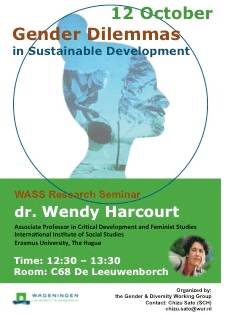 The Wageningen University Gender & Diversity working group presents a lunch-time lecture on Gender Dilemmas in Sustainable Development
