‘Change agents facilitating ecologically intensive production and value chains’

Exciting PhD opportunity with Rural Sociology Group and Knowledge, Technology and Innovation Group.

FoodGovernance's avatarFood Governance

We are looking for two PhD candidates with knowledge and experience working in Chile to contribute to the project ‘Horticultural food systems based on ecologically intensive production and socio-economically sustainable value chains in the transition economies Chile and Uruguay’ (HortEco).  These are  4-year research positions at Wageningen University, with scholarships.

1) PhD position in sociology of innovation and transitions ‘Change agents facilitating ecologically intensive production and value chains’

Transitioning towards ecologically and socio-economically sustainable production and marketing require combined ecological, technological, social and institutional change. Current innovation systems in Latin American countries, including Chile and Uruguay, are oriented towards high external input agriculture, and see innovation as science-driven technological change.

Co-innovation, while successful at a small scale, requires work beyond the farm level. Public and private actors throughout the food system need to fulfil key change agency roles in the transition to ecologically intensive production and value chains providing knowledge and mobilizing…

View original post 183 more words

Differing ideas about healthy diets

In the last period of this academic year I gave the course Eating, Customs and Health, mandatory for first-year students Health and Society. As part of this course students were to execute a small research, in order to practice their interviewing skills. I asked the students to study the importance of a particular part of a diet (such as meat, dessert, or breakfast) for two groups of people (such as students following different study programs, or students with different nationalities) and to study the health effects of that part of the diet in the eyes of the respondents. They were also asked to compare the two groups.

Continue reading →

PhD course: Gender & Diversity in Sustainable Development

An exciting new PhD course, co-taught by two RSO faculty members: Bettina Bock and Jessica Duncan.

FoodGovernance's avatarFood Governance


Come join us in The Netherlands for this exciting course! Space is limited so apply soon! More information: http://www.wageningenur.nl/en/activity/Gender-Diversity-in-Sustainable-Development.htm 

Gender and Diversity Poster

View original post

PhD course Gender & Diversity in Sustainable Development

September 19 – October 14, 2016

 Lecturers:
Chizu Sato (SCH)
Bettina Bock (RSO)
Margreet van der Burg (SSG)
Jessica Duncan (RSO)
Elise van Nederveen Meerkerk (RHI)
Janneke Pieters (DEC)
Elisabet Rasch (SDC)


Inequality lies at the center of current debates about sustainable development, from which a number of policy issues, including Sustainable Development Goals, emanate. Yet, how social (in)equality contributes to creating sustainable development often remains invisible in research. This course enables participants to recognize linkages between gender and diversity and sustainable development in a contemporary globalising world.

The topics covered in this course are:

  • Introduction: key concepts in gender studies
  • Trends form a historical perspective
  • Economics: macro and micro perspectives
  • Work and care
  • Population and migration
  • Food security and governance
  • Environment and natural resource management
  • Global politics

The last topic will be covered in a public lecture by Prof. dr. Melissa Leach (the Director of the International Development Studies at the University of Sussex, UK) who will connect global policy and local practice in support of sustainable development from a gender and diversity perspective.

Topics will be surveyed from perspectives that attend to the intersecting diverse dimensions of inequality, such as gender, race, ethnicity, social class, and nation, to mention just a few. Intersectional perspectives will be put in context in time and place to explain changing constructions, perceptions and interpretations of inequality. This course examines sustainability historically, as well as both in the global South and the global North, illuminating differences across time and geographical locations and their dynamic interactions.

Course outline  Registration


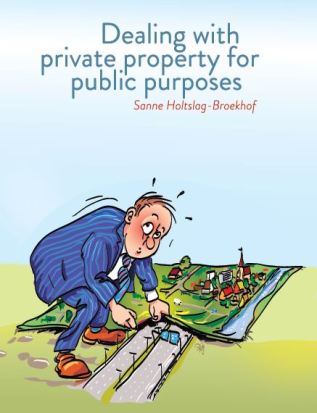
Dealing with private property for public purposes. An interdisciplinary study of land transactions from a micro-scale perspective – PhD thesis by Sanne Holtslag-Broekhof

Cover PhD thesis Sanne Holtslag-BroekhofOn Monday 6 June 2016 Sanne Holtslag-Broekhof will defend her PhD thesis entitled “Dealing with private property for public purposes. An interdisciplinary study of land transactions from a micro-scale perspective” at 13.30 hrs in the Auditorium of Wageningen University.

The defence ceremony will be streamed live by WURTV but can be viewed later as well. The thesis will be available at WUR-Library after the ceremony has been concluded.

Sanne’s PhD thesis focusses on land transactions between governments and private landowners. During these publicly initiated land transactions, central aspects for landowners are ‘a good solution’ and ‘a feeling of justice’. Ideas on just land acquisition are diverse amongst owners and acquirers, but were related to lawfullness, decentness and equality. During land transactions landowners experience many uncertianties. Landowners deal with these uncertainties by creating expectations and act based on these expectations. The risk to end without replacing land, stops many owners from going to court for expropriation. Yet, a comparison between the last compensation offer during the voluntary negotiations and the final compensation in court shows that the final compensation ends on average 52% higher than the last compensation offer.

Since the economic crisis public parties aim for more facilitative land policy, but have often little experience to cooperate with private landowners. The insights of this research can help public parties to deal more effective and lawful with private property during spatial developments.