The Netherlands and the prosecution and trial of Islamic State suspects in Rojava

After the liberation of Kobani from the Islamic State (IS) in January 2015, the Dutch government repeatedly informed Parliament about assistance to the Northern Syria region, which is also known as Rojava, subsequently renamed as the Democratic Federation of Northern Syria and the Autonomous Administration of North and East Syria (AANES). This agricultural region is Syria’s breadbasket, but it endured significant suffering and destruction during the war with IS.

After the defeat of IS, a democratic and decentralized governance system was developed, and agriculture diversified, in which the Kurdish movement played a prominent role. Ministers Ploumen (2016), Koenders (2016), and Blok (2019) made commitments to provide support to the region.  However, given Turkey’s hostility, delivering aid has been a matter of political sensitivity

The government of the Netherlands made references to various forms of aid – emergency aid, humanitarian aid, reconstruction aid, assistance in political processes –  yet what support has been given to whom remains unclear. In pursuit of this information, a Freedom of Information Act (WOB-WOO) request about this aid was submitted in January 2022. Recognizing that prosecution and justice were pivotal areas of focus during this period, a question regarding these matters was incorporated in this request.

In April 2022, documents were released, but disappointingly, they contained minimal information about assistance to the region. The documents primarily revolved around endeavors to prosecute and try IS suspects. Based on the data received, this  article  delves  into  the Netherlands’  efforts   to   explore   potential collaborations with the Autonomous Administration in North and East Syria for prosecuting  and  trying IS suspects.

Read more here: https://journals.tplondon.com/com/article/view/3130

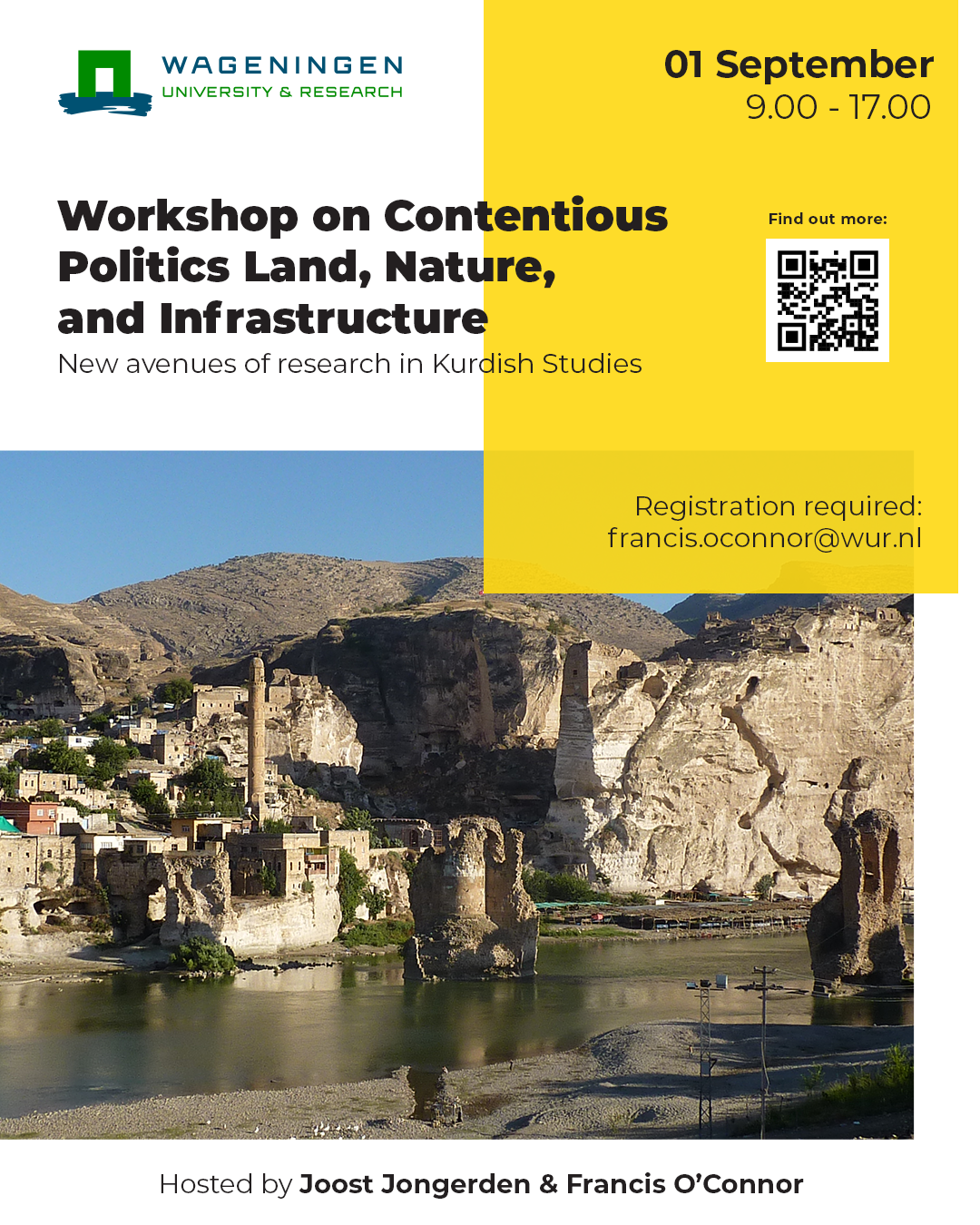
Workshop on Contentious Politics in Kurdish Studies: Land, Nature, and Infrastructure

Hosted by the Rural Sociology Group, Wageningen University and Research, September 1, 2023

In Kurdistan occupations and demonstrations by landless workers and peasants demanding land reform have taken place on a large scale since the middle of the 20th century. In more recent years, this contestation over land has overlapped with the rise of environmental activism. The workshop Contentious Politics in Kurdish Studies: Land, Nature, and Infrastructure addresses a number of theoretical debates and questions related to land.

Affiliations of the participants

Kamuran Akin is an independent researcher who recently defended his PhD at the Institut für Europäische Ethnology, Humboldt Universität zu Berlin.

Seda Altuğ is a lecturer at the Atatürk Institute for Modern Turkish History at Boğaziçi University, Istanbul.

Aysegul Aslan is a Ph.D. candidate in geography at Fırat University, Turkey, and a visiting fellow at the Environmental Policy Group at Wageningen University, the Netherlands

Eray Çaylı is a professor of Human Geography with a Focus on Violence and Security in the Anthropocene, Hamburg University, Germany

Pinar Dinc  is a researcher at the Centre for Advanced Middle Eastern Studies at Lund University.

Ayhan Işık is a Postdoctoral Researcher at Centre de Recherche Mondes Modernes et Contemporains, Université libre de Bruxelles.

Adnan Mirhanoğlu is a researcher in the Department of Earth and Environmental Sciences at KU Leuven, Belgium.

Zeynep Oguz is a lecturer in Social Anthropology at the University of Edinburgh.

Murat Öztürk is associate professor at the  Department of Economics at Kırklareli University in Turkey. 

Marcin Skupiński is a Ph.D. candidate at Warsaw University, Poland.

Necmettin Türk is a PhD Candidate in the Working Group “Critical Geographies of Global Inequalities” at the Institute of Geography, Hamburg University, Germany.

Filyra Vlastou-Dimopoulou is a Ph.D. candidate in Human Geography (NTUA & Paris 1 Panthéon-Sorbonne University.

Dobrosława Wiktor-Mach is professor of Economics, Cracow University, Poland.

Organizers

Joost Jongerden – Associate professor at the Rural Sociology Group, Wageningen University, the Netherlands joost.jongerden@wur.nl

Francis O’Connor – is a Marie Curie Skłodowska Post-Doctoral Fellow in Rural Sociology at Wageningen University in the Netherlands. Francis.oconnor@wur.nl

75th Anniversary: 54) Research at the Rural Sociology Group:  Making a Difference

Dirk Roep

Overall, my main interest has been on how people come together, and, in collective action, (attempt to) make a difference – how they overcome the constraints they encounter in their everyday life, how in their practice they not only deviate from what is taken for granted or imposed but (try to) make what is considered impossible possible and how they can create meaningful differences and opportunities. Meaningful to themselves, but also as meaningfully novel, promising practices, opportunities in the light of all the challenges that humanity faces in making our earthly life more healthy, sustainable, equitable and inclusive – a better place for all. This points to agency as an intermediary between actors and structures and particularly to transformative agency.

Change is not inherently good – it can also be quite ugly. We are subject to all kinds of dynamically interacting processes that impact on our everyday life, human and non-human initiated and operating on different scales. We need to time and again scrutinise, evaluate and critically reflect on the impact that all these processes have on humans and non-humans, on all that matters. This is core to what rural and rural and agrarian sociology is about for me.

In this respect, the PhD thesis on two diverging styles of farming (Stijlen van Landbouwbeoefening: uiteenlopende ontwikkelingspatronen) by Van der Ploeg and Bolhuis (1985) was an eyeopener to me as a novice in the field. It demonstrated that farmers are indeed subject to all kind of ordering processes in which farming is situated, thus limiting the space for farming and even imposing or enforcing a particular mode of farming – but also that farming and farm development is not fully determined by these hegemonic processes.

Within the Technical Administrative Task Environment (TATE), as Bruno Benvenuti (1982) conceptualised the prescriptive structuring principles, there is space for resistance, deviation and divergence, a certain autonomy, although to what extent is not only an empirical question but also heavily debated. Farmers can indeed make a difference, by structuring their (family) farm labour in meaningful ways following a particular rationale based on more widely shared opinions, values and norms about how to best farm that are internalised and externalised in interaction as evolving patterns of ‘rules in use’ (Ostrom 1992).

Styles of farming can be seen as institutionalised ways of doing, thinking and feeling (Berger & Luckman 1967). This explains how diverging styles of farming, as different modes of ordering (Law 1994), emerge within (apparently) homogeneous settings. Farmers, as individuals but more often in collectives, both resist the structuring (political, economic and bio-physical) forces they are subject to in their everyday life and also build the individual and collective capacity to bypass these forces by creating relatively autonomous protected spaces or niches that provide them with the room for manoeuvre to differ, deviate and differentiate according to their rationale. This is how I became engaged in rural and agrarian sociology. The institutional imperative (Zijderveld 2000) has guided me since in understanding how continuity and change are inherent to action and how heterogeneity is reproduced in interactions between humans and non-humans, between society and living and dead matter with technology as an intermediate (Roep 2000).

In my (1989) MSc-thesis, ‘Stap voor Stap of in een Sprong’ (Step by Step or in one Leap), I explored differential growth patterns and family farm income strategies among farmers producing milk for the famous Parmigiano Reggiano, extending the PhD-research by Van der Ploeg, which was further elaborated in Van der Ploeg, Saccomandi and Roep (1990). This became the launching pad for a series of studies on farming styles – ‘bedrijfsstijlen’ in Dutch, following Hofstee – starting in the Netherlands with Van der Ploeg and Roep (1989). Not only were different farm development and family income strategies based on different rationales revealed by this work but also the differentiated impacts they had, such as on the environment through significant variations in nutrient losses. It was also revealed that farmers, within their institutional embedding, built different capacities when following different farm development paths. Farming styles did make a difference, and this made them politically relevant considering the challenges agriculture was, and it still is, facing and the search for more sustainable and even regenerative farming practices.

The farming styles research also showed that farmers on their own, in supporting networks and in collectives were pioneering alternative farming practices to escape the pressing income squeeze in ways other than by increasing production volume. During the 1990s, the Rural Sociology research team at Wageningen became engaged with various farmer-driven initiatives developing alternative farm development strategies and pathways for agrarian and rural development. These were subsequently mapped, first in the Netherlands and then later across Europe (van der Ploeg & Banks 2002). The broadening, deepening and regrounding of farm practices were identified as alternative income strategies to counter further marginalisation, and an alternative rural development paradigm emerged to the dominant productivist paradigm promoting scale enlargement, intensification and specialisation as the only viable strategy (van der Ploeg & Roep 2003).

Within the framing of this alternative paradigm, local grassroots initiatives developed the necessary but previously lacking capacity to develop and operate in experimental spaces or niches, supported by newly created alliances and networks. I became engaged with a group of pioneering farmers in the western peatland area that, inspired by renowned high added value products with a denomination of origin like the Parmigiano Reggiano and Comte, aimed to upgrade farm-made cheese, Boerenkaas, a speciality product with excellent but underdeveloped potential. Having turned completely towards bulk production, the Netherlands lacked both the capacity to produce and market high-quality speciality food products with a denomination of origin and the proper institutional setting to support this.

Based on this case, I argued in my PhD-thesis, ‘Innovative work: tracks and traces of capacity and incapacity’ (Roep 2000), that the narrowly focused productivist paradigm which had dominated agriculture and rural development since the 1950s and transformed Dutch agriculture and rural areas profoundly through its comprehensive capacity had, at the same time, resulted in an institutionalised incapacity. Diversity was long seen as an aberration, not as a rich source to explore alternative, promising pathways.

Thus, there developed a research agenda on the transformative potential of a wide range of novel practices in farming and food provisioning – or, the Seeds of Transition (Wiskerke & Van der Ploeg 2004). I have been involved in some of the research projects and publications exploring promising sustainability pathways and the new capacities being forged. We have identified and elaborated on various niches supported by alliances in new networks and the accompanying, co-evolving institutional reform (Roep & Wiskerke 2004, 2006, 2012).

The transformative capacity of grassroots initiatives and promising practices, the ability to make a difference and specifically the struggle with allies for and the creation of a favourable institutional embedding to counter unsustainabilities, degeneration, exclusion and inequalities make up the connecting thread throughout my research (Horlings, Roep & Wellbrock 2018; van den Berg et al. 2018). This was complemented by a relational approach, inspired by actor-network theory (ANT) (Law & Hassard 1999) and what Law and Mol (1995) dubbed ‘relational materialism’, and then by Massey (1994) and others with regard to place-shaping practices. This was foundational to the Marie Curie ITN project ‘SUSPLACE: Exploring the Transformative Capacity of Place-Shaping Practices’ (Horlings et al. 2020). Thence, the focus of my work has shifted from sustainable farming practices to sustainable food provisioning practices and sustainable place-shaping practices – and, more recently, from sustainability to regeneration as a future guide.

In line with the above, my current interest is in grassroots or citizens initiatives that aim to

  • Restore and regenerate agro-ecosystems, particularly pioneers in regenerative agriculture and regenerative modes of food provisioning;
  • New commons and commoning, particularly diverse forms of community farming.

And, not least, support and report once again on those initiatives engaged in making a difference.

References:

  • Benvenuti, B. (1982) De Technologisch-Administratieve Taakomgeving (TATE) van landbouwbedrijven. Marquetalia, 5, p.111-136.
  • Berger, P.L., and Luckman, T. (1967). The Social Construction of Reality; A Treatise in the Sociology of Knowledge. London: Penguin Press.
  • Hermans, F., Klerkx L., Roep, D. (2016). Scale Dynamics of Grassroots Innovations Through Parallel Pathways of Transformative Change. Ecological Economics, 130: 285-295.
  • Horlings, L.G., Roep, D. and Wellbrock, W. (2018). The Role of Leadership in Place-Based Development and Building Institutional Arrangements, Local Economy, 33(3): 245-268.
  • Horlings, L.G., Roep, D., Mathijs, E., Marsden T. (2020). Exploring the Transformative Capacity of Place-Shaping Practices, Sustainability Science, 15: 353-362.
  • Law, J. (1994). Organizing Modernity. Oxford: Blackwell.
  • Law, J., and Mol, A. (1995). Notes on Materiality and Sociality, The Sociological Review, 43: 274-294.
  • Law, J., and Hassard, J. (Eds.) (1999). Actor Network Theory and After. Oxford: Blackwell.
  • Methorst, R.G., Roep, D., Verstegen, F.J.H.M., and Wiskerke, J.S.C. (2017). Three-Fold Embedding: Farm development in relation to its socio-material context. Sustainability, 9: 1677.
  • Massey, D. (1994). Space, Place and Gender. Cambridge (UK): Polity Press.
  • Moschitz, H., Roep, D., Brunori, G., and Tisenkopfs, T. (2015). Learning and Innovation Networks for Sustainable Agriculture: Processes of co-evolution, joint reflection and facilitation, The Journal of Agricultural Education and Extension, 21(1): 1-11.
  • Ostrom, E. (1992). Crafting Institutions for Self-governing Irrigation Systems. San Francisco: ICS Press.
  • Roep, D. (1988). Stap voor Stap of met een Sprong: Bedrijfsstrategieën in het landbouwstelsel van de Parmigiano Reggiano. Doctoraalscriptie Agrarische Ontwikkelingssociologie. Wageningen: Wageningen University. (Dutch)
  • Roep,, D. (2000). Innovative Work: Tracks of capacity and incapacity. PhD thesis. Wageningen: Wageningen University. (Dutch)
  • Roep, D., van der Ploeg, J.D., and Wiskerke, J.S.C. (2003). Managing Technical Institutional Design Processes: Some strategic lessons from environmental co-operatives in the Netherlands, NJAS Journal for Life Sciences, 51(1-2): 195-217.
  • Roep, D., and Wiskerke, J.S.C. (2004). Epilogue: Reflecting on novelty production and niche management in agriculture, in J.S.C. Wiskerke and J.D. van der Ploeg (eds.), Seeds of Transition: Essays on Novelty Production, Niches and Regimes in Agriculture, pp. 341-356. Assen: Van Gorcum.
  • Roep, D., and Wiskerke, J.S.C. (Eds.). (2006). Nourishing Networks; Fourteen Lessons About Creating Sustainable Food Supply Chains. Rural Sociology Group. Wageningen/ Doetinchem: Wageningen University and Reed Business Information.
  • Roep, D., and Wiskerke, J.S.C. (2012). On Governance, Embedding and Marketing: Reflections on the construction of alternative sustainable food networks, Journal of Agriculture and Environmental Ethics, 25: 205-221.
  • van den Berg, L., Roep, D., Hecink, P., and Mancini Teixeira, H. (2018). Reassembling Nature and Culture: Resourceful farming in Araponga, Brazil, Journal of Rural Studies, 61: 314-322.
  • van der Ploeg, J.D., and Bolhuis, E.E. (1985). Boerenarbeid en Stijlen van Landbouwbeoefening; En socio-economisch onderzoek naar de effecten van incorporatie en institutionalisering op agrarische ontwikkelingspatronen in Italië en Peru, Leiden Development Studies, 8: 511.
  • van der Ploeg, J.D., Saccomandi, V., and Roep, D. (1990). Differentiële Groeipatronen in de Landbouw: Het verband tussen zingeving en structurering. Tijdschrift voor Sociaal wetenschappelijk onderzoek van de Landbouw, 5: 108-132.
  • van der Ploeg, J.D., and Roep, D. (1990). Bedrijfsstijlen in de Zuidhollandse Veenweidegebieden: Nieuwe perspektieven voor beleid en belangenbehartiging; Koninklijke Land– en Tuinbouwbond en Vakgroep Agrarische Ontwikkelingssociologie Wageningen University.
  • van der Ploeg, J.D., Long, A., and Banks, J. (2002). Living Countrysides. Rurale development processes in Europe: The state of the art. Doetinchem: Elsevier bedrijfsinformatie.
  • van der Ploeg, J.D., and Roep, D. (2003). Multifunctionality and Rural Development: The actual situation in Europe, in G. van Huylenbroeck and G. Durand (Eds), Multifunctional Agriculture: A New Paradigm for European Agriculture and Rural Development, pp. 37-53. Farnham (UK): Ashgate Publishers.
  • Wiskerke, J.S.C., and van der Ploeg, J.D. (Eds.). Seeds of Transition: Essays on Novelty Production, Niches and Regimes in Agriculture. Assen: Van Gorcum.
  • Zijderveld, A.C. (2000) The Institutional Imperative: The value of institutions in contemporary society. Amsterdam University Press, Amsterdam.

75th Anniversary: 53) Research at the Rural Sociology Group: Agriculture, Decolonization and National-Popular Development

Max Ajl

What has been the role of poor rural people in the periphery in changing the world? How can the world change so that poor rural people are no longer poor? How does putting the social inclusion or exclusion of poor rural people front-and-center change how we understand politics, planning, methodology, and epistemology? And what happens to these questions when we place them in the broader framework of ecology and the ecological crisis? These questions have been central to development theories over the last decades or even the last century, and have inflected discussion of the agrarian question, in its political, social, ecological, and national aspects. Yet there has remained a nagging gap between (1) work on decolonization, including contemporary epistemological inquiries; (2) work dealing with macro-economic planning; (3) work on agro-ecology, food sovereignty, pastoralism, and sustainable livelihoods.

Over the last decade, I have tried to address these questions in a variety of ways. Spatially, I have worked outwards from Tunisia to North Africa, the Arab region as a whole, and world ecological crisis. In terms of disciplines, I have worked outwards from rural sociology into historical ecology, the intellectual and social history of planning, and the intellectual history of heterodox post-colonial theories of development.

My dissertation research (Ajl 2019a) started with a puzzle: why and how did Tunisia come to be a poor country, and specifically how did state policies reproduce rural poverty? It tried to understand this through the phenomenon of state price engineering. Yet prices reflected social and political power balances, and the origins of those balances were unclear to me: why and how had poor rural Tunisians been excluded from development? This led to work on the political-historical sociology of anti-colonial revolt, decolonization, and post-colonial political management, especially focused on how the political mobilization of the peasantry/pastoralist population of Tunisia was sheared and blocked from becoming inclusion in Tunisian developmentalism.

In parallel, I worked on other cases in the Arab region, including Syria (Ajl 2019b; Ajl et al. 2020), Yemen (Ajl 2018a), and the Arab region more broadly (Ajl 2021a) tracing how different constellations of social forces, domestically and internationally, led to different agrarian trajectories: partially rural-incorporating as in Syria and Egypt, for example. Or, how the Green Revolution manifested in the Arab region (Ajl 2017; Ajl and Sharma Forthcoming). These studies showed the agrarian question was central to world geopolitics, with more rural-incorporating governments understood as antagonistic to the established order because of their partial endogenization of productive forces. In this way, they showed that national agrarian question were local expressions of a global process (McMichael 1997), wherein political shifts in some Arab nation-states changed the parameters of agrarian/developmental politics in others. In this way I was able to think about how to break from methodological nationalism not only at the level of capitalist accumulation (Wolf 1969) but also resistance to it.

Examining the politics of national liberation and post-colonial planning led me into critiques of those processes from heterodox planners, agronomists, and economists in the Arab region, extending to West Africa and especially Senegal, the home of Samir Amin. In a series of essays (Ajl 2021b, 2019c, 2018b, 2022) I have examined notions of self-reliant or auto-centered development. This idea is based on the diagnosis that countries’ insertion into global capitalism pushes them to pursue policies inimical to the well-being of their poorest sectors. It would follow that more auto-centered policies, focusing on fulfilling the basic needs of the poorest, would lead to superior development outcomes. I examined this idea theoretically through the work of Amin and at the level of intellectual history, as it emerged in planning proposals from Chinese-influenced Egyptian and Tunisian planners.

A third ‘track’ has been my concern with climate change, in particular how to connect the problems of Northern planning and social and ecological crisis with southern aspirations for national popular and ecological development planning. This has resulted in a book (Ajl, 2021c) and a series of articles and chapters (Ajl 2021d, Forthcoming; Ajl and Wallace 2021; Tilley and Ajl 2022) focusing on various aspects of this question: critiques of green modernization, green demographic management, intervention in pastoralist livelihoods, and above all a program for national development planning North and South: bringing what I have learned into Tunisia about popular planning, developmental needs, and appropriate technologies into the northern planning conversation, to think about how to make a world big enough for everyone, North and South.

  • Ajl, M., 2022. Food Sovereignty, the National Question, and Post-colonial Development in Africa, in: Ben Gadha, M., Kaboub, F., Koddenbrock, K., Mahmoud, I., Samba Sylla, N. (Eds.), Economic and Monetary Sovereignty in 21st Century Africa. Pluto, London, pp. 238–258.
  • Ajl, M., 2021a. Does the Arab region have an agrarian question? The Journal of Peasant Studies 48, 955–983. https://doi.org/10.1080/03066150.2020.1753706
  • Ajl, M., 2021b. Delinking’s Ecological Turn: The hidden legacy of Samir Amin. Review of African Political Economy.
  • Ajl, M., 2021c. A People’s Green New Deal. Pluto Press, London.
  • Ajl, M., 2021d. A People’s Green New Deal: Obstacles and prospects. Agrarian South: Journal of Political Economy 10, 371–390. https://doi.org/10.1177/22779760211030864
  • Ajl, M., 2019a. Farmers, Fellaga, and Frenchmen (PhD). Cornell University, Ithaca, N.Y.
  • Ajl, M., 2019b. The Political Economy of Thermidor in Syria: National and international dimensions, in: Syria: From National Independence to Proxy War. Springer, pp. 209–245.
  • Ajl, M., 2019c. Auto-Centered Development and Indigenous Technics: Slaheddine el-Amami and Tunisian delinking. Journal of Peasant Studies 46, 1240–1263.
  • Ajl, M., 2018a. Yemen’s Agricultural World: Crisis and prospects, in: Crisis and Conflict in Agriculture. CABI.
  • Ajl, M., 2018b. Delinking, Food Sovereignty, and Populist Agronomy: Notes on an intellectual history of the peasant path in the global South. Review of African Political Economy 45, 64–84.
  • Ajl, M., 2017. Field Notes on Tunisia’s Green Revolution. Viewpoint Magazine.
  • Ajl, M., Forthcoming. Everything Changes While Everything Stays the Same. Development and Change.
  • Ajl, M., Haddad, B., Abul-Magd, Z., 2020. State, Market, and Class: Egypt, Syria, and Tunisia, in: A Critical Political Economy of the Middle East and North Africa, !!046316523!School for Advanced Research Advanced Seminar Series. Stanford University Press, pp. 46–67.
  • Ajl, M., Sharma, D., Forthcoming. Transversal Countermovements: The afterlives of the Green Revolution in Tunisia and India. Canadian Journal of Development Studies/Revue canadienne d’études du développement.
  • Ajl, M., Wallace, R., 2021. Red Vegans against Green Peasants [WWW Document]. New Socialist. URL http://newsocialist.org.uk/red-vegans-against-green-peasants/ (accessed 11.1.21).
  • McMichael, P., 1997. Rethinking Globalization: the agrarian question revisited. Review of International PoIiticaI Economy 4, 630–662.
  • Tilley, L., Ajl, M., 2022. Eco-socialism Will be Anti-eugenic or it Will Be Nothing: Towards equal exchange and the end of population. Politics 02633957221075323. https://doi.org/10.1177/02633957221075323
  • Wolf, E.R., 1969. Peasant Wars of the Twentieth Century. University of Oklahoma Press.

75th Anniversary: 51) Family Farming Futures: A research agenda

Henk Oostindie

Family-farms’ responsiveness to societal change plays a prominent role in my research interests. Initially, I focused on the societal significance of differentiating ‘farming styles’ in relation to a variety of topics, such as deteriorating farm incomes, agri-environmental problems and loss of rural amenities. Later, I studied agricultural diversification tendencies, guided by notions like resistance, resilience and redesign as integrating insights from various sociological strands. In this wider theorizing of the empirical material collected over previous decades on farmers’ individual and collective reactions to marginalisation tendencies, narratives of their struggles to regain a certain autonomy have been interwoven with active attempts to create alternative, more promising and independent relations through new forms of cooperation (networks, alliances, partnerships, etc.). 

I believe there are good reasons to continue to develop a strongly empirical and grounded approach to research on the resilience of family farming. Here, I will illustrate this with a consideration of ongoing agricultural dynamics in the Dutch setting, which has a particular value also given the relatively little attention afforded to our Rural Sociology Group ‘home situation’ in the other contributions to this anniversary book.

The Netherlands faces a period of serious tensions between its farming population and society at arising from struggles for space, both literally and in terms of agri-environmental pollution rights related to the persistence of agri-environmental climate change issues in a rather vulnerable delta setting. As part of the politically highly sensitive national Nitrogen Dossier, agriculture as an economic sector is increasingly in competition with others, especially transport and housing, with reference to compromises around reduction targets and the (re)allocation and distribution of emission rights. Dutch farmers differ rather fundamentally in their opinions about how to tackle this agri-environmental challenge.

For a significant part of the Dutch farming community, this represents less of a challenge than a fundamental threat to their professional interests and identity – as expressed, for example, in recent farmers’ demonstrations and their accompanying demands. However, as revealed by national surveys, around 40% of farmers are willing to accept cuts in their nitrogen emission rights provided there are accompanying compensation measures. These would include better targeted and more finely-tuned remuneration systems for their delivery of other, non-food ecosystem services ( contributions to biodiversity, landscape values, sustainable water management, etc.). These farmers’ openness to multifunctional, nature-inclusive and regenerative farming futures – or any other alternative to the primary mode of agricultural modernisation – reflect much more positive, constructive and hopeful attitudes to changing societal demands. As confirmed by research insights, something that can and should be at least partly explained by the peculiarities of family-farming logics.

In the Dutch setting, the wider societal benefits of the resilience of family-based farming remain under-recognised, I would argue. Thus, resilience understudied in relation to broader research topics involving the attractiveness of rural life-styles, vibrancy of rural communities, reproduction and preservation of rural distinctiveness, healthy and sustainable foodscapes and rural-urban interdependencies. Probably for the same reason, there is relatively little research attention devoted to topics such as how to deal with the particular vulnerabilities of family-based farming such as inter-generational succession.

Latter’s  increasingly high dependency on external financial resources as well as family-members willingness to accept non-market conform compensation levels, makes it often a critical moment, or break-point, in the continuity of family-farming. The current emergence of financially more accessible and socially more acceptable succession models reflects interesting responses in this context that deserve further research attention. For instance, splitting farms into multiple, smaller business units that continue to collaborate closely but that can be sold and purchased independently of one another might improve farm continuity and expand the social accessibility of farming, including better opportunities for new entrants without agricultural backgrounds.

My own special interest in the future of family-farming encompasses its accompanying policy-practice interfaces, with particular attention to novel forms of collective action. Again, limiting myself to the Dutch setting, this comprises initiatives as agri-environmental and territorial cooperatives, as well as a broad spectrum of other initiatives around the emergence of novel rural markets (green care, agri-tourism, leisure, alternative food qualities, etc.). In short, primarily, although certainly not exclusively, I investigate farmer-led collective responses to societal demands for more integrative agricultural development and more sustainable food systems. Associated social struggles against prevailing policy interventions and market dependencies and attempts to establish more place-based partnerships and alliances, along with the accompanying processes of negotiation, learning and boundary-crossing efforts all structure, motivate and orientate my interest in contemporary rural development practices and initiatives. This is theoretically underpinned by actor-network theory and relational approaches and insights from transition- and governance scholars.

Taken as a whole, these research interests are closely related to the research agenda of the Rural Sociology Group as outlined in this anniversary book. Contemporary family-farming dynamics are becoming particularly meaningful in relation to wider societal concerns as sustainable food-scapes and rural, or perhaps better, place-based well-being in a broader sense. This perspective draws on my three decades of participation in European projects addressing these type of interrelations in different ways, ranging from varying sustainable food network trajectories (e.g. within the EU-funded project SUS-CHAIN) to theorising rural competitiveness and quality of rural life through the rural web concept (e.g. EU-funded project ETUDE). I have certainly appreciated these attempts to integrate the research fields of the Rural Sociology Group within European projects, notwithstanding their limitations. One concern in this regard that I would like to address in this anniversary contribution is the absence of opportunities for more longitudinal research.

A mixture of short project time frames and commissioner-led agenda setting makes it difficult to get deeper insights in continuity and change over longer time periods. How did regional farming styles develop in time, or particular sustainable food networks? What happened to hopeful farmer-led collective initiatives, or promising and less promising rural web dynamics? I guess I will keep struggling with, and dreaming about, how to create space for more longitudinal research approaches to further unravel and underpin societal relevance, impact and promises of aforementioned research fields and interests.