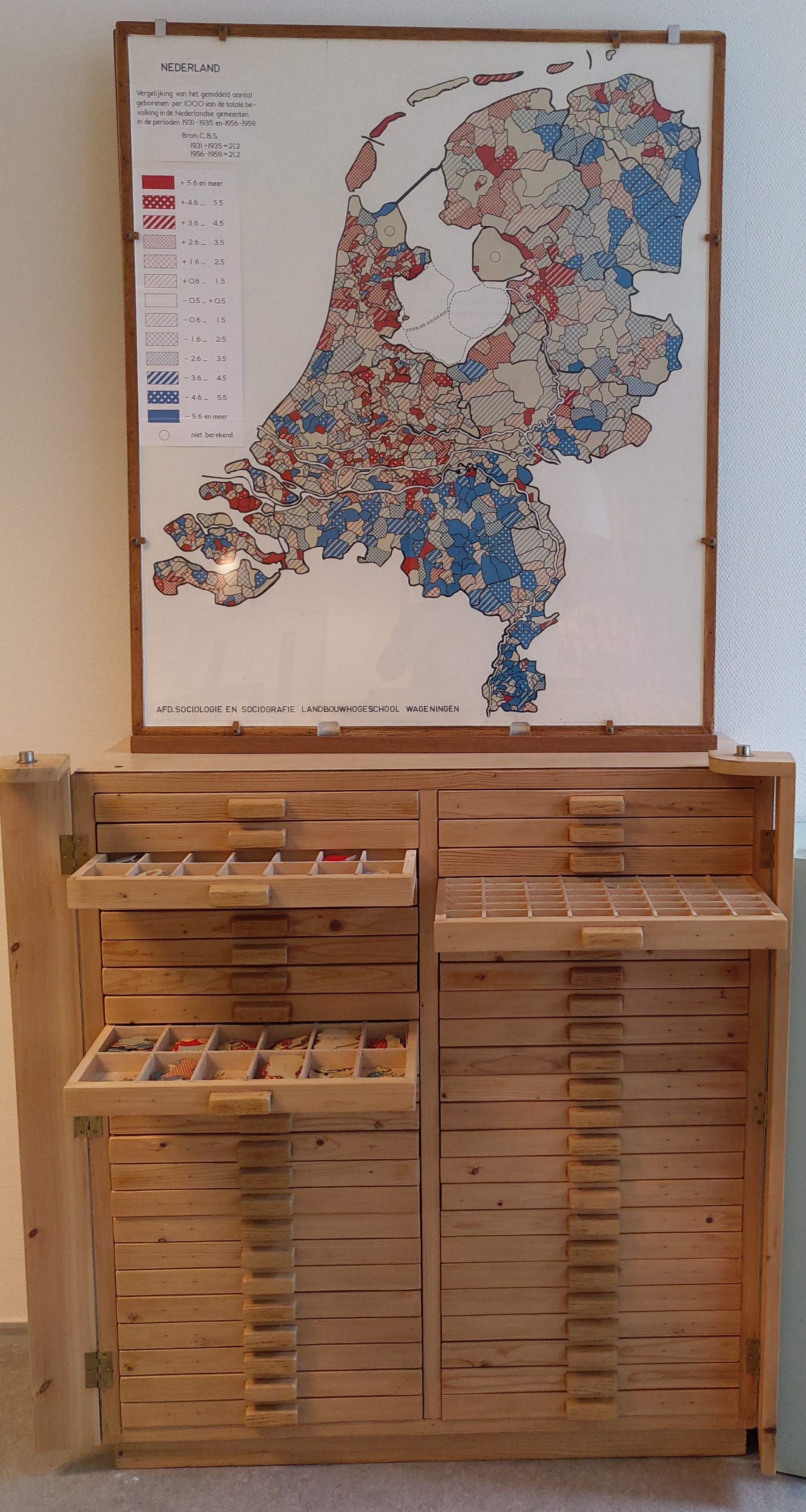
75th Anniversary: 6) The Cartophoot: Hofstee’s geographic mapping of difference

Picture 1. The cartophoot

In 1949, three years after his appointment as professor in social and economic geography, the ‘trojan horse’ through which rural sociology entered Wageningen, Evert Willem (E.W.) Hofstee became the chair of a commission to study the development of fertility in the Netherlands.[1] This Commission for Birth Research (Commissie voor het Geboorte-Onderzoek)[2] was part of the Institute for Social Research of the Dutch People (Instituut voor Sociaal Onderzoek van het Nederlandse Volk [ISONOVO]). Continue reading

Unpacking legitimacy in regional development

In 2018, Yasmine Willy came as a visiting fellow to the Center of Space, Place and Society at WUR. Two years later, the fruits of this visit have been published in the journal Territory, Politics and Governance. The article focuses on an issue widely discussed in academic literature: the lack of legitimacy of regional development agencies.  Following Hannah Arendt’s distinction between legitimization and justification, the article argues that the main problem regional development agencies struggle with is not procedural rightfulness (legitimization) but means–end coordination (justification). The abstract of the article writes: “In recent years, policy-makers and researchers have identified regional development agencies as the most suitable actors to carry out public tasks. One of these tasks has been the coordination of regional development processes. Both practitioners and researchers argue that legitimacy is a prerequisite for these regional actors to function properly. Although legitimacy is a key issue, little is known about the challenges that arise while producing it. Selecting six regional development agencies in Switzerland and applying an interview-based research method, this explorative study analyses how regional development agencies deal with legitimacy issues. The findings indicate that the main problem with which regional development agencies struggle is not procedural rightfulness but means–end coordination. By proposing a clear distinction between legitimacy and justification, we aim to stimulate the debate on how to operationalize legitimacy and further the discussion of the functioning of regional development agencies. Consequently, we introduce the concept of ‘asymmetric justification’ to the debate on regional development processes in order to shed a light on the functioning of regional development agencies.”

If you are curious, you can access the article under this link
https://rsa.tandfonline.com/eprint/FVR9SKRQMMXG8GMVRZ5S/full?target=10.1080/21622671.2020.1805352


(De)coding a technopolity: Tethering the civic blockchain to political transformation – PhD-thesis by Syed Omer Husain

May 14 2020, at 11.00 am (CET) Syed Omer Husain will defend his PhD-thesis ‘(De)coding a technopolity: Tethering the civic blockchain to political transformation‘. See the Abstract below. The full thesis can be downloaded (click title) from WUR Library after the defence ceremony.

The ceremony will be live-streamed by Weblectures.wur.nl but is recorded and can be viewed later as well. Syed Omer Husain is affiliated as PhD-candidate at the Rural Sociology Group of Wageningen University. He was employed at the EU-funded MSCA ITN project SUSPLACE.


Abstract

This study rests at the intersection of technopolitics, translocal networks and political change. The overall aim of the thesis is to understand, and in turn, influence, the way technology interacts with political transformation. It responds to the fact that social science has thus far neglected to adequately account for and analyze how emerging technologies like blockchain and civic tech influence the way politics is practiced. The main research question guiding the study is how does the design, implementation and use of technopolitical innovations influence the practice of politics. The thesis foregrounds the idea that technopolitical experiments personify a ‘prefigurative politics by design’ i.e. they embody the politics and power structures they want to enable in society.

Conducted as part of the EU-funded SUSPLACE project that explores the transformative capacity of sustainable place-shaping practices, the research was predominantly inspired by a hybrid digital ethnography methodology. The thesis confines its focus to three empirical clusters: technopolitical blockchain projects, government-led blockchain projects and place-based civic engagement technologies. The study delineates how differing politico-social imaginaries play a role in the design and implementation of technopolitical projects; addresses contemporary post-political phenomena such as the depoliticization of agency; and identifies the activation of a place-based geography of political action through digitally-mediated municipal networks. It articulates the language and frameworks necessary to analyze these present-day challenges, while simultaneously developing approaches that can be exported to different domains of political activism.

Technology is not neutral; but neither are its designers and users. The thesis finds that it is through considerable, deliberate efforts, in conjunction with individual and collective choices, that technopolitical innovations can reframe our socio-economic and political realities. The study demonstrates the emphatic and urgent need for researchers, practitioners, politicians and citizens to collaboratively work on redrawing boundaries of access, empowering the citizenry, creating new forms of organization and re-politicizing the economy. It outlines a transdisciplinary research and practice agenda that aims at not only (de)coding the existing technopolitical innovations, but also (re)coding them to create a more equitable system of politics. The thesis concludes that since coding affordances and constraints in a technopolitical system is shown to regulate political agency and even influence the behavior of citizens, we must devise value-driven technology that incentivizes creating a more equitable political system.

Register now for RSO55306 – A Global Sense of Place: Place-based approaches to development | Period 5

soap-bubble-406944

In the face of urgent environmental and societal challenges, how do we move towards inclusive futures? What is the role of people in places? And what can be our role as (social) scientists?

In this course, we explore inclusive place-based approaches to development. We analyse how change happens from below and how people take matters in their own hands, shaping the places they live in according to their own needs and values. A relational perspective allows us to see the interdependence between the local and the global, the urban and the rural and the individual and the collective.

Besides engaging with key theories and analysing topical cases, we reflect upon our own role as (social) scientists and explore the tools and methodologies we need in place-based research, specifically focusing on participatory and creative methods.

This advanced MSc course is relevant for all students (including PhD candidates) with an interest in inclusive development, that seek theoretical as well as methodological guidance. The course can help students prepare an MSc thesis proposal and is supported by lecturers from all chair groups involved in the Centre for Space, Place and Society (RSO, SDC, HSO and GEO)

For more information, contact anke.devrieze@wur.nl.


The EU Protein Plan: shifting to sustainable supply-chains or more of the same?

Chris Chancellor, WU Graduate

The impact that our industrialised global food supply-chain has on diverse ecosystems and communities around the world is receiving greater attention than ever before. Scholars and activists have for decades emphasised how European agricultural demand has driven deforestation and environmental destruction in species-rich biomes such as the Amazon and Cerrado regions in Latin America.  Now it is becoming clear that the consequences extend far beyond the environmental harm generated by the production stage itself. When looking at the wider chain, the implications of industrial food systems for issues such as food and nutritional security, human health, social justice, rural vitality, employment, and the concentration of market control, become apparent.

Having found its way onto the political agenda, the European Union (EU) has come up with the idea of a European Protein Plan. The EU is currently heavily reliant on imports of protein crops, primarily soybean from Latin America’s Southern Cone region. As well as being linked with major environmental and human rights concerns, the reliance on imports also makes the EU agricultural industry vulnerable to shocks in international commodity prices. Soybean is the favoured ingredient in animal feed for the EUs powerful livestock industry, and therefore a price shock would have major socio-economic consequences.

The Protein Plan essentially proposes increasing the amount of domestic protein crop production. The idea is that this would lift the burden on Latin American ecosystems whilst at the same time providing the EU with greater ‘protein independence’. This has been presented as a win-win situation, and yet the manner in which this production would take place has received little or no critical attention.

A report published by civil society organisation European Coordination Via Campesina (ECVC) highlights the dangers of simply transplanting the same corporate industrial supply-chain into Europe. Last year, an agreement called the European Soya Declaration was signed by 13 member states, highlighting the suitability of fertile and ‘underused’ lands in Central and Eastern Europe (CEE) for expansion of European soybean production. The ECVC report details the recent emergence of agribusinesses and financial investors in the CEE region. Land here is cheaper and often more fertile than in Western Europe, and offers suitable agro-climatic conditions for commodity soybean cultivation. There is therefore an opportunity for large profits to be made if land is bought up now, cultivated with soybean or other commodity protein crops, and potentially sold later when land prices have reached western European levels. As one company puts it: ‘protein crops are the new gold bars’. However, this process is not a neutral one, and entails radical reformulations of arable land ownership and control, threatening the livelihoods of the region’s small-scale producers and rural communities.

Another report from the Land and Resource Lookout reaches a similar conclusion, pointing out that ‘a control-blind approach’ to sustainability is evident. Much attention is given to the fact that this soy would be non-GM, would be deforestation-free, and would help to fix nitrogen in crop rotations. These are undoubtedly positive, yet these traits in isolation don’t automatically equal sustainable supply-chains. The manner in which this soy is produced, distributed and consumed, as well as how and who controls these processes and relevant markets, are key for building a truly sustainable and inclusive food system. It argues that sustainable food system strategies must explicitly address the issue of corporate control if effective progress is to be made.

With the European Commission set to release a report on the EU Protein Plan before the end of the year, both reports advocate for the inclusion of agroecological principles and the concept of food sovereignty in any future EU protein strategies. An agroecological transition offers a potential pathway for a truly inclusive, interconnected and mutually beneficial food system to be built, but this must receive political backing in order for it to really take hold.

The fact that the sorts of headline issues emphasised in the European Soya Declaration are receiving genuine political attention is a positive step. It provides an opportune moment to address deep-seated systemic problems in our current industrially-based food system; policy-makers must now be brave enough to seize it!

Note: are you a WU master student and interested in doing a thesis research on this issue, please contact joost.jongerden@wur.nl