 By Yanick Bakker, MSc International Development Studies.
MSc-thesis Social Capital and Fisheries participation in Marine Spatial Planning in Orkney, Scotland (complete thesis can be downloaded).
In the autumn of 2016, I spent three months on the Orkney Islands in Scotland, where I delved into the worlds of inshore shellfish fisheries and marine spatial planning. Marine spatial planning is a relatively new tool for marine governance designed to manage the use of marine space while minimizing user-user and user-environment conflicts. The marine environment around the Orkney Islands is an important natural asset for the island communities. The waters are used for recreation and transportation, they provide fresh sea foods and are a central part of the islands’ ecosystem, identity and diverse livelihoods. Since 2010, the inshore waters around the Orkney Islands and the North East coast of Scotland have also become sites for marine renewable energy developments. Controversy over the allocation of marine space for these developments, have led to the set-up of a pilot marine spatial plan for the Pentland Firth and Orkney Waters.
Writing this thesis, I was curious to see how fishermen relate to this new way of looking at and giving direction to the development of marine space. As the waters in which they fish and the fish stocks they target are central resources for fisher communities, access to these resources is vital for their survival. Not only do new marine developments create concerns for sustainability, the notion of spatial planning at sea also causes concern for decreased mobility and consumption of space among fishermen. Taking community resilience theory as a starting point, I have focused on the use of community social capital in fisheries’ engagement with marine spatial planning in Orkney.
Social capital refers to practices, values and sets of norms found within different forms of social networks (or communities) which can contribute to the collaboration, functioning and collective action of the network. Social capital can be produced within a community (bonding), between different kinds of communities (bridging) or across scales and hierarchical structures (linking). Community resilience theory assumes that community members can act as agents of change, whereby they use different strategies to ensure the survival of the community in face of change. For example by engaging in social relation within and beyond the boundaries of the community to mobilize resources or gain power.
By conducting qualitative interviews with fishermen, representatives of fisher organizations, researchers and policy makers, I have gained insight in the different ways in which the Orkney inshore shellfish fisher community employs and continues to develop its community social capital in order to collaborate, mobilize resources to generate information to reframe the definition and formal representation of marine space and to gain power in (future) marine spatial planning negotiations.
Although social capital seems to be an enabling factor for participation in policy making, this research has shown that it is not a community asset which can be readily mobilized. Having social capital, does thus not equal having agency to act. Seeing the participatory sphere as one of unequal power, stakeholders’ ability to gain influence in governance processes is influenced by institutional limiting and facilitating factors. Social organization of fishermen in fisher organizations has shown to be an important enabling factor for participation in marine spatial planning, in Orkney.

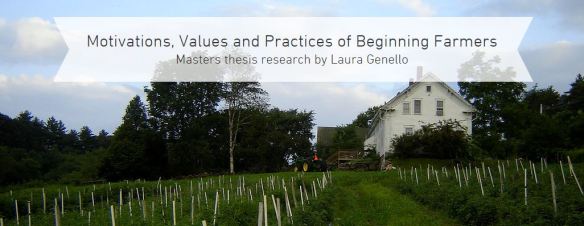 Laura Genello, student MSc Organic Agriculture van Wageningen University, doet een vergelijkend onderzoek naar eerste generatie boeren in Nederland en de staat Maryland in USA. Eerste generatieboeren zijn zij die geen familiebedrijf hebben overgenomen, maar toch op de een of andere manier zijn begonnen met boeren. Zie haar website Beginning farmers research voor meer informatie (in Engels). Daarop staat ook de online vragenlijst met een Nederlandse en Engelse versie.
 Rural Sociology Wageningen University