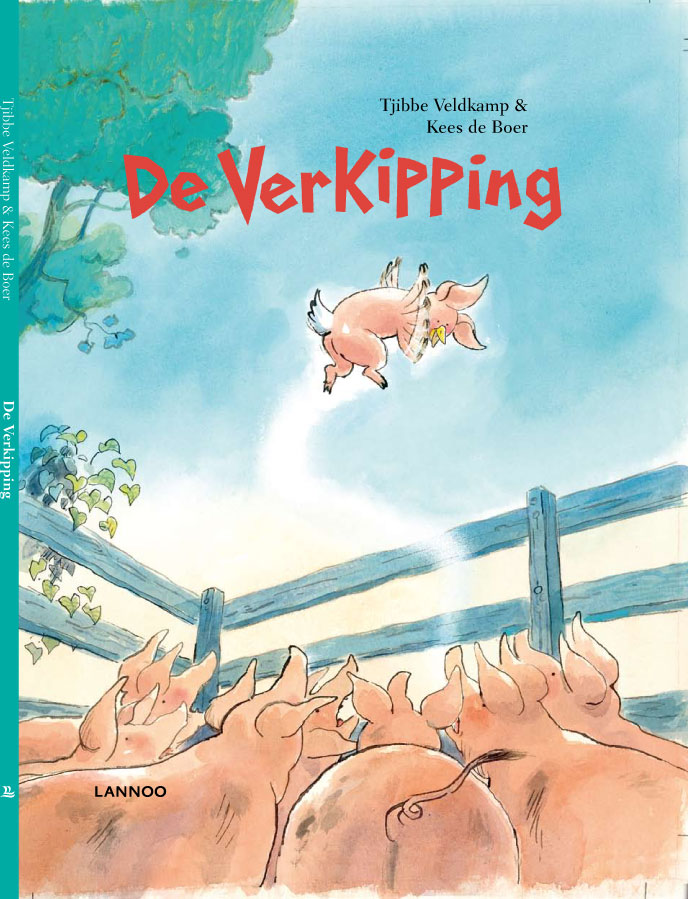
Hoe een varken een ei legt

Onlangs is het kinderboekje ‘De Verkipping’ verschenen, geschreven door Tjibbe Veldkamp  en geïllustreerd door Kees de Boer in opdracht van Kasteel Groeneveld.

Tjibbe kreeg van Kasteel Groeneveld de opdracht dat “in kinderboeken ook wel eens een realistisch beeld van het moderne boerenbedrijf neergezet mocht worden.” Dat haakt mooi aan bij een stelling uit mijn proefschrift  “Kinderboeken en –boerderijen geven vooral de ‘rurale idylle’ weer, waardoor idyllische denkbeelden over de landbouw al vroeg gevormd worden, daarmee wordt volledig voorbij gegaan aan het feit dat moderniteit ook een belangrijk onderdeel van de landbouw is waarover kinderen zouden moeten leren.”

Maar ja, Tjibbe wist zelf eigenlijk ook niet hoe dieren in de huidige veehouderij gehouden worden, vertelt hij openlijk op You Tube in The making of ‘De verkipping’. Zijn inspiratie kwam van dikbilkoeien. Bij deze dieren is er zo sterk gefokt op spierontwikkeling (vlees dus), dat kalveren niet meer via een natuurlijke weg geboren worden, maar alleen via een keizersnede ter wereld kunnen komen. Dit bracht de auteur op het idee dat de dieren in de huidige veehouderij allemaal aangepast zijn aan de wensen van de mens.

Het verhaal gaat over een boer die zijn varkens eieren wil laten leggen. Daarvoor ontwerpt hij een ‘verkippingsmachine’. Eén klein varkentje waagt – opzoek naar vrijheid – de sprong in de machine….en wat er dan gebeurt… dat mag u zelf (uw kinderen voor)lezen.

‘De Verkipping’ raakt aan een wezenlijk dilemma in de veehouderij: In hoeverre kunnen en mogen wij als mensen dieren aanpassen voor onze behoeften?

Complimenten aan Tjibbe en Kees hoe zij dit thema in een mooi geillustreerd en humoristich kinderboekje hebben vormgegeven. Eén puntje van kritiek…. De boer komt er wel erg bekaaid af, die wordt als grote boosdoener geschetst. Maar ja, het is al een ingewikkeld onderwerp voor volwassenen, en het uitleggen van de relaties tussen economische en politieke actoren in en rondom de landbouw gaat wat te ver voor een kinderboek.

Intensive Experience Slovakia

by Petra Rietberg

From April 25th to May 1st, an intensive program (IP) on ‘the role of agriculture in regional identity and competitiveness in rural areas’ takes place in Podkylava, a small Slovakian village. For two weeks, around 50 students from countries all over Europe gather to see and analyze rural development in Western Slovakia. Since our flight is obstructed by the ash of Eyjafjallajökull, Marlies and I head off for a journey by car, train and bus and, eventually, are able to make it in time. The majority of the participants has found similar solutions, so the program proceeds as planned. Continue reading

Pleidooi Duurzame Veeteelt

Er is nogal wat commotie rondom het ‘Pleidooi Duurzame Veeteelt’. Het pleidooi is inmiddels ondertekend door ruim 200 hoogleraren, ook vanuit Wageningen, zoals Noëlle Aarts, Paul Struik, Cees Leeuwis, Olaf van Kooten en onze ‘eigen’  Han en Jan Douwe.

Het pleidooi staat voor een drastische verandering van de intensieve veehouderij, in navolging van het rapport van Commissie Wijffels in 2001: 

“De intensieve veehouderij moet ingrijpend worden veranderd. Dieren moeten meer ruimte krijgen voor natuurlijk gedrag, zoals het buiten rondscharrelen. Het transport van levende dieren moet worden beperkt en het fokken van vee moet niet uitsluitend gericht zijn op toename van de productiviteit.”

Het debat rondom de intensieve veehouderij speelt al tijden en laait met enige regelmaat weer op. Met dit actuele pleidooi lijkt het stoplicht voor de intensieve veehouderij nadrukkelijk op oranje te staan… Kunnen en willen we op deze wijze dierlijke producten blijven produceren in Nederland of niet? Oftewel, accepteren we de huidige manier van produceren – het stoplicht blijft groen – of zeggen we  ‘STOP, het is tijd voor een andere veehouderij’?

De keuze is aan jou. Velen – inclusief ondergenoemde – zijn je inmiddels voorgegaan en hebben het pleidooi ondersteund.

Food Flight

The first people have entered the airspace again after almost a week of non-mobility at this side of Europe. While the large number of grounded people can slowly start to return, also freight transport by air can resume itself. Schiphol is packed with just-in-time deliveries such as consumer electronics and also perishable things like flowers, vegetables and fruit. Albert Heijn reported no immediate problems last week friday in the NRC just after the closure of Schiphol, but there was optimism then about the time it would take to re-open the airspace. Most of the supermarket’s food is transported over land, specific things like tropical fruit salad might get out of stock, the newspaper reported. It might be interesting to see what is not available anymore after a week of silence in the air. This extraordinary situation might further inspire the emerging practice of urban food planning and policy.

Food planning has risen in attention (see also earlier blogs) because of the “new food equation” (Morgan and Sonnino 2010). By this, the authors refer to a combination of factors which together make that food supply matters again as a political issue. They mention amongst others:

– Rapid urbanisation and rise of the number of people dependent on food supply

– Land conflicts and new colonialism

– Climate change effects such as water stress

– The food price surge of 2007/ 2008 and consequent food riots.

Food security, therefore, has become a national security issue again in many countries. So far, however, not really for us, it seemed. The ash coming down in silence might draw extra attention to the logistic miracle of keeping the shelves full with the thirty thousand items or more per supermarket each day. A vulnerability assessment of the food system might not be such a bad idea in the light (or darkness) of an eruption of the second, much larger volcano on Iceland.

Touching food and social relations through art

“Since Eve ate apples, much depends on dinner” Byron wrote. Food, both solid and liquid, is making the difference between life and death. For all the interest in and appreciation of ‘landscape’ and ‘nature’ we are most intimately connected to nature through the integration of nature in ourselves; our daily intake of food. However, there can be quite a disparity between care for nature and with what care we fill the supermarket basket. The availability of an abundance of food is such a taken for granted fact of life that we know less and less what food actually is.

“The extent to which we take everyday objects for granted is the precise extent to which they govern and inform our lives” Margaret Visser says.

The couch, the fridge, the supermarket and the fork are making us to who we are and simultaneously prevent us from being different. It is artists, among others, who can address that which has become invisible by its omnipresence.

An interesting art project is currently taking place in Smalle Ee, a tiny little place in the northern province of Friesland. Last week I visited Matthew Mazzotta, an artist from the US who is living in the P.A.I.R installation of the Peergroup for two months. Here, he is building his tea house where he will make tea from locally collected plants and from energy which he generates from methane of locally collected manure. Through this he uncovers knowledge about local food foraging and edible plants.

His project is a social intervention. In every aspect of his project he purposely relies on local knowledge and help of the local community. Since the beginning of March many people have become involved in one way or another. Curiosity to that weird thing he is building, helping out such as the ‘rietdekker’ did and -above all – people come to share. Not least through meals. With a few exceptions he had dinner with local people each night. Dinner is, after all, a matter of life and death. See what he is doing through this link, partly in Frisian and partly in English.