RSO Organized PhD Course: Spatial thinking in the social sciences

RSO is organizing a course for PhD students. This course “new perspectives on the urban and the rural: spatial thinking in the social sciences ” is meant for PhD students in the social, environmental and political sciences. In the course we will switch between close reading of texts, workshops, and discussion. Students following this course will not only learn to think about place as an analytical category, but also learn to ‘work with place’ by applying various perspectives to concrete cases. The course will also give ample attention to the question how to develop research methodology.

Social sciences have gained a renewed interest in space and place. Acknowledging that through activities and practices people are linked into broad geographical fields, the times are gone that we could assume a city, a village, a park or the nation-state as discrete entities. The emergence of the concept of the city-region, focusing on relations stretching out, connectivity and fuzzy borders, is just one illustration of the way spatial thinking entered the social sciences. Disciplinary vocabularies too get blurred: the concept of gentrification travelled from urban to rural and nature studies (today we can find contributions on rural gentrification and the gentrification of nature), and agriculture, once banned from the city, has become a welcome partner of the urban again (exemplified in the studies on urban agriculture).

Central to the course is a relational analysis, in which we look at the production of place and space in and through social practices. This includes the lived experience, the many ways in which people, consciously or not, are engaged in place making activities through the things they do as consumer, farmer or citizen. Another angle is to look at place/space making from the perspective of what we may call‘processes of abstraction’. This refers to the ‘logics’ imposed by markets and bureaucracies and may include processes of commodification and identity-politics. This course will also deal with questions of methodology: how to apply the spatial turn in social sciences in research?

For more info: http://www.wageningenur.nl/en/Education-Programmes/PhD-Programme/Graduate-Schools/Wageningen-School-of-Social-Sciences/Courses/Show/WASS-PhD-course-New-perspectives-on-the-urban-and-the-rural-spatial-thinking-in-the-social-sciences.htm

Resource Revolution – Sustainable Entrepreneurship

stichtingruw's avatarBringing Life to Science

141215 - ResourceRevolution v1What: lecture and debate
When: 21 January, 19.15
Where: Public Library // Stationsstraat 2
Entrance: Free

A new wind is blowing in entrepreneurial land and it is called sustainable entrepreneurship. Erik van Slobbe (WUR) will lead the evening and look into the question what sustainable entrepreneurship is and whether it is more than nowadays’ catchphrase. Who better to answer this question than those who are entrepreneurs?

An introduction of the speakers:

Dr. ir. Erik van Slobbe – WURFoto Erik van Slobbe

Erik van Slobbe completed his PhD at Wageningen University and is currently a senior researcher for the chair group Earth System Science as well as teaching integrated water management and adaptive water management. Before returning to Wageningen University he worked for Arcadis as a senior consultant and has thus acquired experience in moderating meetings with different stakeholders. He was the coordinator of the Climate KIC funded ‘Working with Nature’…

View original post 582 more words

Internship: the role of dairy in a sustainable diet

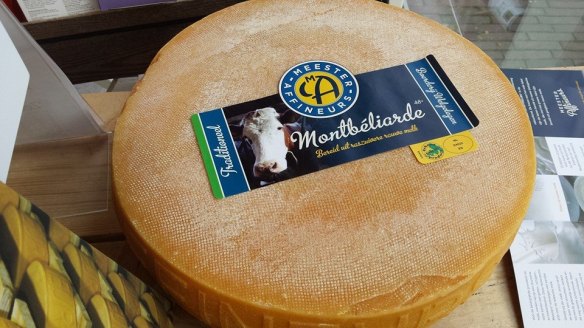
Dairy-products-1024x752 There are many definitions of a sustainable diet. A sustainable diet should not only be sustainable, but also be nutritious and healthy. Furthermore, in order to insure compliance, attainability is also an important aspect.

Sustainability, health and attainability all are very broad, overarching terms. In order to create a better understanding of those terms one should break them down in smaller more concrete determinants. E.g. sustainability can be determined by CO2 footprint, land use, water use, animal welfare, ……
In order to understand the role of dairy in a sustainable diet it is important to understand how dairy does score on the different determinants of sustainability. Furthermore, it is important to understand the influence of the dairy production process (from grass to glass) on the different parameters of sustainability.

Once the position of dairy in the sustainability landscape is defined, it is important to include other elements such as health, nutrition, food availability, habits, affordability etc. By taking all those elements together you can determine the position of dairy in a sustainable diet. Continue reading

M.Sc. thesis: New opportunities and new constraints for Maasai livelihoods

 Part 3: Dispatch on M.Sc. thesis results    

Florian Neubauer has been working on a M.Sc. thesis with RSO titled `New opportunities and new constraints – Understanding changes in land tenure and livelihoods among the pastoral Maasai in southern Kenya´. In his third and last post, he shares some of the thesis` main findings. Florian’s second post can be found here.

Localized coping strategies increasingly gain in importance: Here, cattle which has accessed a fenced area where grass is preserved for stressful times.

Localized coping strategies increasingly gain in importance: Here, cattle which has accessed a fenced area where grass is preserved for stressful times.

Background

Pastoral livelihoods in Africa are characterized by a high reliance on strategic migration and livestock keeping as a source of social and economic wellbeing. However, over the past decades pastoral livelihoods in Sub-Saharan Africa were increasingly exposed to various pressures like a progressing privatization of land. The experiences of the Maasai in southern Kenya provide an illustrative example for livelihood changes due to land privatization. During the 1970s, a transformation from land held in trust to individual ‘group ranches’, as land communally owned and managed, took place in the Maasailand. During the 1980s, title deeds were privatized and group ranches subdivided into smaller, individually owned ranches. Focusing on Maasai households, this research analysed – with specific regards to impacts and implications on food (in)security – how these changes in land tenure shape the livelihoods of Maasai pastoralists in southern Kenya.

Main results – Summary

The research suggests that changes in land tenure – notably,  the privatization of title deeds and the commodification of land – shape Maasai livelihoods and can contribute to increase a household`s food security. It suggests furthermore that Maasai actively adapt their livelihood strategies as a result of these changes and use(d) the new land tenure system to develop new livelihood strategies. However, these new or changed livelihood strategies impact Maasai pastoralism both as a production system and as a socio-cultural way of life.

Continue reading

Thesis Opportunity: Stakeholder analysis for sustainability a in Central Mexico

A new and exciting RSO thesis opportunity: Stakeholder analysis for regional sustainability analysis in urbanizing landscapes in Central Mexico

Introduction

Around Mexico-city, rural landscapes have changed significantly – and continue to do so – due to the growth of the city into these rural landscapes. This so-called peri-urbanization occurs in many places in the world and is accompanied by a specific sustainability challenges regarding water management, the role of agriculture in rural communities and the cultural changes that result from this. This MSc thesis will be part of a study of how peri-urbanization has affected the sustainability of three case study regions or watersheds. Regional assessment of the sustainability of natural resource management is complicated by the large range of stakeholder priorities and perspectives. Obtaining an accurate idea of the existing stakeholder’s priorities with regard to the state of the region’s natural resources, the main challenges and their management, is thus an important first step. This gives a basis for the definition of indicators for the sustainability assessment. However, it does not yet enable giving weights to each indicator. A proposed answer to this challenge is to first distil a list of possible sustainability indicators from semi-structured stakeholder interviews, and subsequently ask those same stakeholders to attach a weight or value to these indicators, using pairwise comparisons. The resulting ranking can then be used as an important input to a regional sustainability assessment. Another challenge, still to be resolved, is how to weigh the perspectives of different actors, perhaps according to each actor’s influence and/or importance.

Objective: To define a list of regional sustainability priorities with quantitative weights attached to them, based on the analysis and integration of stakeholder perspectives.

Activities

  • Stakeholder selection
  • Semi-structured interviewing
  • Survey development and execution
  • Combining qualitative and quantitative approaches
  • Writing and defending an MSc thesis

Requirements

  • MSc student in (rural) sociology or related
  • Fluency in Spanish
  • Willingness to do research in Mexico
  • Financial self-sufficiency
  • 5-6 months for the project
  • Start date January 2015 or late July 2015

Contact details

This MSc thesis will be jointly supervised by Dr. Jessica Duncan (Rural Sociology) and Leendert van Wolfswinkel (Farming Systems Ecology).

The project will contribute to the PhD project of Leendert van Wolfswinkel, who will also be the daily supervisor in Mexico. The PhD project is a collaboration between Farming Systems Ecology (WUR), CIMMYT and the Universidad Autónoma Metropolitana.

For more information contact jessica.duncan@wur.nl with a statement of interest and a CV.