Urban Fish Farming in Lagos

By Marc Wegerif. PhD Candidate, Rural Sociology Group Wageningen University, contact: marc.wegerif@wur.nl.

The Gate CompThe grey concrete buildings and high rusty brown gate we were outside in a suburb of Lagos were not encouraging. Especially as we were looking for a farm, a fish farm, this did not look like any kind of farm. The yard beyond the gate with half finished buildings and concrete with rusty steel reinforcing sticking out was also not inspiring.

BlueTanksCompI was with a group of 12 amazing women farmers from all geographic zones in Nigeria, finalists in the Female Food Hero awards in Nigeria. This was an exposure visit for them as part of their training and build up to the announcement of the female food hero of the year (https://www.facebook.com/ffhnigeria?fref=ts).

FishGoCrazyCompWhen we looked a bit closer, behind an apparently collapsing shed, we saw three blue plastic water tanks. We gravitated to wards them as they were the newest and most functional looking things in the yard. Looking inside the first blue tank we did at least see some fish and a young man appeared from one of the buildings and admitted that he worked there. He was not the most talkative person, but did start to show us around. When he threw some fish food into the murky water it suddenly came to life, hundreds of fish rushing to get to the food, water splashing even outside the tanks.

FeedingFishCompCatFishInHandCompWhen he threw feed into the slimy green water, of what I had thought were empty concrete tanks, these also exploded into catfish filled life. I was at last convinced we were not wasting our time. With a net he pulled some fish out, including a catfish that was probably weighed about 5kgs. There were close to 9,000 fish in the outside tanks. Most of them catfish in the concrete tanks, but one of the plastic tanks had about 1,000 pangasius fish as well.

In an incomplete building in a corner of the yard we were shown breeding tanks and the thousands of juveniles/fingerlings in them. The breeding tanks on the upper floor of the building contained exotic fish for aquariums. These days this fish farm sells only on Saturdays and focuses on selling parent stock as they get a better return, thousands of dollars a week. We did also see a few fish in a smoker, for the fish farmers own consumption.

This urban fish farm is part of a rapid expansion of fish farming and related industries in Nigeria. It was good to see that the fish feed came from a Nigerian company. The government has got ambitious programmes to promote fish farming with an aim to replace the 1.9 million tons of fish imported each year, at a cost of over $700million, with local production (http://www.fmard.gov.ng/news_inside/96 ). The Ministry of Agriculture and Rural Development gave each of the 12 female food hero finalists start-up kits including fish for them to go into or expand their own fish farming.

The yard remained a mess, but the fish production did impress, and fish farming at quite large scale in small urban spaces clearly has potential that I had never realised before. We got back on our bus and into the Lagos traffic. Along the way we saw women selling smoked fish from buckets on their heads and we also had cat fish as part of our dinner.

Take Back the Economy 3: Who profits? Taking back business

Inspired by the presentation of Katharine Gibson on Wednesday September 4 and her latest book book ‘Take Back the Economy: an ethical guide for transforming our communities’ (http://takebackeconomy.net/) Michelle Steggerda started her weblog on which she will post her reading of the book and her effort to take back the economy.

michellesteggerda's avatarThe social side of capital

Have you heard of Airbnb already? Which started as a small initiative in San Francisco in 2008 developed into one of the biggest shared economy platforms, now compromising 800,000 listings in 34,000 cities. Airbnb is a worldwide network in which people (hosts) rent out (part of) their house to tourists on an irregular basis. Tourist pay less than for the average hotel in the same city and can enjoy a much more personal environment. Hosts who rent out part of their house earn money in return. Trust is gained through a reviewing and verification system. The organization Airbnb gets a commission on every transaction and it so able to get a business model out of it. Everybody is happy, except for the hotel industry. Hotels increasingly experience the Airbnb business as unfair competition as hosts don’t pay taxes and don’t have to comply with the strict legislations. By now the…

View original post 640 more words

Pioniersnetwerk zorglandbouw

Esther Veen's avataronderzoekerstadslandbouw

Eén van de projecten waarbij ik betrokken ben is het project ‘zorglandbouw’. Hierin werken we aan strategieën om in te spelen op veranderingen in de financiering van de zorg, die voor 1 januari gepland staan. Binnen dit project ben ik verantwoordelijk voor het pioniersnetwerk zorglandbouw. Dit pioniersnetwerk bestaat uit ongeveer vijftien pioniers in de zorglandbouw die zich richten op verschillende doelgroepen (ouderen, jongeren, gehandicapten) en diensten (onderwijs, behandeling, kleinschalig wonen).

Pioniers worden vaak gevraagd mee te denken, advies te geven of hun ervaringen te vertellen, omdat ze voorop lopen en visie hebben. De vraag is echter bij wij zij zelf terecht kunnen. Daarom hebben we het netwerk opgericht; tijdens de netwerkbijeenkomsten kunnen pioniers onderling informatie delen en elkaar adviseren. Bovendien nodigen we partijen van buiten uit, die vanuit een andere hoek inspiratie en kennis kunnen brengen. Het netwerk is dit jaar twee keer bijeen geweest en de deelnemers waren enthousiast. De laatste bijeenkomst, vorige week, ging over samenwerking. Er was…

View original post 71 more words

Invitation to learn about Fast Food in Ghana’s Restaurants (November 20th at 11:00)

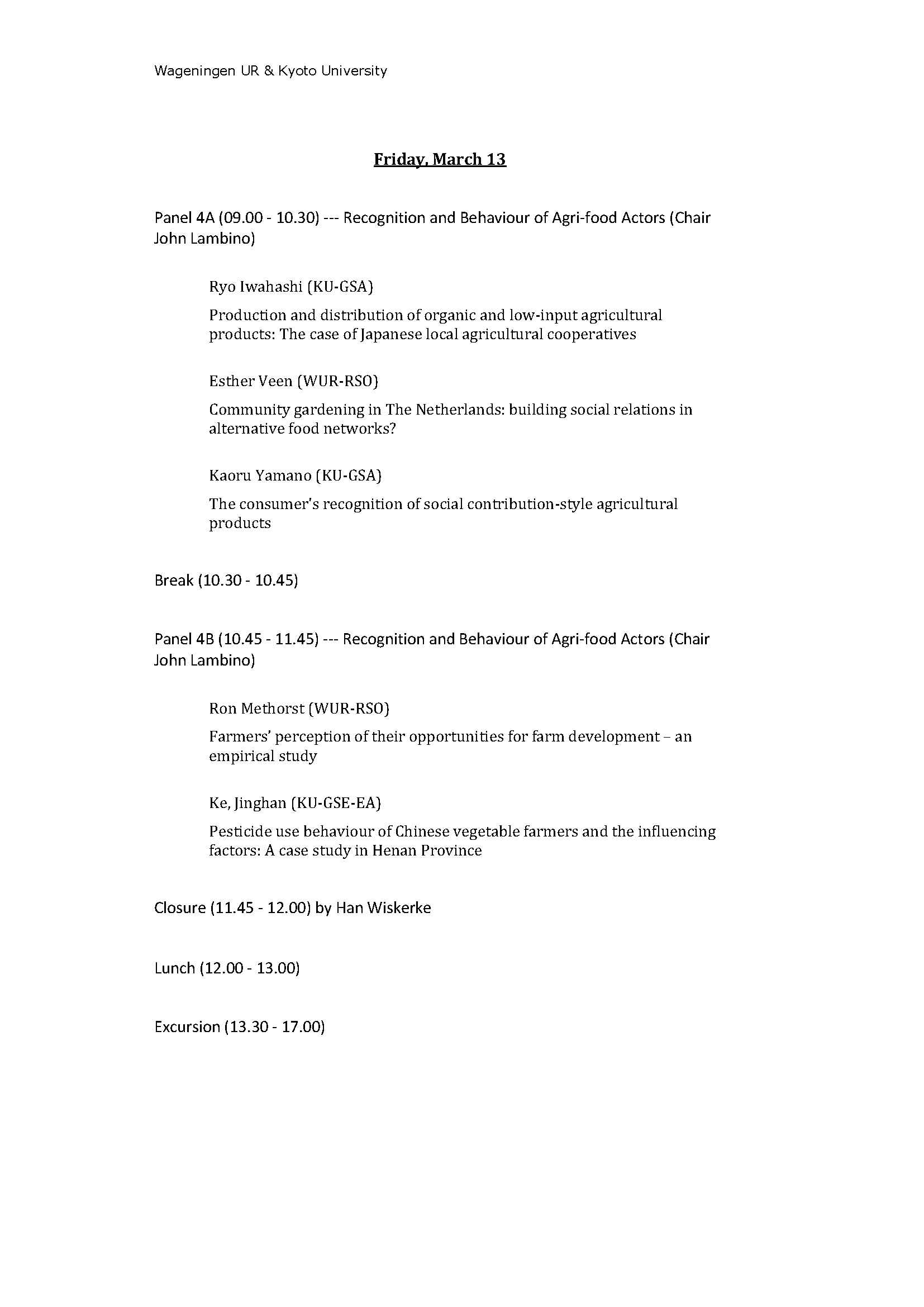
On Thursday, November 20, 2014 at 11:00 am in the Aula (General Foulkesweg 1a, Wageningen), Rose Omari will defend her PhD thesis titled: Fast Food in Ghana’s Restaurants: Prevalence, Characteristics, and Relevance, an interdisciplinary perspective. 

The defence will include a public presentation which will explain why it is impossible to achieve an universal definition of fast food because of its continuous re-contextualization in time and space. The thesis also addresses questions related to health, technology and the environment, and reflects on these questions in the context of developing countries.

Everyone is welcome. 

The proceedings will also be streamed online at this site: https://wurtv.wur.nl/P2G/cataloguepage.aspx

Stappenplan buurtmoestuinen II

Esther Veen's avataronderzoekerstadslandbouw

Vandaag een korte update van een eerder bericht, om onze nieuwe brochure ‘Buurtmoestuin? Zo gedaan!’ te promoten. Deze brochure is voortgekomen uit een Wetenschapswinkelproject voor de Kenniskring Buurtmoestuinen Almere. In dat project beantwoorden we als projectleiders twee vragen: 1) Hoe start je een buurtmoestuin? en 2) Wat zijn de faal- en succesfactoren van het instrument kenniskring ?

Bij het beantwoorden van de eerste vraag zijn we flink geholpen door een groep studenten, die een erg mooi stappenplan hebben gemaakt. Dit stappenplan was het uitgangspunt voor de 2.0 versie, die dus nu beschikbaar is. Download hem hier.

IMG_20141112_120600

View original post