Feeding the city or nourishing the city?

More than half of the world’s population is living in cities. It are especially the larger cities that are increasing in size and many of these ever expanding cities are located in regions that are most suitable for food production. The tension between a growing urban population and a decline in agricultural land is increasingly acknowledged. Also the former Dutch Minister of Agriculture, Cees Veerman, states that the growing urban demand for food requires a fundamental shift in food production systems: fresh food should be produced closer to cities. He holds a strong plea for setting up a large Metropolitan Agriculture pilot project (see also this video interview). At first sight, the idea of producing food close to where people live sounds appealing as it will reduce food miles significantly.

But at second sight, his plea for metropolitan agriculture is to a large extent nothing but a plea for an ongoing industrialization of food production as this metropolitan agriculture video shows. Veerman also states that small-scale initiatives like urban agriculture cannot fulfil the growing urban food demand. Although this may be true, I do believe that innovative forms of urban agriculture such as SPIN farming, small-scale hydroponics and rooftop gardening can provide a significant part of the food needed for the urban population.

Most important, however, is that urban agriculture is about nourishing the city, while Veerman’s metropolitan agriculture is limited to feeding the city or actually, to phrase Michael Pollan, to produce foodstuffs (i.e. the highly processed, modified, fructosed, hormoned, and antibioticized products that we eat) for the urban population. With nourishing the city, I refer to the fact that food is more than a vehicle for nutrients, vitamins, calories, proteins, etc…; it is also a means to contribute to the development of  sustainable and healthy cities: 

Urban agriculture has the potential to make a significant contribution to the solution of many current urban problems that fall within the rubric of healthy communities and sustainable development. These include:

  • environmental degradation and ecological restoration
  • resource consumption
  • health and nutrition issues
  • food security and access for lower income citizens
  • ecological education
  • local economic development and diversification
  • community building

All these can be influenced in a profound way by the activity of food production in urban spaces.  Add to that the increased freshness of locally produced food, lower transportation costs, dietary diversification, and responsiveness to local needs and the advantages of producing at least some of our food in cities becomes obvious. This is what makes the prospect of a city full of food gardens and overflowing with the bounty from urban greenhouses so exciting” (http://www.omegagarden.com/index.php?content_id=1509).

One aspect that is missing in the quote above is that urban agriculture is, unlike the form of agriculture now proposed under the label of metropolitan agriculture, a form of food production that centres around notions of food democracy and food sovereignty (see also Petra’s recent blog).

Although Cees Veerman may be right by concluding that urban agriculture is not capable of feeding the urban population, I do think that urban agriculture has the potential of producing a significant part of the food needed by urban dwellers, and, more important, urban agriculture does much more than just producing food (see e.g. urban farmer Will Allen). So if we take the different contemporary problems of many metropoles into account, I would argue that we are much better of with metropolitan food systems that do not simply feed the city but that actually nourish the city.

Allium Sativum L.

The corn grain elevator of Minburn

The grain elevator, a corn symbol in every town

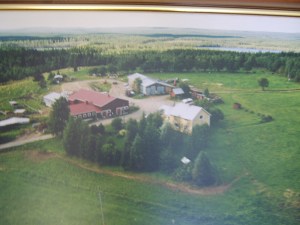
I drove to Minburn yesterday where I spent a great day at the Small Potatoes Farm. I past the road to the farm without noticing and stopped at the post office, next to the grain elevator, to ask for directions. A good choice because the post office, I soon realized is the epic center of this tiny town. So a few minutes before my arrival, the news was announced by the post office, calling to the farm that a tall Dutch lady was coming over.

We harvested more than 5 different varieties of garlic. If it would have been not such wet weather so far, the harvest would have been in already around the 4th of July. And even now, the land was quite wet, which meant that the garlic bulbs came out with big lumps of soft black earth hanging in their roots. We pulled, collected, cleaned and trimmed the garlic bulbs after which they were let to dry hanging in the barn, in bundles of eight. Each variety had its own place in order not to mix them up, and we indicated what we hung on a map. Of some varieties we only harvested a basket full, just to grow more seed.

STA72112

The Small Potatoes Farm grows an incredible amount of different vegetables and different varieties. These include different kinds of: squash, melon, potato, eggplant, peppers, tomatoes, lettuces, unions, leek, cabbage, beets, kale, beans, strawberries, asparagus and herbs. The total amount of hectares available for production is around 4.5, however at any point in time, there is 1.5 hectares in production while the other acres have a cover crop such as buckwheat to increase soil quality and organic mass. STA72126

When you see the rows of different crops weaving in the wind, you wouldn’t think there is much mathematics involved. However, the production planning system is a complicated multi dimensional puzzle. While rotating land out and into production and rotating the right kind of crops after one another to minimize disease, there also has to be a certain kind of yield available every week throughout the season to give the CSA members their vegetable share. And, of course, this share demands a certain kind of diversity too. A puzzle for winter times,  when a thick pack of snow is covering the land.

Buying fresh local organic sustainable and just food….

Corn! The first harvest of sweet corn at the farmers market in Des Moines

While I am staying in Ames, I am enjoying the fresh fruits and vegetables of the Community Supported Agriculture (CSA) farm in which the Flora’s have a share. All throughout the growing season, the weekly share can be picked up at the church, organized by the Farm to Folk Collaborative, which serves as an intermediary organization in order to connect the local producers and consumers. Different CSA farmers and other local producers offering ‘a la carte’, deliver each Tuesday after which the Farm to Folk people take care of assembly and payment handling.

Now I know my way around, I picked up their share at the church this week. It is a share of the Small Potatoes Farm, based in Minburn, southwest of Ames. I had onions, kohlrabi, carrots, squash, potatoes and kale. All the certified organic produce of the Small Potatoes Farm finds its way to the customer through CSA shares. The nature of the CSA model, based on a direct and trusting link between producer and consumer is the closest you can get to an unambiguous ‘honest’ product. It is both organic ánd local. But in the market place both ‘organic’ and ‘local’ can obscure different meanings and practices.

Organic can be produced in an industrial way within the limits of the label. Much of the organic produce in supermarkets is coming from industrial-size farms or companies with farms, which often have an organic line next to conventional production; organic is just another market. The local, at the other hand, has no regulation as to what sustainability standards should be applied. Local produce can come from small scale, but conventional farms, can include the use of pesticides and herbicides for example.

Des Moines Farmers Market

Des Moines Farmers Market

Since organic production has become an industry too, the ‘local’ is often elevated above the organic because the local – by its very nature – cannot be incorporated easily into the centrifuging forces of global commerce. Buying local is an act of opposing corporate food chain powers by going back to a less asymmetrical peer-to-peer relationship between buyer and seller.

A popular platform for these relationships is the farmers market. There are 18 farmers markets in Greater Des Moines (the city and the surrounding counties including Story County in which Ames is located). Saturday, together with Rick, Stacy and Tillie from the Small Potatoes Farm, their worker Brian and his friend, we visited the Des Moines farmers market, one of the biggest in the country. It is huge. Over 200 stands with a variety of products, from vegetables to ‘Dutch letters’ (??), a peculiar S-formed pastry letter, from clothes, to ‘Frisian Gouda’ cheese and from bread to garden equipment.

The beets are 'pesticide free'

The beets are 'chemical free'

Vegetables are promoted as ‘fresh’, ‘without pesticides’ or ‘local’. But that does not necessarily apply to all vegetables at one particular stand. I bought some tomatoes, thinking that I bought local produce. I found out later that it will take a few weeks more before tomatoes can be harvested in Iowa. I have no idea where my tomatoes came from. Being a conscious consumer is hard work.

Knee-high by the 4th of July

Independence Day, the 4th of July is of course an important day in the US. And it therefore serves as a marker in time, if the corn is knee-high by the fourth of July, you can be happy. STA72046Well, here in Ames, one can be satisfied. The corn is more like shoulder-high already. Maybe this is caused by the “black gold of Iowa.”

A series of glacial events (Quaternary) delivered an extremely black and fertile soil throughout the middle of the state Iowa. Soil like this can deliver an abundance of fresh and varied produce. But driving through Iowa this weekend on my way to Mount Rushmore in South Dakota, I actually drove through a food desert. The corn, grown at each side of the road, cannot be eaten.

 The various F1 hybrids which are grown here are not essentially vegetables but an industrial raw material. During the eighties, the integrated farm made way for the integrated agro-industry. The nutrient cycle at farm level broke once the diversified farm specialized into different and geographically separated monoculture operations. The nurturing cycle in which there was no such thing as ‘waste’ was replaced by a system producing at least three new categories of dangerous waste.

1. Nitrogen in (drinking) water from artificial fertilizers. Hybrid corn consumes more oil – that is, fertilizer – than any other crop. And since it is corn after corn each year, more fertilizer is needed to keep production figures high. Much of it ends up in the rivers. Rivers which provide drinking water. Iowa has the largest nitrogen filter in the world in their Des Moines River water treatment facility. They take out so much nitrogen for which they do not have a storage place that they dump some of it into the river again downstream.
2. Antibiotic residue’s in (drinking) water. Over half of all corn grown in the mid west goes into animal feed. Much of it goes to the cattle in the feedlots or to hog CFO’s. After half a year of grazing, the beef cattle are confined for over half a year more in feedlots to be fed nothing but corn. In this last phase, they are fast fed into steaks and burgers, but there is no need to say that the cow’s stomach is not made for an exclusively low structure energy rich diet (despite the difference in stomachs, much like humans). Moreover, the amount of animals per square meter standing in their own dirt is just the kind of environment for whatever disease to arise. Their feed contains therefore a standard amount of preventative antibiotics which pollute the animals as well as the environment; not least the water. Ultimately a danger to all of us creating resistances and superbugs.
3. Toxic manure. The large concentration of animals in a feedlot produce a large and concentrated amount of manure, stored in pits, tanks or open air lagoons. Manure leeks from these types of storages into the ground water, or as emissions in the air. And the level of concentration of the manure is often so high that it is useless as fertilizer. Existing feedlots are often exempted from many water and air regulations.

Fighting from inside capitalism

Last week I joined Jan Flora to a meeting in Des Moines called the “Midwest Meat Roundtable”. It was organized by the Interfaith Center on Corporate Responsibility (ICCR). ICCR is a nationwide consortium of faith based intentional investors, such as the Adrian Dominican Sisters from Michigan or the United Methodist Church in Illinois.

The meeting brought together a very wide range of civil society organizations, faith based as well as non-faith based. All are concerned with one or another damaging aspect of the agro-industry. Here I was in a room with people whose life task is the “fight against factory farms”. A fight of David against Goliath. “I have been in the fight for 20 years” is how some would introduce themselves. Or, “I fought Tyson for years, we took them to court, but two anonymous jury decisions were stolen from us.”

The government was not present. It seems again, that the public sector is not regarded as an ally in these issues. The effect of the Bush Administration has been devastating, remarked one of the participants. Less and less regulation, and an ever stronger intertwining of corporate and political interests through for example campaign financing. “Industrial Ag has split and damaged our communities”. And families; one of the participants told how the intended establishment of a CFO by one family member had ruined family relationships for years. “People live alongside each other in small communities and go to church together.” To cope, “they tend not to talk about it.”

A CFO is short for Confined Feeding Operation. There are other terms as well like Concentrated Animal Feeding Operation, which essentially mean the same. For example, Indiana government defines a CFO as:

“as any animal feeding operation engaged in the confined feeding of at least 300 cattle, or 600 swine or sheep, or 30,000 fowl, such as chickens, turkeys or other poultry.”

However, usually CFO’s contain far more animals than the minimal used for this definition. I have seen feedlots on our way to Denver which contained thousands of cattle, much like this image.

The problems with Industrial Ag are multiple, social as well as environmental and can fill many blogs. What was unique to this meeting was presence of organizations who work towards change from the inside, from their position as shareholder in for example the large meat processing companies. This means that inside and outside tactics can be combined to reach more effect. The inside – shareholder – tactic can be used if one has some minimum amount of shares held over a certain period. Intentional investors then go to file a resolution, which has to be done usually 6 months before a shareholder meeting.

Resolutions are around 500 words requests asking two things: show us data on e.g. air emissions, and, please adopt our proposed change/principles. The company then, has three options. They can do nothing, so that the resolution will be on the ballot at the shareholders meeting. Second, they can challenge it before a committee (SCC) and plea for their interest by saying that it is ordinary business or that they already implemented some. And thirdly, they can start negotiations to see how they can get the filer of the resolution to withdraw it.


It is a sensitive game. The intentional investor wants to end up at the negotiation table for dialogue, preferably even before filing a resolution. Usually, companies don’t like resolutions to be flagged up, and they will try to prevent them from being on the ballot. If they appear on the ballot anyway, and a resolution receives more than 10% of the shareholders votes, this means a victory for the intentional investor because there is a big chance that the issue will get more attention the next year. As you can tell, it is a slow and tedious process. And, it can only be done with those corporate businesses which are not privately held – like one of the biggest; Tyson, where the family will always vote as a block.