75th Anniversary: 4) Some thoughts on the overhead projector

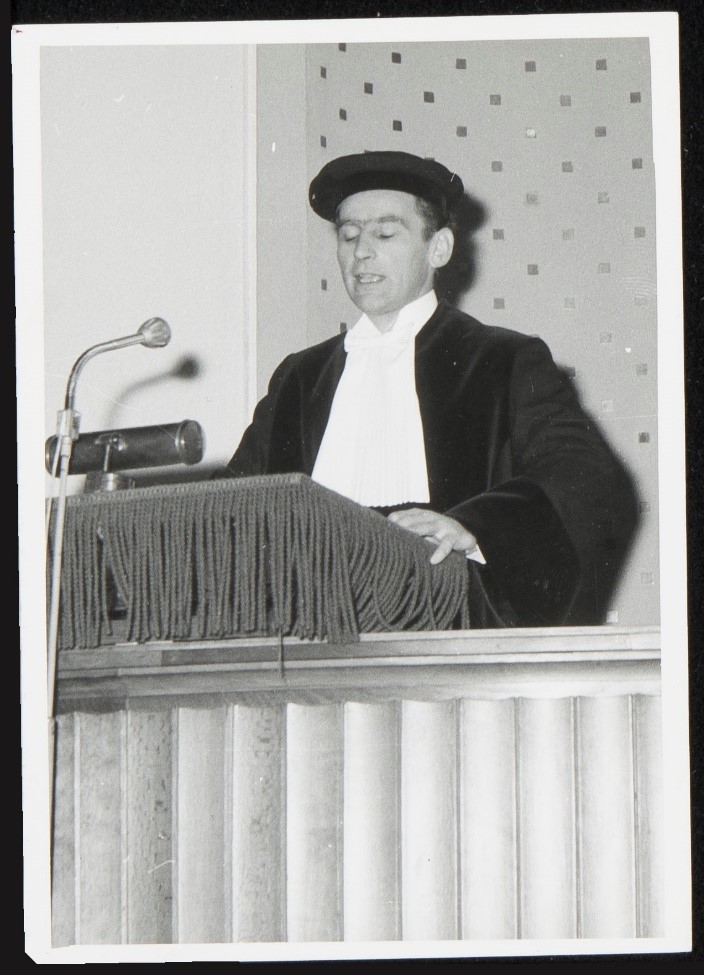
This is a picture of Professor Hofstee. It is clearly an old picture: it is black and white (no filter!), and the clothing looks rather outdated and overly formal. But what also stands out is the phone. I wonder whether he was really making a phone call here, or whether this was staged for the picture. In any case, this bakelite phone (‘bakeliet’, have you ever used the word for something else than a phone?) made me wonder how technology has changed over the last 75 years. How differently we must be writing, teaching, researching, reading, searching for literature than the generations before us! Many of us will have cursed our computers or have been annoyed with having to use yet another digital tool, but for sure technology has made our lives easier in several ways. I can’t imagine having to do my work without email, or having had to type or even handwrite (!) my PhD thesis. Continue reading

Foodscapes in times of uncertainty – blog 1

Members of the foodscapes cluster supervise a number of students who are looking at changing food(scapes) in times of corona. We therefore introduce a blog series in which these students can share their work. This first blog is written by Lisa Marijke van den Berg.

How COVID-19 changed consumers’ motivations for local consumption

Since the declaration of the COVID-19 pandemic by the World Health Organisation in March (WHO, 2020) countries around the world had several ways to cope with the disease. Despite negative influences of COVID-19 on daily life, some sectors benefit from the pandemic. One of these sectors is the Alternative Food Network (AFN) sector, as you might have seen in the media the past months. AFNs aim to counteract the environmental, social, and economic conflicts that results from the dominant food system (Renting et al., 2003). They aim for local consumption and are characterized by a close producer-consumer interaction (Zoll et al., 2017).

AFNs are an alternative to the global, ‘common’, food system: the majority of the population does not participate in AFNs. However, as said, during the corona crisis the Dutch national interest in AFNs increased (Kamsma, 2020; Smit, 2020). Local initiatives throughout the Netherlands, like ‘Rechtstreex’, ‘Support your locals’, ‘Streekboer’ and ‘Bioweb’ argued that their number of orders more than doubled when compared to the days before the corona crisis (Smit, 2020). Furthermore, chain shortening initiatives received attention in several talk shows and in the news. For example, an episode of Jinek discussed the initiative “Support Your Locals” (Jinek, Baarsma & Levie, 2020), which promotes the idea that consumers should support local farmers during the corona crisis.

In my thesis I studied the motivations of consumers to start participating in an AFN during the COVID-19 pandemic, to better understand the mechanisms behind this increased interest. I interviewed AFN participants who started their participation during the pandemic, and compared their motivations to those of consumers who participated in AFNs already before COVID-19 hit, as found in the literature. The comparison showed that motivations for AFN participation during the COVID-19 pandemic mostly emphasise factors close to home: new AFN participants wanted to support local farmers or to treat themselves, but they did not mention structural societal reformation as a reason to participate. In other words, their motivations were focused on their local area. Reasons for AFN participation as found in the literature – from people who started participating in AFNs before COVID – were to a higher extend focused on a global level. For instance, these people often mentioned environmental concerns. Those concerns were not identified in the interviews with new consumers. Also freshness as a driver for participation before the pandemic had moved to the background. This was replaced by the importance of healthy and safe food to increase personal and family health.

The interviews showed that there is a demand for better availability and accessibility of information about local food purchasing. Several participants mentioned that they did not know that certain types of food were grown locally too. The awareness raised in the media to support farmers encouraged them to take a first step into local grocery shopping. The media showed consumers what they could do to support farmers and where to get specific produce. Hence, while AFN participation is often marketed as a sustainable alternative to the supermarket, this thesis reveals that this is not necessarily the most influential attraction for new consumers to participate in an AFN, especially during a pandemic. These new insights enable better responses to the needs of consumers.

References

Jinek, E., Baarsma, B., & Levie, S. (Presenter, Economist & Guest Speaker). (2020, 19th March). Aflevering 55 [Talkshow]. E. Van der Horst (Producer). Jinek, Amsterdam, Netherlands: RTL Group.

Kamsma, M. (2020a, 30 maart). Terug naar de boer, ook na corona. NRC. Retrieved on 5 April, from https://www.nrc.nl

Renting, H., Marsden, T. K., & Banks, J. (2003). Understanding alternative food networks: Exploring the role of short food supply chains in rural development. Environment and Planning A, 35, 393–411.

Smit, P. H. (2020, 6 april). Nu zien we wel kans om boeren in de buurt op te zoeken. De Volkskrant. Retrieved on 6 April, from https://www.volkskrant.nl

World Health Organization: WHO. (2020, 10 January). Coronavirus. Retrieved on 5 April 2020, from https://www.who.int/health-topics/coronavirus#tab=tab_1

Zoll, F., Specht, K., Opitz, I., Siebert, R., Piorr, A., & Zasada, I. (2017). Individual choice or collective action? Exploring consumer motives for participating in alternative food networks. International Journal of Consumer Studies, 42(1), 101–110. https://doi.org/10.1111/ijcs.12405

75th Anniversary: 3) In the beginning there was E.W. Hofstee or the birth of Rural Sociology in Wageningen

Photo: E.W. Hofstee on the shoulders of the sociologists Ad Nooij and Rien Munters at the occasion of the 25th anniversary

The history of rural sociology in Wageningen goes back to the appointment of Evert Willem (E.W.) Hofstee as professor in economic geography. His appointment by Royal Decree took place on May 9, 1946. He started to work at the university on September 15, 1946, though his formal employment did not start until October 1, 1946. Hofstee gave his inaugural lecture “On the causes of diversity in agricultural regions in the Netherlands” on October 30, 1946.

The appointment of E.W. Hofstee not only marked the beginning of  rural sociology in Wageningen, his work also laid the foundations for the social sciences department at this university. Moreover, Hofstee played an important role in the development of rural sociology in Europe. He was the co-founder and first president of the ‘European Society for Rural Sociology’ (1957) and co-founder of the journal ‘Sociologia Ruralis’ (1960). Continue reading

75th Anniversary: 2) In den beginne was er E.W. Hofstee – het ontstaan van Rurale Sociologie in Wageningen

De geschiedenis van rurale sociologie in Wageningen gaat terug tot de benoeming tot hoogleraar van Evert Willem (E.W.) Hofstee per Koninklijk Besluit van 9 mei 1946. Volgens eigen zeggen begon hij zijn werkzaamheden op 15 september 1946, maar zijn formele indiensttreding was op 1 oktober 1946 en het einde van die maand, op 30 oktober 1946, hield Hofstee zijn inaugurele rede met de titel “Over de oorzaken van de verscheidenheid in de Nederlandsche landbouwgebieden”. Hofstee kan met recht beschouwd worden als de grondlegger van de rurale sociologie in Wageningen, maar misschien ook wel van het departement maatschappijwetenschappen aan deze universiteit. Ook speelde Hofstee een sleutelrol in rurale sociologie in Europa. Hofstee was medeoprichter en eerste president van de European Society for Rural Sociology (1957) en medeoprichter van het tijdschrift Sociologia Ruralis (1960).

Continue reading

Grow, share or buy? PhD-thesis by Lucie Sovová

October 13 2020, at 13.30 am (CET) Lucie Sovová will defend her PhD-thesis ‘Grow, share of buy? Understanding the diverse food economies of urban gardeners‘. See the abstract below. After the defence the full thesis can be downloaded from WUR Library here. The ceremony will be live-streamed – click here – but is recorded and can be viewed later as well. Lucie Sovová is affiliated as PhD-candidate at the Rural Sociology Group of Wageningen University. 

Abstract
How do urban gardens work as sources of food? That is, in a nutshell, the central question of this thesis. Urban gardening and other food alternatives have received growing attention in relation to issues such as food quality and the environmental impacts of food production. However, we know little about how urban gardens actually provide food. In order to answer this question, I conducted an in-depth study of 27 gardening households in Brno, Czechia, exploring the long and lively tradition of gardening in Central and Eastern Europe. I investigated how much food gardeners produce in their plots, how they think of this practice and how it relates to other ways of obtaining food such as shopping. The results reveal that several practices facilitate food self-provisioning, such as food sharing or preserve making. I conclude that urban gardens play a central role in gardeners’ food supply, influencing eating as well as shopping habits in all four seasons.