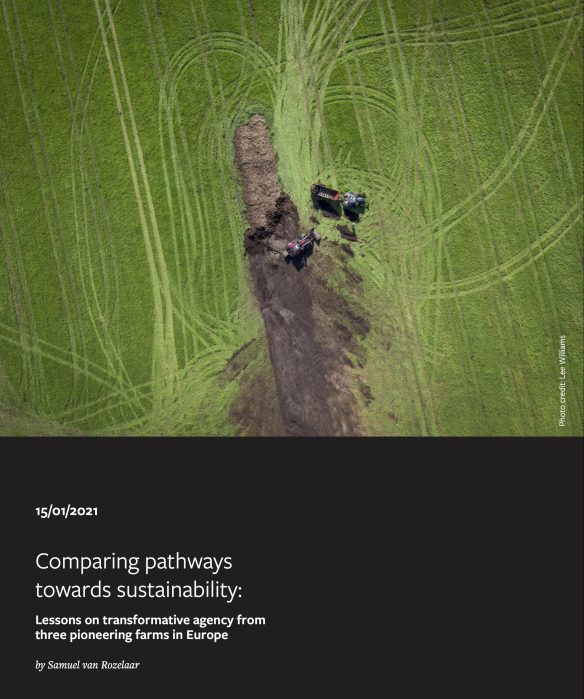
Samuel van Rozelaar is a Master student Organic Agriculture has recently completed an excellent and beautifully illustrated MSc-thesis on the transformative agency of three pioneering farmers, all members of the lighthouse farms network, and meticulously reconstructed their transition pathways towards sustainable farming systems. ‘Comparing pathways towards sustainability: Lessons on transformative agency from three pioneering farms in Europe‘ can be downloaded (click on hyperlink). Below the abstract.
Abstract
This thesis offers lessons on the transformative agency of the farmers behind three pioneering farms. This is done by comparing the transformative strategies they applied in relation to the three-fold embedding of their farms, throughout their pathways towards more sustainable farming systems. To reconstruct these pathways semi-structured interviews and pathway mapping exercises were conducted with the main actors on each farm. This data was then coded, categorized and grouped in dimensions that allowed for a comparison of the interplay between strategies and embedding. The resulting 8 lessons show that these farmers persevered in developing, adapting, and moving towards their dreams and visions, despite many critical moments, by applying a range of transformative strategies. Through these strategies they managed to transform their farms in terms of its practices and relations. Throughout this process of transformation, the farmers continuously moved through a learning process, and as such also personally transformed in terms of thinking and doing, which in turn further enhanced their transformative capacities and strategies. Finally, the lessons show that these farmers have managed to create and navigate complex sustainable farming systems by tapping into the knowledge, skills, and resources of others. This shows the significance of the co-creation of contextual knowledge and the capacities to apply it in the transformation towards sustainable food systems. For future research, it is recommended to test to what extent these lessons resonate with other pioneering farms, but also with conventional farms. In addition, it is worth comparing family farms with non-family farms in their transformations towards sustainable farming systems, with a focus on intergenerational differences. In doing so, the frameworks of resilience of social-ecological systems and the adaptive cycle of transformations could be highly useful. Lastly, future research into transformations should also include the role of the relations to non-humans.