
Multifunctional farming (an umbrella term to indicate a combination of agriculture and services to society, wur.nl) has been a research subject for the Rural Sociology Group for decades, as multifunctionality is one of the diversification strategies employed by farming to sustain their farms and connect with various groups in society such as consumers or tourists. The first multifunctional activities were nature conservation, agritourism/recreation, care farming, farm shops/short chains, farm education and agricultural day care. These activities, however, are subject to constant change. This leads to new research topics and new collaborations for the Rural Sociology Group. Continue reading
Thesis ‘Ervaringen op de Biologische moestuin’
Het Leger des Heils heeft de wetenschapswinkel van Wageningen UR gevraagd onderzoek te doen naar verschillende aspecten van haar biologische moestuin in Amsterdam Noord, één van haar vier werkbedrijven.
Deelnemers die op de tuin komen vormen een kwetsbare groep: zij worstelen veelal met complexe problemen, op diverse levensgebieden. Hoewel hun begeleiders aangeven dat de tuin voor veel van hen een fijne plek is om te zijn en te werken, kent de tuin ook een aantal moeilijkheden. Eén daarvan is dat niet alle plekken op de tuin bezet zijn: niet alle woonbegeleiders van het Leger des Heils lijken de weg naar de tuin te kunnen vinden voor hun cliënten.
Eén van de doelstellingen van het project is daarom inzicht te geven in wat de tuin betekent voor deelnemers, en wat redenen zijn om juist niet (meer) op de tuin te willen werken. Daarom bieden wij een thesismogelijkheid met de volgende onderzoeksvraag aan:
Wat zijn de ervaringen van deelnemers en oud-deelnemers met de biologische moestuin van het Leger des Heils in Amsterdam-Noord? Wat zijn redenen van niet-deelnemers om niet op de tuin te willen werken?
Mogelijke onderzoeksmethoden: literatuurstudie over mogelijke effecten van het werken in een groene omgeving op de (mentale) gezondheid, en interviews met deelnemers en niet-deelnemers.
Zie voor meer informatie over het project: https://www.wur.nl/nl/Onderwijs-Opleidingen/wetenschapswinkel/Projecten/Show/Groene-begeleiding-Leger-des-Heils-de-biologische-moestuin.htm
Geïnteresseerd? Mail esther.veen@wur.nl
Thesis (or internship) opportunity – Urban Agriculture: developing a typology within a European Context
MSc-Thesis/internship opportunity
Duration: 6 months
Language: English
Start Date: As soon as possible
The European Forum for a Comprehensive Vision on Urban Agriculture (EFUA) has the objective to unlock Urban Agriculture’s potential by achieving better knowledge, better deployment, and better policies in this field. The Chair groups Rural Sociology and Health and Society and Wageningen Plant Research are managing a work package that aims to update knowledge on the types and benefits of Urban Agriculture (e.g. social cohesion, local food provision, health, biodiversity, business generation). We are looking for students who have an interest to collaborate in this European Forum to identify stakeholders, and develop a typology of urban agriculture. Your work will be the starting point for understanding the benefits of Urban Agriculture. The research also supports a European agenda on urban agriculture, co-designed within EFUA.
Contact information: Esther Veen (esther.veen@wur.nl), Lenneke Vaandrager and Jan Eelco Jansma
75th Anniversary: 16) Meaningful Diversity: Origins of the Farming Style Concept
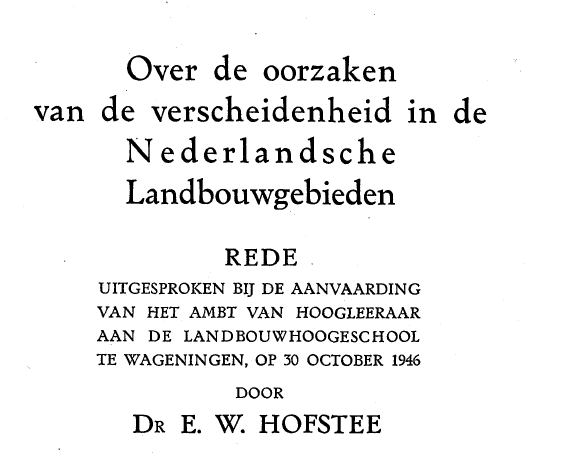
Part of the front cover of Hofstee’s inaugural lecture “On the causes of diversity in agricultural areas in the Netherlands” (1946)
E.W. Hofstee’s interest in the concrete, the lived, and the particular marked his inclination towards an “inductive” research methodology. He combined in-depth descriptions of social groups with a comparative approach (Hofstee 1938: 7-8). This grounded theoretical approach yielded the concept of farming styles in agricultural production. A farming style can be defined as shared normative and strategic ideas about how farming should be done (see also Blog 10). Hofstee’s concept of farming style implied an important analytical inversion: one should not try to understand the practice of farming from the structural conditions to which the farmers responds but rather move to the center of our analysis the agency of farmers as creative actors. Hofstee thought that rural sociology should emancipate itself from structuralist and functionalist “adjustment sociology,” as the understanding of rural life in terms of an adaptation to “order” was not only narrow and incomplete but also wrong: it erased the agency of people in the creation of the world they inhabit (see also Blog 14). Continue reading
Online Thesis Market 2021
Rural Sociology, Sociology of Development & Change and Health & Society
February 8 & 9 (16:00-17:00)
Live online presentations about research projects and thesis topics & Online bar to meet and talk to potential supervisors
Join us! You can add yourself @ Teams by using this link.
Make sure to use your WUR email account. Your Teams request will be accepted some days before the market takes place (you’ll receive a notification about this).
The MS Teams page will be open all week from 8-12 February. There will be lots of information available about current research projects, thesis topics, potential supervisors, thesis vacancies and more.


