Learning about the role of agriculture and natural resources in sustainable rural development – student’s reflection (4)

Together with four students of Wageningen University, I spend two weeks in Kaunas, Lithuania to represent Wageningen University, and the Rural Sociology Group, at this years’ ‘Intensive Programme’ on rural development. This post is the last one in a series of posts in which the participating students reflect on the programme and share their experiences.

By Camilo Carrillo Wilisch (Erasmus student Master Environmental Sciences, Wageningen University):

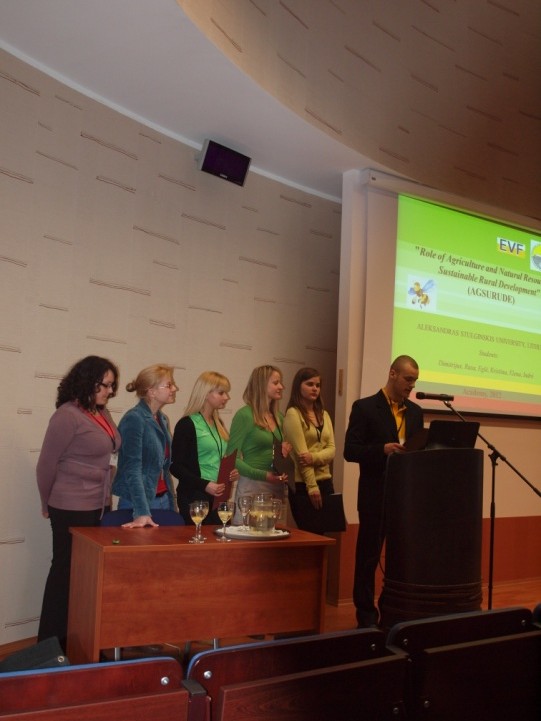
From the 15th to the 28th of April I participated in the IP “Role of agriculture and natural resources in sustainable rural development” in Kaunas, Lithuania. The preparation for this IP started some weeks on forehand. Together with the other students, we discussed about the expectations and motivation for participating in the course. In my case, I visited Lithuania few years ago and I liked the country and it’s people a lot, the IP represented a wonderful opportunity to visit and learn more about Lithuania. In addition I’m a Erasmus-Student from Berlin and I study environmental technology. In Wageningen I followed courses of the BSc Minor Sustainable agriculture and consumption. My appetite for new experiences and knowledge and my interests on the links between rural and urban areas, multifunctional agriculture and sustainable food production and consumption were the main reasons why I wanted to participate in the IP. I did expect to get an overview about the agribusiness sector, it’s relation with rural development, and the natural resource management in Lithuania. With my expectations and my small luggage I traveled to Lithuania in company of the other students.
Continue reading

Learning about the role of agriculture and natural resources in sustainable rural development – student’s reflection (3)

Together with four students of Wageningen University, I spend two weeks in Kaunas, Lithuania to represent Wageningen University, and the Rural Sociology Group, at this years’ ‘Intensive Programme’ on rural development. In a series of posts, the participating students reflect on the programme and share their experiences.

By Tikva Kooima (student Regional Development and Innovation at Van Hall Larenstein University of Applied Sciences (part of Wageningen UR):

In April, we went with a group of five people of Wageningen University to Lithuania to participate in an intensive international conference about rural development, hosted by the Aleksandro Stulginskio University of Kaunas. Without knowing the details, I went quite open-minded to this conference, and filled with lots of ideas, experiences and impressions, I went home.

The first days

The first two days  were filled with lectures which were more or less associated with rural development in Lithuania. It was exciting to follow classes with about 50 international students from all over Europe with totally different backgrounds. In the evening we were introduced to the countries. The different countries presented themselves with a presentation followed by delicious national food specialties.

The trip

Continue reading

Learning about the role of agriculture and natural resources in sustainable rural development – student’s reflection (2)

Together with four students of Wageningen University, I spend two weeks in Kaunas, Lithuania to represent Wageningen University, and the Rural Sociology Group, at this years’ ‘Intensive Programme’ on rural development. In a series of posts, the participating students reflect on the programme and share their experiences.

By Woutine Pauw (student Master Agricultural & Bioresource Engineering):

On forehand, I did not have the objectives of the Intensive Programme (IP) clear in mind. What would be the program, the methods and the results? What people and cultures will we meet and work together with? What are we going to learn about rural development? I did not know what to expect, but I did know: whatever I would expect was not going to happen – and the other way around. I decided to pretend my brains to be a sponge and let them soak everything I saw around me. So here it is:

Continue reading

Learning about the role of agriculture and natural resources in sustainable rural development – student’s reflection (1)

Together with four students of Wageningen University, I recently spend two weeks in Kaunas, Lithuania to represent Wageningen University, and the Rural Sociology Group, at this years’ ‘Intensive Programme’ on rural development. In the following series of posts, the participating students reflect on the programme and share their experiences.

By Malou Heidekamp (student Master International Development Studies):

The last two weeks of April I got the opportunity to participate in an Intensive Program (IP) in Lithuania. It is a yearly study program of two weeks to bring students from over whole Europe together to discuss a topic. This year theme was: “Role of Agriculture and Natural Resources in Sustainable Development”. The program consisted of presentations, field excursions in smaller and larger groups, social evenings, group work in international setting and country presentations. In total there were about 40 participants and 20 tutors, a mixed group from different universities, countries and cultures.

Continue reading

“Kuifje in India” (4)- International Master of Science in Rural Development (IMRD)

The Hindu (“India’s National Newspaper since 1878”) opened yesterday’s edition with agricultural news on the front-page. “Skyrocketing fertilizer prices floor farmers” was the title of the story about increasing costs of inputs. Small and marginal farmers, who constitute almost 80 per cent of the total of farmers in the State of Karnataka, has been hit hard by the skyrocketing prices of all fertilizers. The prices of most fertilizers doubled or even has gone up with over 250 per cent since 2010. It’s rather complicated why the costs are skyrocketing that high, but once again it makes clear how vulnerable marginal and small scale farming is for external costs. Going ‘organic’ or going for a maximum of ALEI (Agriculture on Low External Inputs) is the strategy that most of my colleagues at the UASB plea for, and they really ‘go for it’. Although a ‘top university’ in a scientific way (UASB is nr. 3 ranked of all Agricultural Universities in India), everyone I met so far isn’t just a ‘top scientist’, but also ‘a grass root worker’; very committed with the poor and the very poor, and always trying to find ways to help and to give mute people a voice or some kind of a future.

I participated many seminars and presentations, and I did speak with many professors, researches and teachers. And they all touched my heart, because their heart was always with the oppressed and the poor. I had the opportunity to meet the highest person in charge (Prof. dr. Gwonda, the Vice Chancellor) several times, and every time I spoke with him, I was impressed by his commitment with the message and mission of his institute. To help the poor and the very poor; to empower the weak and the marginalized.

Continue reading