
 During the first week of the course Food health and society, the students set on to analyse Urban Food Strategies, each of the six groups having their ‘own’ city. They received classes in what ‘policy’ is and had to apply the ‘what’s the problem’ approach by Carol Bacchi. The key idea is that policies are not neutral or objective but that how the problem is represented – what is brought to the fore and what is left out – is constructed in social context. It is therefore important to ask who’s problem is represented and how discourse has intended and unintended effects. Continue reading
Tag Archives: Food security
Meat: the good, the bad and the complicated
By Birgit Boogard, former RSO-staff member, now Post-doctoral fellow at the International Livestock Research Institute (ILRI) currently working on the imGoats project that has the objective to: ‘increase incomes and food security in a sustainable manner by enhancing pro-poor small ruminant value chains in India and Mozambique’. (b.boogaard@cgiar.org).
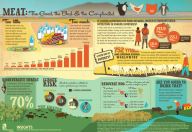
Meat: the good, the bad and the complcicated (IFPRI Infographic)
The International Food Policy Institute recently published an interesting info-graphic on meat production and consumption in the world entitled ‘Meat: the good, the bad and the complicated’ . The debate about meat production and consumption is a very interesting one in many ways. I don’t need to remind us of the recent discussion at Wageningen UR on ‘the good’ of intensified animal production ‘to feed the world’. In response to such arguments, ‘the bad’ are brought into the debate (see for example earlier blog by Petra), which are subsequently answered by the animal production sector with defensive responses. Continue reading
Food myhts Busted – do we need industrial agriculture to feed the world?
In the light of the debate on how to feed the world’s growing population and what type of agriculture is needed, a video by the Food Myth Busters takes a firm position: we do not need corporate agriculture, actually we are even better of without it. In the video they demystify claims upholded by corporate businesses with some facts. I’m however sure that these are not the facts the CEO of Wageningen UR has in mind when proclaiming that further intensification of agriculture is needed (in fact he is arguing for a further industrialization of agriculture according the famous Dutch model and promoting a joint venture of corporate business and science, ergo: corporate science) to secure food provision for 9 billion people. Have a look yourself and make up your mind:
Food4all – about right to food, sustainable family farming and agro-ecology
 With Food4all Otherwise and Boerengroep offer a critical perspective to food security and sustainable farming next to the yearly Food4you festival. Food4all starts on Thursday 11 October with a lecture on Land grabs and the right to food, next an expert panel on Feeding the world on Friday 12 October, a regional farmers market on Saturday and it ends with the Dutch premiere of the film ‘Crops in the Future’ on Tuesday 16 October. Food4all is organized in colaboration with ILEIA and SOS Faim (Belgium).
Celebrate food and farming in Wageningen, the Netherlands! Food4all is a festival that takes you on a journey through sustainable family farming, agro-ecology and the right to food. The Food4All festival is a critical supplement to the “Food4you festival”. The festival seeks to provide a critical perspective on global food security, and give voice sustainable alternatives.
Look at http://grassrootsscience.nl/ for the programme.
Feeding the world sustainable – agroecology v industrial agriculture
Feeding the world in a sustainable way is vehemently debated these days. In international fora the debate is not just about how to increase food production to feed the world’s growing population but also whether increasing food production is adressing the key issue of the relation between poverty and hunger. Increasing food production is not a neutral matter. Although some voices like to put it that way to sustain their claim that ‘facts’ show that their solution is the only right one. A solution is never neutral just because of the combination of technological and institutional means and the social and environmental impact it has. This is not new at all all. The impact of the (first) Green Revolution has been heavely disputed and this socalled neutralness of technology has been key issue in the massive techology and innovation studies of last decades. One cannot simply ignore the wider impact of technological fixes in the debate about how to provide the world’s population in a sustainable way.
In an editorial Eric Holt-Gimenez, Executive Director of Food First / Institute for Food and Development Policy (www.foodfirst.org) in response to a recent study in Nature has added a contribution to this ongoing debate. He argues that there is a difference between between producing more food and ending hunger. Read his editorial at on what kind of agriculture can best solve the problem of the growing number of hungry people: agroecology or conventional industrial agriculture at http://www.agriculturesnetwork.org/magazines/global/farmer-organisations/opinion-eric-holt-gimenez or at Nourshing the planet (the weblog of the Worldwatch Institute). One can also see video of a lecture on Food movements, agroecology, and the future of food and farming.
The Christensen Fund made an interesting infographics evaluating the major differences between agroecology and industrial agriculture:

 Rural Sociology Wageningen University