
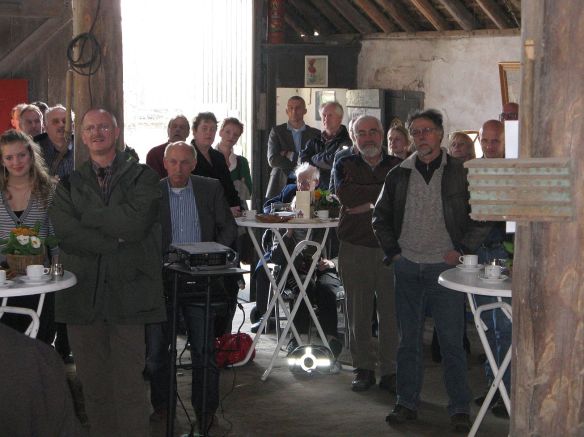
On Wednesday evening, I participated in a Plattelandscafé (countryside-café) at the Natuurboerderij Lammerburen (nature development farm) in Oldehove, Westerkwartier, Groningen. The aim of the gathering was to present results of past projects, ongoing projects and project ideas aimed at ensuring the sustainability of the predominantly rural Westerkwartier. Jan Oomkes, chairmen of the LAG Westerkwartier (LEADER) and alderman of Zuidhorn municipality, opened the evening with a summary of activities in the Westerkwartier, including activities of the citizen action group (WSI), the Westerkwartier as LEADER-region, the community house in Grootegast and numerous projects which have been realised using money from the EU (LEADER), the Rural Area Programme of the province of Groningen as well as the different municipalities. Thereafter, the word was given to different project leaders and the present 60 visitors were informed about ongoing projects and activities.
With regard to my upcoming DERREG (see previous post) research activities on rural business networks and the support of rural initiatives and regional learning in the Westerkwartier, the presented projects were highly interesting. For instance, one suggested project idea described the construction of hiking routes through the Westerkwartier, improving the touristic infrastructure and stimulating tourism as a new economic source for the region. Potentially, the project would thus provide possibilities for farmers to engage in side activities such as farm cafés and touristic accommodation and would help to establish networks between different stakeholders of similar interest. A further interesting project that was introduced is a new network for local business women (Wichterwest). Since the DERREG project aims to put special emphasis on the role of women in rural development, the newly formed network would be an interesting idea to study and could act as a best practise example for other rural areas throughout Europe.
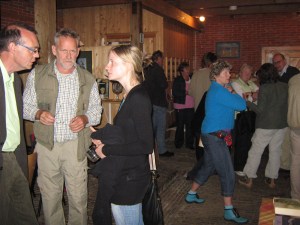
Conversations at the plattlandscafé
The evening was accompanied by guitar music- including a self-composed song about the Westerkwartier-, drinks and snacks. The inspiring atmosphere provided a good opportunity for everyone to exchange thoughts and ideas about the development of the Westerkwartier. Considering the enthusiasm of the people present at the gathering and their commitment to the development of their region, the event was also for me a motivating experience, highlighting once again the significance of research towards ensuring the sustainability of rural regions in the era of globalization.
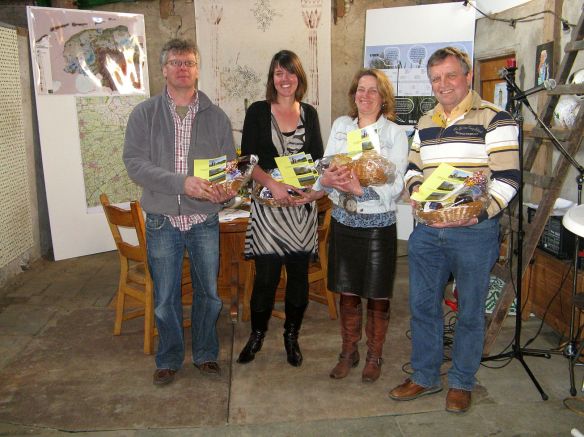
 De gezamenlijke betrokkenheid die de afgelopen jaren kenmerkend was voor de samenwerking is ook terug te zien in de publicatie van het boek, waaraan RIGO, de vakgroep Dierlijke Produktiesystemen, LEADER Westerkwartier en Staatsbosbeheer financieel hebben bijgedragen. Het project heeft een belangrijke basis gelegd voor toekomstige samenwerking in de driehoek gebied, beleid en onderwijs.
 The modernization of Europe’s agriculture and rural areas has been uneven, also in the Netherlands. As Han argued (13 of March) rural regions subject to the Dutch spatial modernization project have become non-places, striped from ‘constraining landscape’ interchangeable, not worth to care for. Those areas which escaped this process are now heralded for re-discovered values beyond economic rationalization. The neighboring area to the Frisian Woodlands, the area Westerkwartier, located in the province Groningen is also one of those areas which escaped modernization through spatial reconstruction. Collective farmers opposition and rejected spatial plans in the 70s led to a voluntary and much diluted plan in 1989 which preserved farming and landscape structures.
 Rural Sociology Wageningen University