Rural Sociology Wageningen University

Rural Sociology Wageningen University
Unknown's avatar

About FoodGovernance

Jessica Duncan is Associate Professor in Rural Sociology at Wageningen University (the Netherlands). She holds a PhD in Food Policy from City University London (2014). Jessica’s main research focus concerns the practices and politics of participation in food policy processes, particularly the relationships (formal and non-formal) between governance organizations, systems of food provisioning, the environment, and the actors engaged in and across these spaces. More specifically, she maps the diverse ways that actors participate in policy-making processes, analysing how the resulting policies are shaped, implemented, challenged, and resisted, and she theorizes about what this means for socio-ecological transformation. Participation and engagement is at the core of her approach. In turn, she is active in a broad range of local, national and international initiatives with the aim of better understanding participation processes with a view towards transitioning to just and sustainable food systems. She is involved in several research projects including ROBUST, HortEco & SHEALTHY. Jessica is published regularly in academic journals. She recently co-edited the Handbook on Sustainable and Regenerative Food Systems (2020). Her other books include Food Security Governance: Civil society participation in the Committee on World Food Security (2015) and an edited volume called Sustainable food futures: Multidisciplinary solutions (2017). Jessica has received several awards for her teaching and in 2017 she was awarded Teacher of the Year for Wageningen University (shortlisted again in 2018 and 2019, longlisted in 2020). With the funds she has received for these awards she launched a story-telling workshop for students and faculty, with storytelling trainer, Emma Holmes. Jessica is on the Editorial Board of the journal Sociologia Ruralis and is an advisor to the Traditional Cultures Project (USA). She is a member of the Wageningen Young Academy and sits on the Sustainability Board of Experts at Wageningen University.

Thesis Opportunity: What is inclusive when it comes to policy?

Thesis Opportunity with Rural Sociology: What is inclusive when it comes to policy?

Proposed title: Inclusive approaches to policy making: Making sense of options for food policy

Key words: policy, inclusivity, civil society, multi-actor, stakeholder, co-production

Context:  There have been increasing calls for more participation in policy making to allow for more inclusive policies. But what does this look like in practice? What models have been developed and tried? What has worked and what hasn’t? What are the implications of trying to be more inclusive. And, what does inclusivity even mean in a policy making context? The goal of this thesis is to start to answer these pressing questions and to related them to food policy.

Objective: The goal of this research is to identify and understand strategies for including people and their lived experiences, into policy making processes.

In this thesis, you will:

  • Undertake a literature review into inclusive governance (theory and practice)
  • Identify examples of inclusive governance from a broad range of sectors
  • Create a database of examples
  • Select an appropriate number of case studies to examine in greater depth
  • Collect data (including via interviews) to support description and analysis

On the basis of this, you will be expected to deliver concrete outputs.

Outputs:

  • Develop a clear research proposal building on a structured literature review and outlining clear methods for undertaking the research
  • Collect relevant literature and empirical cases to support the answering of the research question.
  • MSc thesis conforming to the criteria and quality indicators of the Rural Sociology Group.

Start date:  February or March 2018

Qualifications:

  • You are registered in one of the following MSc programmes:

MIDMHSMOA or MFQ

  • You have an interest in participatory policy making, civil society, food security and food sovereignty
  • You have some knowledge about theories of change
  • You have completed at least 2 RSO courses (or relevant social science courses)

Supervisor: Dr Jessica Duncan (RSO)

If you are interested, please email Jessica Duncan (jessica.duncan@wur.nl ) with a short letter of motivation.


Planning for Equitable Urban and Regional Food Systems

There is a new Special Issue of the journal “Built Environment” on the topic of Planning for Equitable Urban and Regional Food Systems.

The Special Issues starts from the question: How does and can planning and design enhance the freedom and wellbeing of marginalized actors in the food system – low-income residents, people of colour, small-holder farmers, and refugees – the very people the alternative food movements purport to serve?

In the Special Issue authors from across the Global North and South explore the role of planning and design in communities’ food systems, while explicitly considering the imbalances in equity, justice, and power.

The collection includes a paper by former Rural Sociology MSc student Maria Vasile and Jessica Duncan.

We want to be part of the broader project’ Family Farmers and Local Food Governance in Porto Alegre, Brazil

Brazil has been praised for the development of its agricultural sector, its policies against hunger, and its support for family farming. Yet, the future of small-scale family farmers remains uncertain. In this paper, we question whether food system localization facilitates the integration of small-scale family farmers into food governance processes in Porto Alegre, Brazil. To answer this, we present the City Region Food System (CRFS) as a conceptual approach to explore the relationship between food systems localization and enhanced participation of small-scale family farmers in food governance. After introducing the case study of local food in Porto Alegre, we highlight key structural inequalities that limit family farmers’ participation in local food practices and influence their involvement in food governance. We then examine linkages between local food policy efforts and family farmers’ praxis, attempting to discern mismatches and related implications for the development of an inclusive CRFS. We argue that systematization of local food practices within the city region represents a double-edged sword as it may
translate into a decrease in farmers’ autonomy and ownership of local initiatives and burden them with regulations not fit for purpose. In conclusion, we suggest that a CRFS approach to planning can help to address structural inequalities and power asymmetries in local food governance only if informed by local dynamics and based on context-sensitive mechanisms for participatory governance incorporating a variety of small-scale family farmers (and other stakeholders).

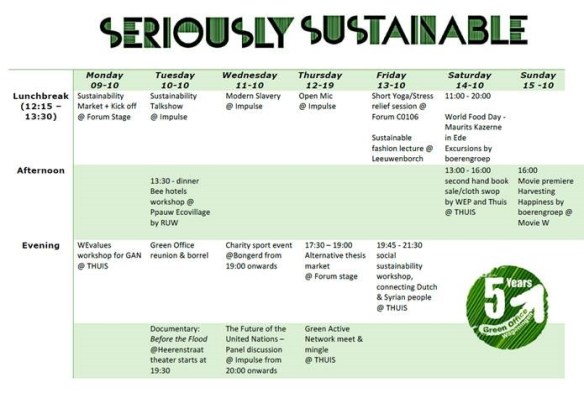
Seriously Sustainable Week 2017

Seriously Sustainable Week 2017 is coming up and Wageningen University’s Green Office has organised an entire week, packed with all kinds of activities, from fun to serious, from small to big.


Seriously Sustainable.jpg

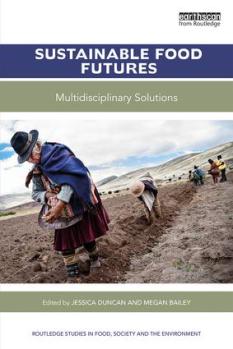
Sustainable Food Futures (NEW BOOK)

FoodGovernance's avatarFood Governance

bok coverVoltaire once said that “no problem can withstand the assault of sustained thinking”.
In this book, we put that statement to the test. The problems plaguing food systems are well researched and well known. But how can we support transformation towards sustainable and just food systems?

One thing is clear,  the objective of future food systems can no longer be to simply maximise productivity

We are very pleased to announce that our new book, Sustainable Food Futures: Multidisciplinary Solutionshas just been published. The book includes proposals for solutions to move us toward more sustainable food futures.  The solutions, which are based on concrete cases, are organised around 4 themes:

  1. Recognizing place
  2. Enhancing participation
  3. Challenging markets
  4. Designing sustainable food futures

The solutions proposed in this book can be read as an atlas of possibilities.

There are multiple roads we can, and must, travel to bring us towards our…

View original post 410 more words

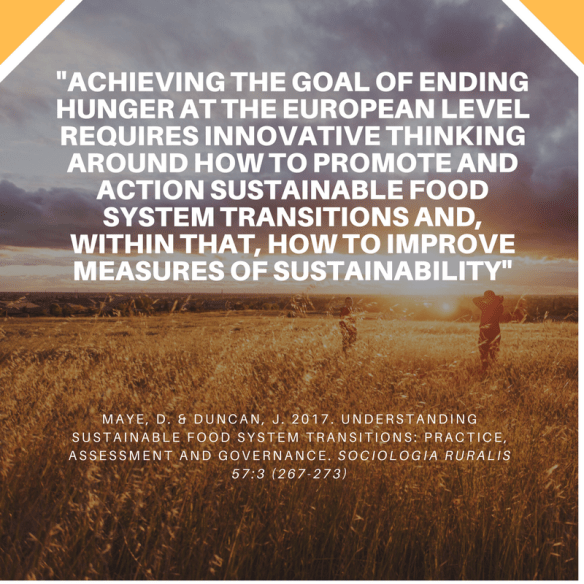
Understanding Sustainable Food System Transitions: Practice, Assessment and Governance

FoodGovernance's avatarFood Governance

SoRo Sustainable Food Transitions

I am very pleased to share that a new special issue of Sociologia Ruralis edited by Damian Maye and me is now online: Understanding Sustainable Food System Transitions: Practice, Assessment and Governance.

The Special Issue provides theoretical insights and advancements into sustainability transitions through empirically grounded and informed investigations of food system practices. The papers confirm, following Hinrichs (2014, p. 143), that ‘numerous opportunities exist to forge more productive links between work on food systems change and the broad and growing sustainability transitions field’.

The Special Issue brings together 8 articles grouped together around two themes:

  1.  Examining relations between AFN practices and transition;
  2. Opening up measures and assessment practices for sustainability transitions.

Taken as a whole, the Special Issue advances discussions and thinking on alternative food practices and sustainability, opening up the debate not only on how to identify and analyse ‘alternative food practices’ in Europe, and beyond…

View original post 209 more words