Unknown's avatar

About FoodGovernance

Jessica Duncan is Associate Professor in Rural Sociology at Wageningen University (the Netherlands). She holds a PhD in Food Policy from City University London (2014). Jessica’s main research focus concerns the practices and politics of participation in food policy processes, particularly the relationships (formal and non-formal) between governance organizations, systems of food provisioning, the environment, and the actors engaged in and across these spaces. More specifically, she maps the diverse ways that actors participate in policy-making processes, analysing how the resulting policies are shaped, implemented, challenged, and resisted, and she theorizes about what this means for socio-ecological transformation. Participation and engagement is at the core of her approach. In turn, she is active in a broad range of local, national and international initiatives with the aim of better understanding participation processes with a view towards transitioning to just and sustainable food systems. She is involved in several research projects including ROBUST, HortEco & SHEALTHY. Jessica is published regularly in academic journals. She recently co-edited the Handbook on Sustainable and Regenerative Food Systems (2020). Her other books include Food Security Governance: Civil society participation in the Committee on World Food Security (2015) and an edited volume called Sustainable food futures: Multidisciplinary solutions (2017). Jessica has received several awards for her teaching and in 2017 she was awarded Teacher of the Year for Wageningen University (shortlisted again in 2018 and 2019, longlisted in 2020). With the funds she has received for these awards she launched a story-telling workshop for students and faculty, with storytelling trainer, Emma Holmes. Jessica is on the Editorial Board of the journal Sociologia Ruralis and is an advisor to the Traditional Cultures Project (USA). She is a member of the Wageningen Young Academy and sits on the Sustainability Board of Experts at Wageningen University.

Nominate your greenest teachers!

green-officeThis week the Green Office of Wageningen is launching this year’s Green Teacher Award !

Last year the Green Office selected the teachers. This year they will do things differently.

Their aim is to let the members of the WUR community  nominate themselves, their colleagues and/or their teachers.  After this, the nominated teachers will get a questionnaire and a jury will use different criteria to select the ‘Green Teacher(s) of 2016’.

To nominate a Green Teacher, you can fill in this short form: https://goo.gl/forms/H6yeYLl7HPtauJmT2

The objective is to celebrate green teachers and to encourage teachers to think (more) about sustainability and how to implement this in their lectures.
 

Capital Selecta: Global Food Security

cfs-42-students

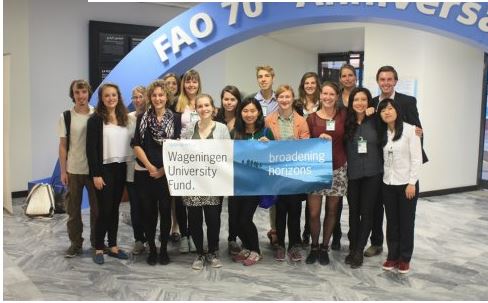
WUR students attending CFS negotiations in 2015

In October RSO will offer a 3 ECTS Capita Selecta course called Global Food Security: Linking theory and practice. 

The course offers the opportunity for students to learn more about international food security governance through lectures, assignments, and by attending the annual meeting of the UN Committee on World Food Security (CFS) in Rome.

The schedule (subject to change) is:

  • Tues Oct 11 17:30-19:30 Lecture- Introduction to Global Food Security Governance
  • Thurs Oct 13 17:30-19:30 Lecture- Introduction to the Committee on World Food Security + potluck dinner
  • Oct 15-22 Excursion to the CFS in Rome
  • Nov 1st 17:30-19:30 Presentations of final assignments

Registration is limited and open to students with a proven interest in food security, international development, and/or global governance. Interested students should send a CV and letter of motivation to jessica.duncan (a) wur.nl

Please note students are expected to cover the costs of travel (airfair, accomodation (we will likely reserve a large apartment via AirBnB), and food). Student course coordinators are working to secure funding to help reduce these costs.

Gender Dilemmas in Sustainable Development

Exciting lecture!

FoodGovernance's avatarFood Governance

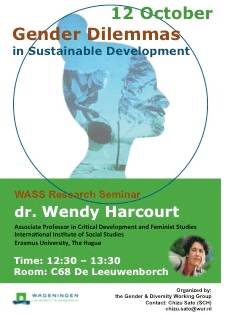
harcourt-lectureThe Wageningen University Gender & Diversity working group presents a lunch-time lecture on Gender Dilemmas in Sustainable Development
by Dr Wendy Harcourt

Date: Wednesday, October 12

Time: 12:30-13:30

Place: C68, de Leeuwenborch, Wageningen

Wendy Harcourt argues that feminist theory brings important political lessons to sustainable development. Her talk explores: development as transformative politics; intersectionality; and the inter-section of gender with sustainability issues. She argues that new methodologies are required in development that bridge the divide between practice-based analysis and universalising ‘global’ theory. She presents the case for why it is important to learn from those who are breaking new ground listening and learning from the perspectives of communities living and working on the margins of mainstream development.

Dr Wendy Harcourt is Associate Professor in Critical Development and Feminist Studies at the International Institute of Social Studies of the Erasmus University in The Hague. She is Research Programme Leader for the Civic…

View original post 86 more words

Interdisciplinary Postdoc position – “Food system transformability to ecologically intensive production and sustainable value chains”

FoodGovernance's avatarFood Governance

We are hiring a Postdoc for a neat project in Chile and Uruguay. Deadline for applications is September 19th

Based in Wageningen with frequent travel.

More information here:

Function
The development of sustainable food systems depends on
  • resilience and adaptability of socio-ecological systems to respond to short term variation in drivers, and
  •  system transformability to reach new equilibria under drivers that change over longer periods of time.

The different food system components, their interactions and feedbacks, and the different time scales on which they operate give rise to complex systems in which interventions may have diverse and unexpected outcomes. Systemic learning and co-innovation have been advocated as key elements for analysis and decision making in complex (food) systems.
The Postdoc will develop and implement a systemic learning approach on ecologically intensive production and value chains.

The main research question will be “How can stakeholders stimulate transformation towards…

View original post 110 more words

Innovation and Its Enemies: Discussion on future research agendas

Untitled

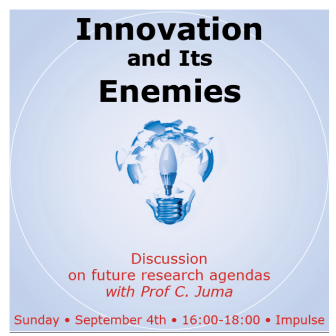
The Opening of the Academic Year is fast approaching. Register now for an opportunity to discuss the future of innovation research with this year’s Keynote Speaker, Professor Calestous Juma (Harvard University) and  Cees Leeuwis,Professor of Knowledge, Technology and Innovation (Wageningen University).

Date: Sunday September 4 2014
Time: 16:00-18:00
Location: Impulse (building number 115)

Agenda

16:00 Welcome and Introduction by Dr Sylvia Karlsson-Vinkhuyzen
16: 10 Presentation by Prof Calestous Juma
16:30 Reflections by Prof Cees Leeuwis
16:40 Discussion moderator  Dr Jessica Duncan
17:10 Closing remarks by Dr Sylvia Karlsson-Vinkhuyzen
17:15 -18:00 Drinks, snacks and meet and greet


calestous_juma-size-custom-crop-1086x724

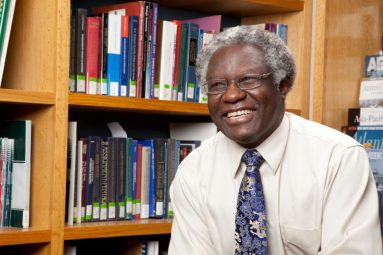
Professor Calestous Juma- Keynote Speaker for Opening of the Academic Year 2016-2017