In our previous blog, we wrote that to understand the overall evolution of farmer protests around the nitrogen crisis, Jaap Frouws’ doctoral dissertation Mest en Macht (Manure and Power, 1994) is highly relevant. Among others, his work provides a an important entry point into the history and the crisis of farmers’ representation and cooptation in agricultural policies in the Netherlands.
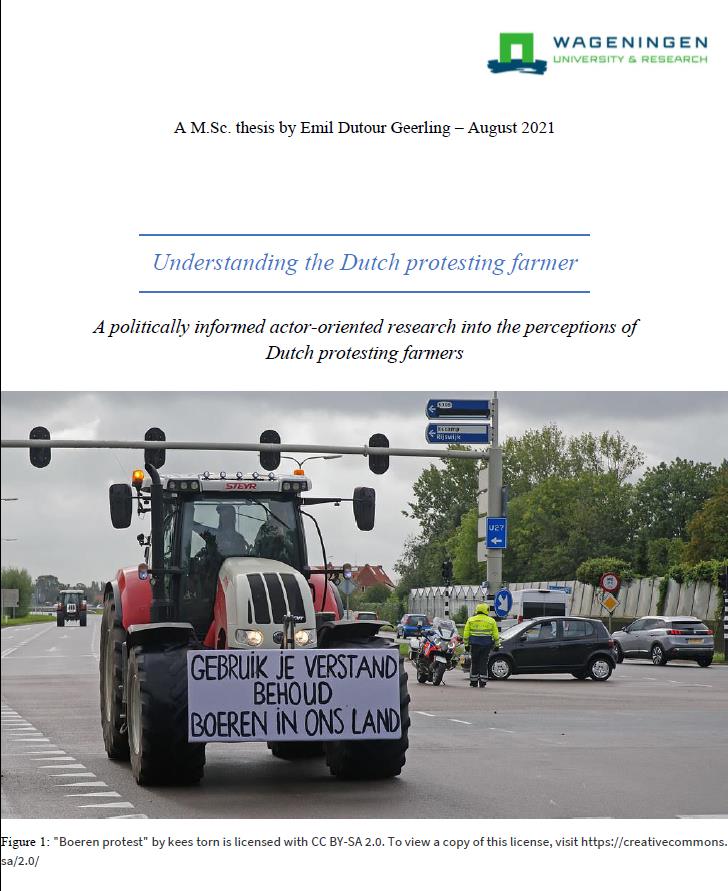
Master student Emil Dutour Geerling delved into this question of representation in his recently defended thesis on the contemporary farmers’ protests. At the time Jaap Frouws did his important work on the politics of the manure crisis in the 1990s, the first cracks had become visible in the bulwark of farmers’ representation. Today, almost three decades later, the landscape of representation has changed dramatically. The long-time alliance between national farmers organizations, political parties and the ministry of agriculture, has become history. Feeling under- or not-represented, and, importantly, not heard, discontented farmers established a defense force. This Farmers Defense Force was able to mobilize thousands of farmers, who were prepared to take a more confrontational approach, blocking highways and retail distribution centers, and converged on provincial government buildings.
In his work, Dutour-Geerling explains the form the protests take from the crisis in representation. Yet, he explains the cause of these protests in terms of a crisis of accumulation. Many of the protesting farmers have built their business strategy on the idea of continuous growth, yet the new nitrogen and phosphate regulations make this business strategy untenable.
This crisis of representation and crisis of accumulation creates a ‘biographical disruption’: the future that farmers perceived for themselves and their farms is not feasible anymore. This asks for a reconsideration of their idea of farming, and their self-perception as farmers. Changing their farming strategy is, if possible at all, costly; the rethinking of their farmers’ identity painful. This explains the fierceness of the protests.
Emil Dutour Geerling. 2021. Understanding the Dutch protesting farmer: A politically informed actor-oriented research into the perceptions of Dutch protesting farmers, Master Thesis Rural Sociology in partial fulfilment of the degree of Master of Science in International Development Studies at Wageningen University, the Netherlands
While writing the first sentences of this blog (7 July 2021), more than hundred tractors of angry farmers drive through the lawns of the campus of Wageningen University as one of many farmer protests against proposed Dutch government policies to reduce nitrogen emissions in agriculture. A farmer spokesman states that this university is an extension of the Ministry of Agriculture (LNV): Wageningen university is writing reports on request of the government against the interests of farmers and it is just suborned to defend environmentalist positions. Farmer protests on the campus grounds are something new as far as I know, but not farmer protests against restrictive environmental policies.
To understand the overall evolution of farmer protests around the nitrogen crisis, Jaap Frouws’ doctoral dissertation Mest en macht (Manure and Power) (1994) about the politics of the manure crisis in the Netherlands is highly relevant. Three reasons inspired me to write here about this academic work on agrarian corporatism written two and a half decades ago. First, when I was a master student Jaap Frouws provided an example that academics can be intellectually inspiring and accessible, kind, and humble at the same time. I consider him as an important figure in the 75 year history of the Rural Sociology group and his untimely death has been a great loss for Wageningen rural sociology. Second, Mest en macht provides a key entry point into the history of farmers’ representation in the conflict between agricultural and environmental demands and after three decades it has lost nothing of its urgency. Finally, Frouw’s pioneering work has become a point of reference for later researchers on manure narratives, such as Marian Stuiver’s PhD thesis (2008) and Janne Hemminki’s recent master thesis (2021) on the current nitrogen crisis. But not everybody reads Dutch, so this blog hopes to draw the attention of English readers to Frouw’s classic Dutch text. One may not be able to read it but could become interested in reading some of Frouws’ articles derived from it.
The main theme in Mest en macht is the nature and decay of agrarian neo-corporatism represented by the Board of Agriculture (Landbouwschap) in the Netherlands. Founded in 1954, the Board of Agriculture―composed of representatives of the three major farmer unions and the labour union of agricultural workers―represented the interests of the whole agricultural sector as a public law organization. Interesting is how Frouws analyses how the state constructed the organization of farmer representation, rejecting to negotiate with an amalgam of different representative bodies and deciding to negotiate and collaborate with one composite organization only. Through this horizontal union model the farmer organizations as a whole became co-responsible for government policy. For several decades this structure would incorporate and reduce the autonomy of vertical product-based, specialized associations. Frouws analyses how this neo-corporatism was structured through a set of resources and rules that resulted in a strong cooperation between state and representative organizations. The representational monopoly was strengthened through providing early information about planned policies to the Board of Agriculture and giving it privileged influence. The strong involvement of farmer organizations via the Board of Agriculture provided legitimacy to government policies as the Board was functional in disciplining the farmer organizations’ constituencies.
Environmental crises, however, have increasingly affected this representational model. One key problem has been the excessive amount of manure produced by the livestock sector which could not all be incorporated into soils due to new environmental regulation. The key argument of Mest en macht is that the growing ‘manure problem’ created or deepened rifts in the so-called ‘Green Front’. It was increasingly difficult for corporatism to keep divergent interests under political control. For example, views of farmer organizations in the North of the Netherlands clashed with those from the South. Farmers in the North had relatively more space to apply to the field their manure whereas the South had more manure surplus regions. Consequently, they had divergent views on the use of duties (to be paid to handle the manure surpluses) for, for example, transport subsidies. Such differences in interests led repeatedly to political confrontations and consequently to obstruction of policy consensus regarding the amplitude and pace of manure policies, the distribution of financial contributions to transporting and processing manure surpluses, and the regulations on buying and selling manure ‘quotas’. Within the state, policy formulation in this domain became less dominated by the Ministry of Agriculture which for a long time simply had organized and defended farmer demands through delegating policy formulation to the Board of Agriculture. Other voices speaking for environmental interests and, for example, members of parliament, gradually became less excluded from policy formulation around the manure crisis.
Frouws does not perceive this decay of agrarian neo-corporatism as a single monocausal unidirectional process. Instead, via an exhaustive empirical study of interview data, minutes of meetings, a survey of farmers’ perception of representation, and participant observation in meetings, Frouws describes the many twist and turns, and tensions, deadlocks and contradictions over time. He reveals many examples of an effective lobby by livestock interest groups to soften or delay restrictive policies. Hence, while on the one hand the neo-corporatist policy-making community could not resolve the manure crisis and its political control of the issue lessened, farmer activism resulted on the other hand in delaying strategies and obstruction of policy formulation to address the manure crisis. Crucial questions regarding the restructuring the livestock sector were pushed aside in favour of maintaining the competitiveness and the export capacity of livestock production, thus precluding any discussion of reducing its volume.
Reading the empirical details of these confrontations, delays, and obstructions as presented by Frouws―with an emphasis on what happened in the 1980s―leaves the impression not of Manure and Power (Mest en macht) but of Manure and Powerlessness (Mest en onmacht). The issue of manure surplus was not resolved, the state was not able to envision proposals for restructuring of the livestock sector, and farmer representation fragmented. While Frouws did not predict anything about the future of the Board of Agriculture, the pivot of agrarian neo-corporatism in the Netherlands at that time, he rightly observed its decay. Not so long after his dissertation was published, the Board would be dissolved and the representation of farmer interests shifted to a more diffused model driven by specialized, product-based farmers’ associations.
Mest and macht is most important for what it offers in terms of empirical data, the analysis of neo-corporatism, and a political sociology of agriculture. The thesis centralizes the political sociology of representation whereby the technicalities of the manure problem are relegated to an appendix. Today with all the talk about assemblages or hybrids, nature/technology-society interaction would likely get a more pronounced treatment in a thesis. Instead, Mest en macht offers a middle range sociological theory about agrarian neo-corporatism and it is Frouws’ history of manure policies which provides us with interesting questions of how to look at the contemporary political upheaval which made farmers invading Wageningen University’s campus.
Similar dynamics as described by Frouws shape the current episode of the manure/N-emission crisis. The farmer protests in 2019, initiated by relatively small farmer activist groups, resulted in a momentary new Green Front, when the government negotiated about nitrogen emission policies with the Landbouw Collectief (the Agricultural Collective), a newly formed platform composed of many different farmer organizations. Like half a century ago, the government preferred to negotiate with just one representational body of farmers only. However, within months the participating organizations disagreed about the structure of the Landbouw Collectief and it felled apart as quickly as it had emerged. The strategies of ‘talking with the government to co-develop policies’ and ‘political activism to demand respect and farmer freedom’ turned out extremely difficult to combine. Of course, not everything is the same, as nowadays many farmers have incorporated ‘sustainability’ in their farm operations. But the challenges defined by Frouws of getting farmers involved in environmental regulation, “accepting responsibility for ‘general’ interests such as the protection of nature”, and accepting the need to discuss a restructuring of the livestock sector, remain as big and as relevant as 25 years ago. It might help to face these challenges if activists, policy makers, and politicians would read Frouws’ classic on farmer representation and environmental crisis.
Frouws, Jaap (1994). Mest en macht: Een politiek-sociologische studie naar belangenbehartiging en beleidsvorming inzake de mestproblematiek in Nederland vanaf 1970. Wageningen University (PhD Dissertation).
Hemminki, Janne (2021). The Nitrogen-crisis and social differentiations in the Dutch livestock sector. Wageningen University (unpublished MSc thesis).
Stuiver, Marian (2008). Regime change and storylines : a sociological analysis of manure practices in contemporary Dutch dairy farming. Wageningen University (PhD Dissertation).
We are delighted to announce our PhD course on agrarian and food citizenship. The course gives participants an opportunity to intensively engage with some of the major debates and approaches on the democratization of our agricultural and food systems so that they can continue to explore and expand these in their own research. The course is organized as a one-week intensive discussion seminar in the week of our 75th anniversary celebration
Rooted in a shared belief that our agricultural and food system has produced unsustainable social and environmental cleavages, social movements like Via Campesina have called for the right of people to define their agricultural and food practices. At the same time, various initiatives have emerged that bring this principle into practice. Instead of assuming our relationship to agriculture and food to be that of a consumer making individual decisions in the marketplace, these movements and initiatives have focused on how we organize our agriculture and food practices, and how this can be done different. The aim of this course is to investigate the shift away from a consumerist perspective in which we shop our way to a better agricultural and food system (”vote with our fork”) and towards a citizenship perspective based on the right to have a say in, as well as actively shape, our agriculture and food system. Applying a citizenship lens to an understanding of how our agriculture and food system are organized implies a consideration of the power-relations and identities concealed. In addition, is raises the question how to understand “citizenship”? Various scholars (Isin and Nielsen 2008, Wittman 2009, Carolan 2017) have argued that citizenship is not a formal status, and that people establish themselves as citizens by enacting rights. In this course we will consider agrarian an food citizenship from this perspective of “citizenship acts”.
This course is intended for students doing a research master, PhDs, postdocs, and staff members who want to expand their engagement with the democratization of our agricultural and food practices and the citizenship approach to this. In order to ensure opportunities for full discussions during the sessions, the minimum number of participants is 10 and the maximum 20.
More information about the instructors in this course and registration will follow soon.
Mundane normativity and the everyday handling of contested food consumption by prof. Bente Halkier, University of Copenhagen, August 30, 16.00-17.30 (CET):
“Food in everyday life is contested from multiple kinds of public debates in present societies such as climate, health, risk, environment and quality, which point to food consumption in everyday life as a site of normative action In the various strands of sociological research on consumption, contested consumption has typically been studied in two strands One strand tends to focus on the mundane routines in consumption that are reproduced, thus to some degree avoiding the normative dimension in the consumption activities themselves Another strand tends to focus directly on political and ethical consumption, thus to some degree ignoring the more mundane dealings with the normative dimension. My contention is that there is some middle ground to cover between each of the two otherwise valuable strands of consumption research if consumption research is to understand the normative dimension of consumption more fully In order to conceptualize such middle ground, an unfolding of the category of mundane normativity and its conditions is useful, and food consumption in everyday life is a clear example with which to think.“
The talk is part of the Rural Sociology 75th Anniverary webinar series ‘Looking back, Looking Forward: Setting a future agenda for rural sociology’.
In the 1950s Professor E.W. Hofstee from the former department Sociology and Sociography developed a tool to create maps with statistical data of the Netherlands. You could consider this technique as a predecessor to today’s GIS. In this video Anton Schuurman, Associate Professor of Rural and Environmental History at WUR, explains how the puzzle was used and why it was so unique.



 Rural Sociology Wageningen University