75th Anniversary: 47) Research at Rural Sociology:  Gender and rural development in Europe – once upon a time and now

Bettina Bock

Once upon a time.

It is almost 44 years since my first research project; it considered the position of women in non-academic positions at the University of Nijmegen. More studies into gender and professions followed; in academia and public service, as well as technical and assumedly masculine occupations such as woodwork and firefighters, and eventually farming.

Women farmers stole my heart – first in Italy and later in the Netherlands when working on my PhD on the role of women in rural development practice and policy. They were so creative and courageous, developing new business activities and conquering a position in a sector in desperate need of transition but often so stubbornly holding on to conventions. In this case, the conventional image and success formula of the male farmer running his farm as a modern business striving to increase production and growth, with the farmwife offering assistance. In the early 90s, some women stood up against these beliefs – men being the head of the farms and farming as regular businesses interested in increasing production and profit. There were women pioneers innovating agriculture by initiating a new model and paradigm of farm diversification and multifunctionality. They introduced new income-generating activities and created new markets with direct communication between producers and consumers. In doing so, these women farmers and their partners developed new knowledge and skills and adapted their agricultural production methods, with less monocultural and more environmentally friendly production methods. Hence, women significantly contributed to the continuity of farming financially through such new business activities, others by gaining off-farm income. Initially, the turn towards diversification and multifunctionality met a lot of criticism and suspicion by mainstream farmers and the farm union – this was not real farming anymore, they said. Or this meant the end of agriculture as a real business and profession. As a result, many women farmers downplayed their activities as hobbies or downplayed the importance of their money. In time, however, the success of these new businesses became evident, and multifunctional agriculture became formally recognised even by the farm unions.
In academia, the role of women in multifunctional farming was cherished in two ways: first as a proof of long due empowerment and recognition of the vital role of women in agriculture; second as one of the elements of the transition of farming, with multifunctionality, high-quality production and direct marketing as the way forward, and thirdly as proof of the sustainability of family farming. Studies into gender relations in agriculture confirmed the presence of more equal gender relations on farms engaged in diversified productions and novel production methods. The situation is quite different in most production-oriented farms that remained conventional also in terms of gender relations. The political interest in women farmers diminished over time, at least at the national level. The EU continued to call attention to the position of rural women, stressing their vulnerability and the importance of strengthening their position in farming and rural areas. However, gender agriculture and rural development did not figure prominently in public, political or academic debates for a long time – in Europe. In international development debates, this was quite different, and gender remained a prominent issue and target of policymakers, donors and academics. Women were presented as important actors, able to enhance production and warrant food security, yet needing support to overcome traditions and realise their potential. Maybe, the global South was again ahead of the North when it came to gender debates – as they were when research into gender and agriculture took place in Europe in the seventies.

Most recently, the interest in gender and rural development seems to be reawakening also in Europe. Looking into a recently published HORIZON, the EU expresses high hopes for women’s engagement in innovations. They expect women to ensure the future of agriculture and rural areas and significantly contribute to climate change mitigation and, hence, our future. It is interesting to see that women who figured in agricultural and rural policies so far, mainly as a vulnerable group, become suddenly framed as our saviours. However, as the EU calls for ways to boost women’s innovations, women are still expected to need a hand to realise their potential, with many hurdles arising from what we may best identify as institutionalised sexism.

What does that mean for academics like me who have fallen for these amazing women who experiment with new ideas, innovate new products and methods, and institutions? Should we worry about their instrumentalisation, as some warn us (reference)? I always have difficulty with that argument – because are we instrumentalised if we choose to do what needs to be done? Do we not all carry the responsibility to be instruments in the realisation of a better world? And is women’s agency to innovate against all odds not in itself transforming structures, identities and relations, self-empowering? Is innovation, hence, not their instrument of empowerment? Yes, they deserve more respect, reward, and support. What they do is valuable and critical, and we need to ensure their engagement has an impact.

In my view, it is not up to me as a researcher to protect women from instrumentalisation. However, I can be of more assistance when understanding what drives, enables and hinders them and where change is essential to realise their potential. The transformation of gender relations is part and parcel of that process, be it explicitly or implicitly. We should also not forget that women do not necessarily view their actions as individual or independent; farm women often feel part of the family business, and many collaborate with others and men. The latter does not make gender equality less relevant yet nuances women’s interest in gender transformation. And what about the kind of innovations in which women engage? Many are novel, of course, but not all are about agroecology or climate change. Or that might not be the leading motive. Women’s primary reason is often to assure the business’s profitability, and not all they do is good for the environment. Does that mean we should then not support their initiatives and engagement in innovation? Do women only as saviours deserve support? The right of agenda-setting is another matter to consider. Which issues should politics and science address, and when are women ‘invited’ to join? Even formulating the question is awkward as, of course, women have the right to set the agenda. Reality is more complex. Generally, interest groups are involved in such negotiations, and as studies report time and again, women farmers are hardly represented in farm organisations.

Intriguing questions that are difficult to answer. As an academic, I might argue that my first task is to understand how innovations emerge when ‘female’ agency fights traditional structures, irrespective of their motive. On a more personal note, I believe it is our responsibility as scientists, policymakers, and practitioners to choose which innovations to support, whether promoted by men or women. In today’s world, it is irresponsible to support innovations that add to the problem of climate change and social injustice.

Some suggestions for overviews of rural gender literature

  • Asztalos Morell I. and BB. Bock (2008) (eds), Gender regimes, citizen participation and rural restructuring, Elsevier: Rural Sociology and Development Series, pp. 3-30
  • Bock B.B. and S. Shortall (2006) (eds), Rural Gender Relations: Issues and case- studies, Oxfordshire: CABI
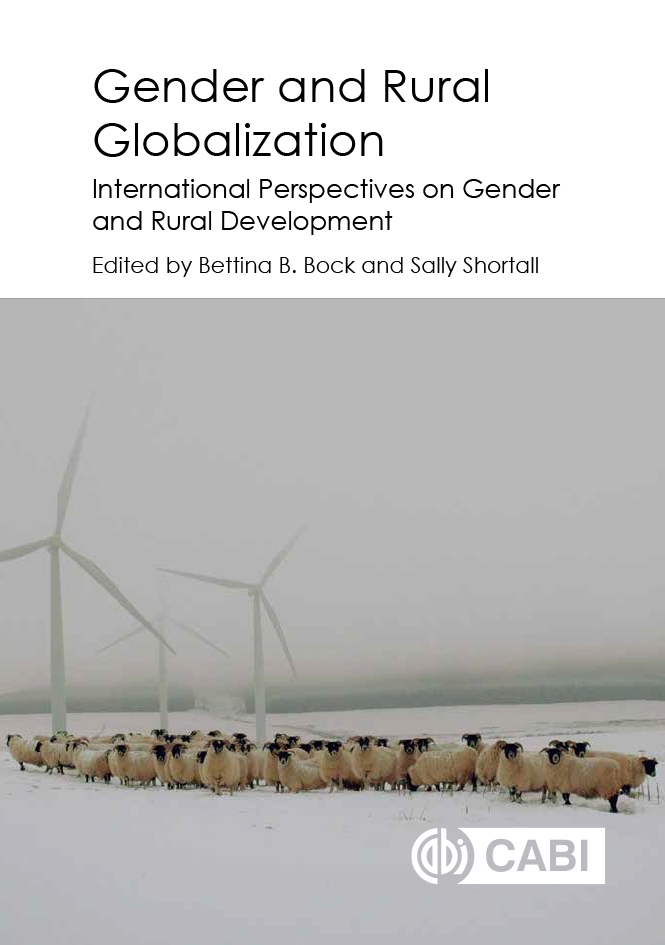
  • Bock, B.B. and S. Shortall (2017) (eds), Gender and rural globalisation: international perspectives on gender and rural development, Oxfordshire: CABI
  • Bock, B.B. and M. van der Burg (2017), Gender and international development, in B.B. Bock and S. Shortall (eds) Gender and rural globalisation: international perspectives on gender and rural development, Oxfordshire: CABI
  • Bock B.B. (2016), The Rural, in: I. van der Tuin (ed.), MacMillan Interdisciplinary Handbooks: Gender, volume 2: Nature, MacMillan, 199-216
  • Cornwall, A. , E. Harrison and A. Whitehead (2007) (eds),. Gender myths and feminist fables: the struggle for interpretive power. Gender and Development, 38(1998) (special issue)
  • Mohanty, C.T. (2003), Feminism without borders; decolonizing theory, practicing solidarity, Durham & London:  Duke University Press (reprint from 1984)
  • Pini B., B. Brandth and J. Little (2015) (eds). Feminisms and Ruralities. London: Lexington Book
  • Plas van der L. and M. Fonte (1994) (eds). Rural gender studies in Europe. Assen: van Gorcum
  • Sachs C. (2019) (ed.), Gender, agriculture and agrarian transformations, changing relations in Africa, Latin America and Asia: London: Routlegde, Taylor & Francis Group
  • Shortall S. and B.B. Bock (2015) (eds) Rural, gender and policy; Rural women in Europe: the impact of place and culture on gender mainstreaming the European Rural Development Programme; Gender, Place and Culture, 22(5), special issue

75th Anniversary: 46) Research at Rural Sociology: The everyday political economy of rural livelihoods in South and Southeast Asia

Mark Vicol

How do rural people make their livelihoods? What determines who prospers and who is left behind? How should we study and understand rural development and agrarian change? These questions are core to critical development studies of Global South countries with significant rural populations. The answers, however, often reflect deeply held ontological and epistemological differences and assumptions about what counts and what doesn’t (or what’s important and what isn’t) in the analysis of rural development. Despite parallel developments in social theory in recent decades to bridge these divides (e.g. Elder-Vass 2010), approaches to rural development in low-income countries tend to fall in one of two camps: those that emphasize structure; and those that privilege agency. Although there are exceptions that integrate across analytical approaches, two exemplars of this agency/structure divide in development studies are actor-oriented livelihoods analysis, and agrarian political economy. Each has been critiqued and often dismissed by the other for what they don’t do: livelihood or actor-oriented approaches critique agrarian political economists on grounds of determinism and for discounting the diversity of practices and actors at the micro level; while agrarian political economy dismisses livelihoods research for its failure to account for broader relations of power, production, reproduction and property. Both approaches also imply rather different outcomes for policy or praxis: the former focuses on increasing autonomy and individual choice; the latter focuses on the role of the state and/or class-based political movements.

According to Scoones (2015: 37), this debate is summarized by the question “what is more important: what people actually do or the factors that constrain or enable their actions?” This question has animated my research on small farming, rural development and agrarian change in South and Southeast Asia over the last decade. My research shows that not only, as Scoones notes, is the answer to this question quite obviously neither, but also that we can consider both livelihoods (agency) and political economy (structure) simultaneously in studies of rural development. The shortcomings of each approach correctly identified by the other should not be taken as further encouragement to retreat into theoretical or methodological fortresses. Instead, I argue it is possible to productively combine the contextual richness of livelihood approaches with the structural insights of agrarian political economy (Scoones, 2015). By moving beyond an agency/structure dualism in critical development studies, we can pay attention to both at the same time as part of the same process. Put differently, livelihoods are central to understanding agrarian change, and vice versa. We can therefore begin to ask questions such as what does it mean to be a poor or rich rural household? What do the livelihood pathways of different social groups look like? How do livelihood practices produce, reproduce or challenge patterns and processes of differentiation in rural areas? And, how do broader patterns of structural change in turn act back upon livelihoods?

In fact, the rationale for combining the insights of agrarian political economy and rural livelihood analysis can be read as coming from Marx himself. In the Grundrisse (1973), Marx argues that to arrive at a concrete understanding of historical change, one must dialectically move in from the abstract towards the “many determinations and relations” that make up the whole, what Marx called the “unity of the diverse”. The core questions that inform contemporary agrarian political economy (Who owns what? Who does what? Who gets what? What do they do with it? See Bernstein, 2010) are also inherently questions about livelihoods. The idea of a combined approach that asks these questions at multiple scales is that on the one hand, a deep understanding of rural livelihoods can unpack the complexity of everyday practices, whereas political economy can make concrete the ways in which social relations at various scales shape livelihood practices and trajectories and ultimately determine patterns of winners and losers in rural spaces. I have used such an approach, what I call the everyday political economy of livelihoods, to try and understand the multiple determinations of agrarian change and the everyday experiences of such change in smallholder farming communities in India, Myanmar and Indonesia (see Vicol, 2017; Vicol, Pritchard & Htay, 2018; Vicol et al. 2018; Vicol, 2019; Vicol & Pritchard 2021).

In India, this approach was applied to explore the implications of contract farming for household livelihood trajectories and broader patterns of agrarian change. In a case study of potato contract farming in three villages in Maharashtra, a wealth ranking exercise, along with household interviews, was used to construct local understandings of differentiation (Vicol, 2017; 2019). Participants in each village constructed three ‘wealth groups’ of best off, middle and lower households, with each category associated with particular landholding patterns, income sources, balance of on- versus off-farm livelihood activities, use of wage labour, and caste. Dominant narratives around contract farming typically conceptualize it as either ‘win-win’ (for farmers and agribusiness) or ‘win-lose’ (agribusiness wins, farmers lose). My research showed that a) participation in contract farming was concentrated in the ‘middle’ group of households; and b) that rather than sparking dynamic new processes of accumulation among contract farmers or leading to new forms of exploitation, contract farming is contributing to processes of agrarian change already under way. More specifically, participation in contract farming tended to reproduce the middling livelihood trajectories of middle households, while best off households concentrate on non-farm activities for their accumulation strategies (engaging in what Gillian Hart has called ‘diversification for accumulation’). These findings challenge existing policy narratives centered around ‘value chain development’ interventions such as contract farming that promote a simplified vision of ‘market-led’ agricultural development and agrarian change.

My research in India and elsewhere demonstrates that processes of rural development and agrarian change can’t be reduced to simplified narratives. Instead, it is the complex interplay of everyday livelihood practices and social and economic structures that shape patterns of winners and losers in agrarian spaces. To paraphrase Marx (1852; see also de Haan and Zoomers, 2005), what an everyday political economy of livelihoods reveals is that rural people in the Global South do make their own livelihoods, but not necessarily under conditions of their own choosing.

References

Bernstein, H. (2010). Class dynamics of agrarian change. Halifax, Nova Scotia: Fernwood.

de Haan, L., & Zoomers, A. (2005). Exploring the frontier of livelihoods research. Development and Change, 36(1), 27–47.

Elder-Vass, D. (2010). The causal power of social structures. Cambridge: Cambridge University Press.

Marx, K. (1852/2008). The Eighteenth Brumaire of Louis Bonaparte. New York: Cosimo.

Marx, K. (1973). Grundrisse. London: Penguin.

Scoones, I. (2015). Sustainable livelihoods and rural development. Rugby, United Kingdom: Practical Action.

Vicol, M. (2017). Is contract farming an inclusive alternative to land grabbing? The case of potato contract farming in Maharashtra, India. Geoforum, 85, 157-166.

Vicol, M. (2019). Potatoes, petty commodity producers and livelihoods: Contract farming and agrarian change in Maharashtra, India. Journal of Agrarian Change, 19(1), 135-161.

Vicol, M., Pritchard, B., & Htay, Y. (2018). Rethinking the role of agriculture as a driver of social and economic transformation in Southeast Asia’s upland regions: The view from Chin State, Myanmar. Land Use Policy, 72, 451-460.

Vicol, M., Neilson, J., Hartatri, D.F.S., & Cooper, P. (2018). Upgrading for whom? Relationship coffee, value chain interventions and rural development in Indonesia, World Development, 110, 26-37.

Vicol, M. & Pritchard, B. (2021). Rethinking rural development in Myanmar’s Ayeyarwady Delta through a historical food regimes frame. Singapore Journal of Tropical Geography, 42, 264-283.

Saving the world – Cultivating the city: Invitation to the 14th Weihenstephan forum (21 & 22 October 2021)

How food production in the city contributes to a sustainable future

21 & 22 October, 2021 [Hybrid Event]

The industrialization of our global food system and growing urbanization not only exacerbate the effects of climate change and accelerate the loss of biodiversity, but also significantly cause the spatial and mental decoupling of food production and consumption.

Against the backdrop of the associated socio-ecological challenges, a “renaissance” of various forms of urban agriculture can be observed worldwide over the last decade, accompanied by the emergence of new multifunctional productive ecosystems in urban spaces. Especially in the Global North, the manifold forms and different dimensions of urban agriculture increasingly show potentials how negative effects along the food value chain can be reduced and how ecological, economic and social added values can be created.

The 14th Weihenstephan Symposium will therefore revolve around a provocative question:

“Urban agriculture – A trend phenomenon or transformative element for the development of resilient cities and food systems?”

To explore this controversial question, the professorship for Urban Productive Ecosystems at Technical University of Munich invites practitioners from science, business, politics and civil society to debate their expertise and experience in the form of keynote speeches and subsequent discussion. Different forms and aspects of urban production – their limits and potentials – will be critically examined and their practical potential discussed from ecological, social and economic points of view.

We invite you to participate in the forum and discuss with us – participation is open to the interested public.

Registration & Participation

Due to the current Covid-19 related regulations, the event will take place hybrid, i.e., with a limited number of participants at TUM Campus Weihenstephan in Freising (Konferenzsaal iGZW, 3G rules apply) and the possibility to participate in the full program via Zoom. Please note that registration for on-site participation is required by October 18 to allow for planning the logistics and catering according to Covid rules. All admitted registrants will receive final information and the access link for Zoom closer to the event. The event will be held partly in German (GER) and partly in English (ENG) with no simultaneous translation. It is open to all and is free of charge.

Registration for participation in presence or in digital form for both event days: https://wiki.tum.de/display/WeiFo21Reg/Registrierung+-+Weihenstephaner+Forum+2021

If you have any questions, please contact stefanie.burger@tum.de.

75th Anniversary: 40) Registration open for PhD Course on Agrarian and Food Citizenship

The PhD course Agrarian and Food Citizenship gives participants an opportunity to intensively engage with some of the major debates about the democratization of our agricultural and food practices, so that they can continue to explore and expand these debates in their own research. The main analytical lens to this democratization of agriculture and food practices in this course is that of citizenship. The course is organized as an one-week intensive discussion seminar.

Each session in this course will have its own set of required readings, which include both foundational literature and new research perspectives on agricultural and food citizenship. Completing these readings is necessary for all students to contribute to discussion during the seminar meeting. These readings will require a substantial time commitment outside of the meeting hours, so participants will need to budget time accordingly in order to fully participate in the course.

Click the link below for more information and registration:

https://www.wur.nl/en/activity/Agrarian-and-Food-Citizenship-3-ECTS.htm

75th Anniversary: 39) Protesting Farmers

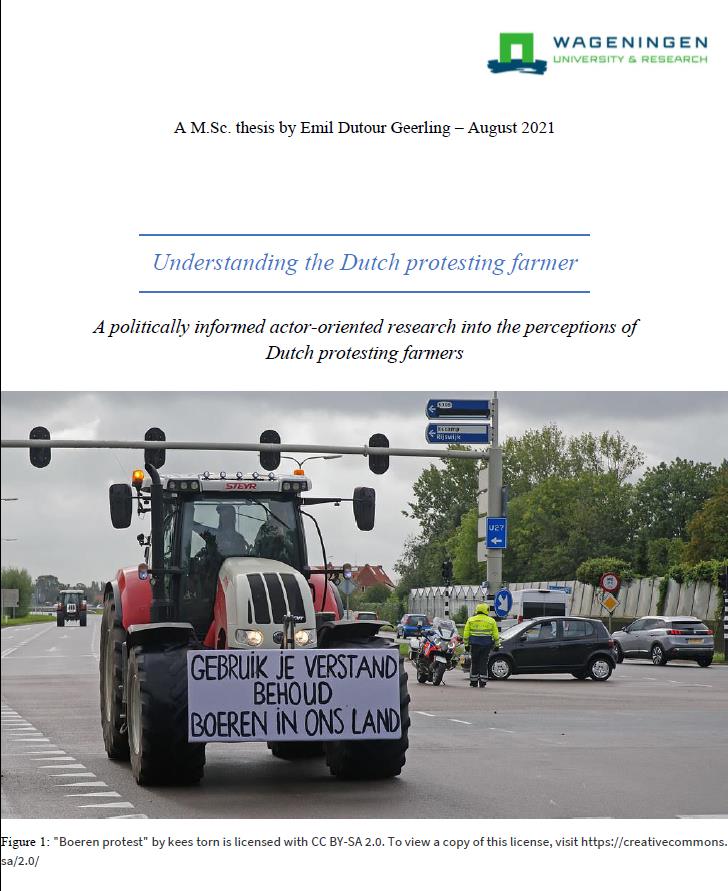
In our previous blog, we wrote that to understand the overall evolution of farmer protests around the nitrogen crisis, Jaap Frouws’ doctoral dissertation Mest en Macht (Manure and Power, 1994) is highly relevant.  Among others, his work provides a an important entry point into the history and the crisis of farmers’ representation and cooptation in agricultural policies in the Netherlands.  

Master student Emil Dutour Geerling delved into this question of representation in his recently defended thesis on the contemporary farmers’ protests. At the time Jaap Frouws did his important work on the politics of the manure crisis in the 1990s, the first cracks had become visible in the bulwark of farmers’ representation. Today, almost three decades later, the landscape of representation has changed dramatically. The long-time alliance between national farmers organizations, political parties and the ministry of agriculture, has become history.  Feeling under- or not-represented, and, importantly, not heard, discontented farmers established a defense force. This Farmers Defense Force was able to mobilize thousands of farmers, who were prepared to take a more confrontational approach, blocking highways and retail distribution centers, and converged on provincial government buildings.

In his work, Dutour-Geerling explains the form the protests take from the crisis in representation. Yet, he explains the cause of these protests in terms of a crisis of accumulation.  Many of the protesting farmers have built their business strategy on the idea of continuous growth, yet the new nitrogen and phosphate regulations make this business strategy untenable.

This crisis of representation and crisis of accumulation creates a ‘biographical disruption’: the future that farmers perceived for themselves and their farms is not feasible anymore. This asks for a reconsideration of their idea of farming, and their self-perception as farmers. Changing their farming strategy is, if possible at all, costly; the rethinking of their farmers’ identity painful. This explains the fierceness of the protests.

Emil Dutour Geerling. 2021. Understanding the Dutch protesting farmer: A politically informed actor-oriented research into the perceptions of Dutch protesting farmers, Master Thesis Rural Sociology in partial fulfilment of the degree of Master of Science in International Development Studies at Wageningen University, the Netherlands