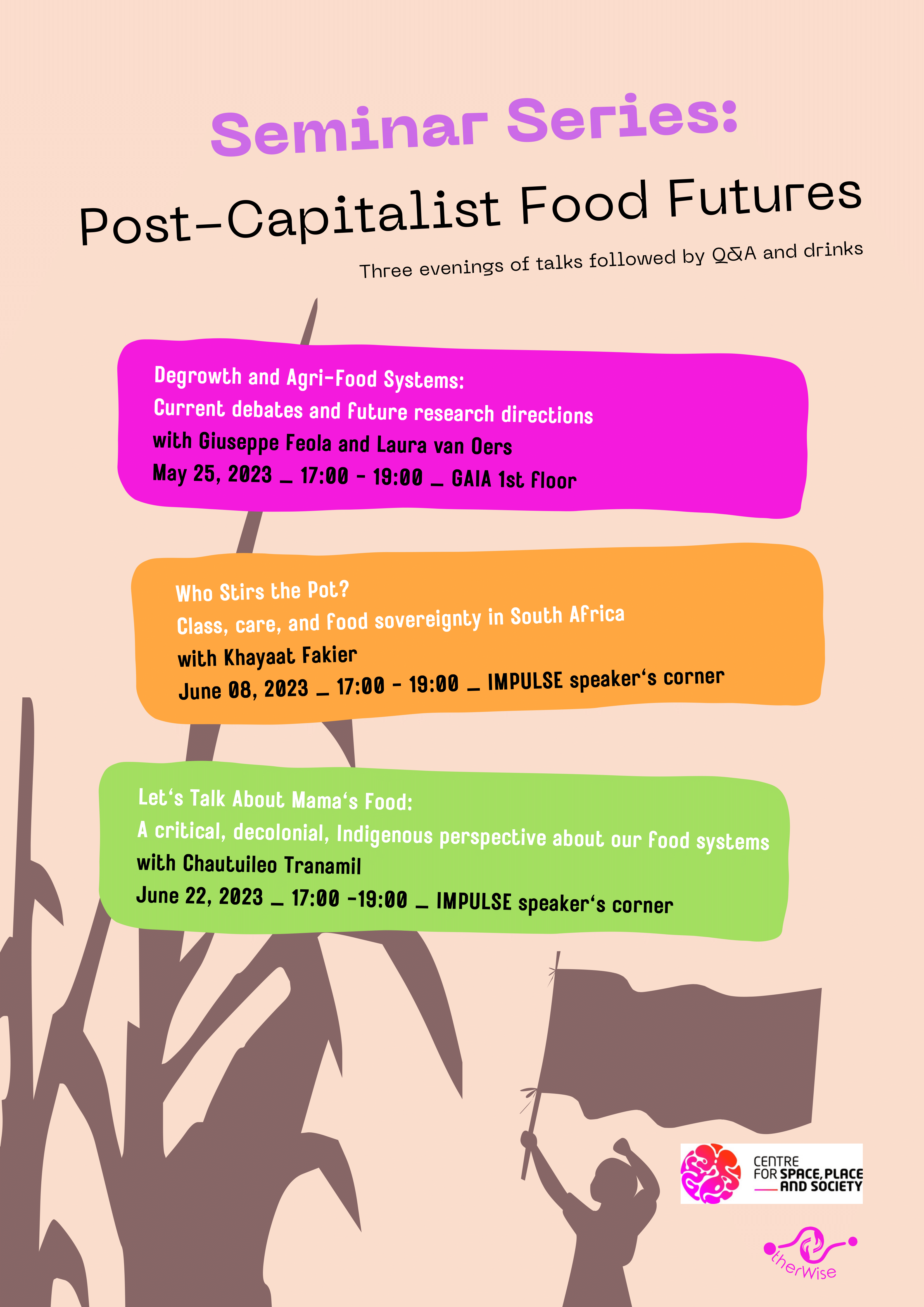
WASS Course | Agrarian, Environmental and Food Citizenship

Issues surrounding agriculture, the environment, and food systems have become central in public debate. This graduate-level course presents a unique opportunity for students to explore these debates through the lens of citizenship and its role in shaping fair and just agricultural, environmental, and food systems.

Key topics include:
>>Approaches and debates to citizenship and its relevance to contemporary agricultural, environmental, and food practices
>> Case studies highlighting successful initiatives and challenges in democratizing agricultural, environmental and food practices
>> The role of grassroots movements in practising inclusive citizenship

Throughout the course, students will develop critical thinking skills and analytical tools to assess the complexities of democratization efforts in these domains. By the end of the course, participants will gain a nuanced understanding of the role citizenship plays in shaping fair and just agricultural, environmental, and food systems, and will be equipped with insights to contribute meaningfully to ongoing debates and practices in this field.

The course adopts an interdisciplinary approach, drawing upon insights from political science, rural sociology, environmental studies, and agrarian studies. Through engaging lectures, discussions, readings, and case studies, participants will examine various dimensions of agrarian, environmental and food citizenship.

This course is intended for students doing a research master’s, PhDs, postdocs, and staff members who want to expand their engagement with the democratization of our agrarian, environmental and food practices and the citizenship approach to this.

More info here.
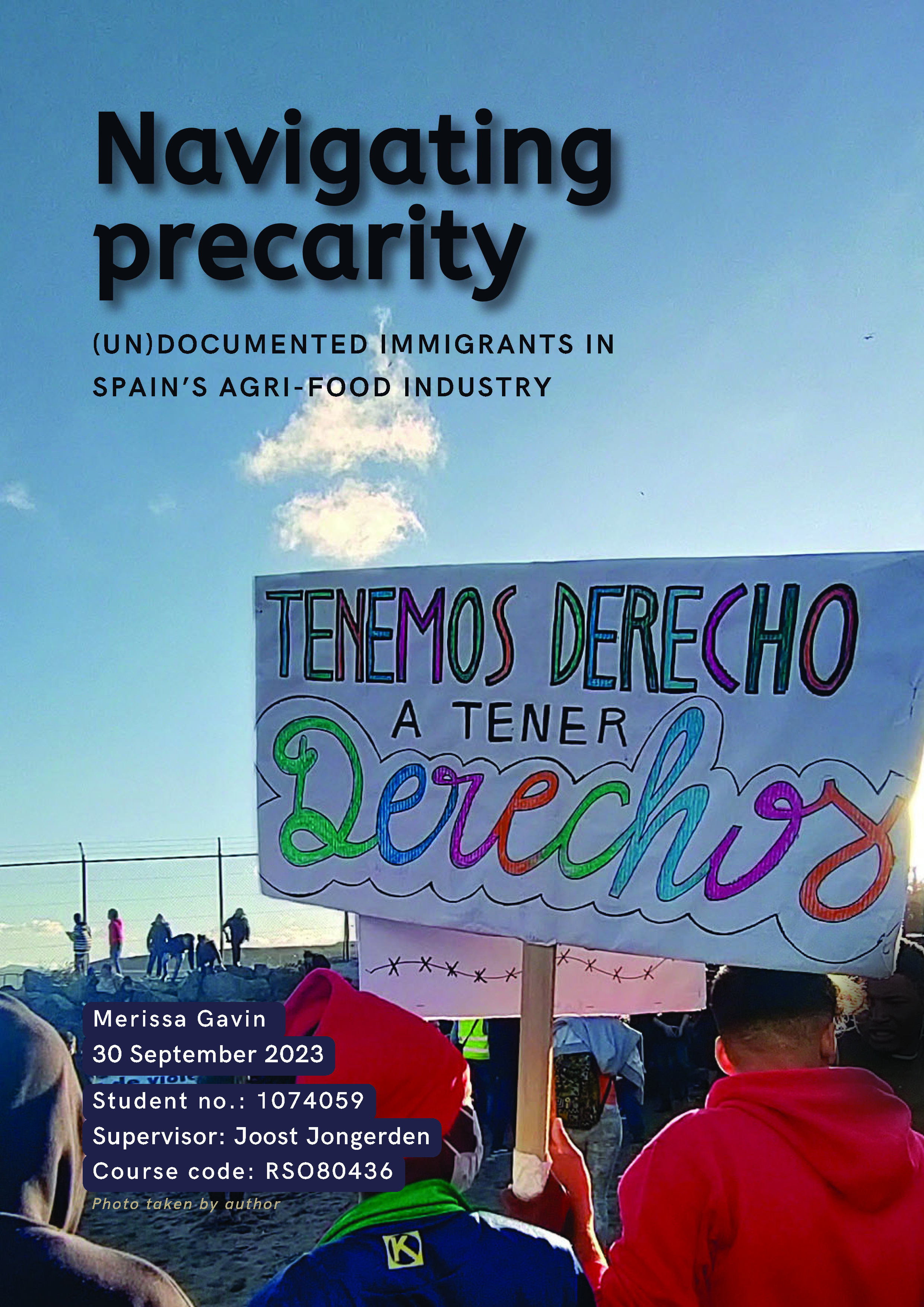
Navigating Precarity:  (Un)documented immigrants in Spain’s agri-food industry

In the master thesis “Navigating Precarity:  (Un)documented immigrants in Spain’s agri-food industry” Merissa Gavin discusses the strategies employed by immigrants in navigating precarity from the perspective of the immigrants themselves and new forms of being political are being created. The main question that guided her research was: “How do undocumented immigrant workers in Spain’s agri-food industry engage in claim-making and claim-living to navigate precarity?”

Over the last two decades, immigrant workers have become a structural element of Spain’s agri-food industry. Arriving to Spain undocumented, immigrant workers have few options other than the exploitative working conditions of the agricultural sector. The present research centres on the precarity of these workers, highlighting the multitude of ways they navigate vulnerability and uncertainty. This research is important, firstly, to raise the voice of undocumented immigrant workers and demonstrate how they exercise agency in everyday activities. Secondly, to investigate the socio-spatial conditions that facilitate, or obstruct, the emergence of a collective political being.

Continue reading

Internship: Governing food sharing in Utrecht

We are looking for a research intern to conduct scientific research on food sharing and governance in the Municipality of Utrecht as part of the EU-funded project CULTIVATE. Knowledge of Dutch and experience with qualitative research methods and analysis are essential.

CULTIVATE uses a multi-actor approach to build sustainability and resilience in urban and peri-urban areas through a ground-breaking online social innovation support platform – The Food Sharing Compass. Built with and for five key stakeholder groups – food sharing initiatives, policy makers, food supply actors, researchers and citizens – the platform will make it possible to navigate diverse food sharing landscapes and cultures, in order to understand, develop, replicate, expand and strengthen sustainable food sharing in Europe. In essence, CULTIVATE will establish the EU as the global frontrunner in the development of resilient and inclusive food sharing economies, identifying drivers and implementation gaps and challenging existing theories and practices which currently constrain sustainable food sharing.

Internship description: The intern will be participating in research which aims to better understand the evolution of, and help transform, existing policies, regulatory regimes, governance structures and habits to strengthen local food sharing economies, promote sustainable food sharing and prevent and reduce food waste.

The intern will part of the Rural Sociology Group of Wageningen University but the work will be based mainly in Utrecht from September 2023 to January 2024 (4 months, full time).

For questions about the position, please contact Dr Lucie Sovova lucie.sovova@wur.nl

Generally, the intern will support the WUR Research team and other members of the CULTIVATE to collect, organize and analyse information and data to help achieve the scientific objectives of the project, develop effective task management and collaboratively work, publish and disseminate project findings.

We seek highly motivated candidates to:

  • work in an international, innovative and multistakeholder project,
  • develop qualitative research skills while working with different types of stakeholders,
  • communicate and amplify scientific, policy and innovation knowledge around food sharing in Utrecht.

Key responsibilities:

  • Follow research protocols to analyse the urban food sharing governance landscape in the city of Utrecht with special focus on food waste, social and solidarity economies, and urban agriculture with support from the research team.
  • Work closely with university researchers and the Municipality of Utrecht to identify leverage points and pathways for transformative change, using scenario and backcasting tools.
  • Support the organisation of project meetings.

Expertise/Competence/Skills:

  • Excellent Dutch and English language skills are a requirement
  • Capable of working independently and meeting deadlines
  • Proven capacity to synthetize and communicate complex ideas
  • Experience with qualitative research methods, especially interviewing is an asset
  • Experience with data collection and policy analysis is an asset
  • Experience with food sharing initiatives is an asset
  • Experience working in diverse teams is an asset

Postcapitalism seminar series

As part of our new course ‘Beyond Sustainability: Theorizing post- and anti-capitalist food futures’ (RSO58806), we are curating an evening seminar series where we will welcome scholars and activists engaged in reimagining food and society more generally. You are cordially invited to join us for the seminars!

Researching in Zapatista Communities: Listen more, ask less

Beatriz Lopes Cerqueira, Master’s Student, Environmental Sciences – Environmental Policy at Wageningen University

For my MSc thesis research, I decided to travel to the home of one of my special interests, the Zapatista movement, which has been fighting with and for the dignity of the indigenous peoples of Chiapas, Mexico, and learn their particular views and practices towards Nature, natural resources and the preservation of the environment.

The relationship established between the Zapatistas and me followed what I believe to be the fundamental properties of emotional relations(hips) – those based on the mutual exchange of ideas and feelings, trust, and respect. For me, these kinds of connections require a careful management of our thoughts and feelings as emotional beings and the ways in which these are interchanged. Thus, for my research with the Zapatistas, I engaged in a long and complex process of analysing and evaluating the best way to create a relationship based on reciprocity and trust. Later on, I tried to apply these reflections in my own research process. Which methods and methodology would allow me to build trust with the Zapatistas, to conduct research without blindly extracting their knowledge? Which would be the best tools for telling the story of the Zapatistas’ ecological consciousness and the values, emotions and worldmaking processes that make up their cosmovision? For academic research, I believe that methodological choice(s) are the most important foundation for a steady and lasting relationship.

When I started to think about my fieldwork, I decided to do exploratory work in Oventik, one of the Zapatistas’ autonomous centres, in the highlands of Chiapas, before beginning.

Continue reading