Today I participated as a guest lecturer in the 8th semester course of Janne Liburd on “innovations in festivals and events” for Tourism & Business students. It is actually a ‘ capita selecta’ course and in today’s lecture we touched upon the relationship between rural development, European rural policy, asset based development and tourism. During this course, the students will also be introduced to a internet-based learning tool called Innotour which has just been launched. The website will serve as a platform for students, teachers and businesses in tourism to investigate innovative business cases and to exchange knowledge. For students it is a possibility to improve writing skills and to be involved in real life research settings by involvement in constructing business cases and research for partners connected to the network.
Category Archives: Education
Intensive Course Programme – agriculture, territorial identity and competitiveness in rural Poland
Since 2002, Rural Sociology Group is partner in a European Intensive Course Programme. MSc-students from universities across Europe can attend an intensive course programme of two weeks to study in depth rural issues in one of the particiapating countries. Earlier IP’s were organized in Ghent, Pisa, Cordoba, Faro, Malibor and, last year, in Kaunas, Lithuania.
As MSc-student I participated in the IP course in Lithuania last year and I have very good memories of the course which fully lived up to its name ‘intensive program’. The days were filled with lectures, excursions and activities aimed at providing us with a thorough inside into diverse problems (regarding society, environment and economy) encountered in rural Lithuania as well as teaching us methodological means to investigate these. On top of that, the course did not fail to allow for time to engage in social activities, providing the opportunity to get to know fellow course participants from various European countries. To support this unique opportunity to get acquainted with rural development in the EU, I will join this years’ IP as a tutor! Perhaps we will meet.
Agriculture, territorial identity and rural competitiveness
This year the IP is organized by the University of Life Sciences in Lublin, Poland, from April 19 till May 2. The IP is open for 52 students from the 13 partner universities. This year topic is the place of agriculture in territorial identity and competitiveness of rural areas and its contribution to rural development. Students that plan to do a minor or major in Rural Sociology and with an interest in the topic can apply and contact Jan Schakel: Jan.Schakel@wur.nl . A course programme and newsletter are available.
Vrienden van het Platteland – stage

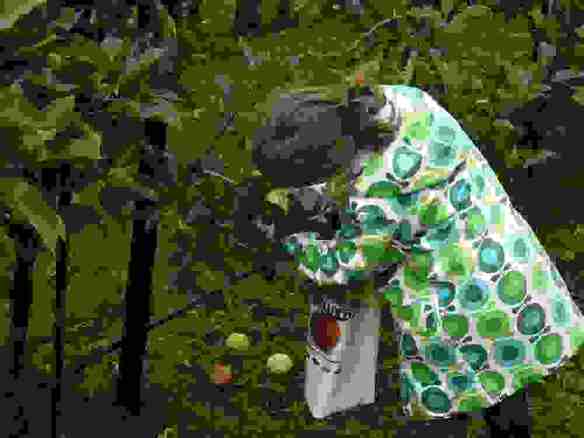
Appelplukdag 2008
Door Simone Plantinga – MSc-student
Van mei tot september 2008 heb ik stage gelopen bij Stichting Vrienden van het Platteland (VvhP) in Wageningen. VvhP is een organisatie die probeert de kloof stad – platteland te dichten door middel van verschillende activiteiten. Onder de noemer ‘Ontdek je band met het Platteland worden er het hele jaar verschillende evenementen (open boerderijdagen en fietstochten) georganiseerd, met als hoogtepunten in september de Appelplukdag en de Dag van het Platteland. De Plattelandsgids is een onderdeel van de website waar plattelandsondernemers hun verbrede activiteiten kunnen promoten.
Excursions give real-world examples
By Zachary Daly – exchange student at Wageningen University from Guelp University, Canada.
It’s always nice to be able to actually go out and see real-world examples of what you are studying and reading about in class. During the course Globalisation and Sustainability of Food Production and Consumption we had the opportunity to visit some farms. As such it was very interesting to see and talk to two organic farmers that are involved in alternative food provisioning networks, but work in a quite different way. The first farmer, Gerrit Marsman, has a mixed farm called De Eerste with a cheese factory and home delivery service, employing about 10 persons. He was ideologically very dedicated to what he was doing, talking about the madness of the global trade in feed and food, the health problems that the use of chemicals in agriculture cause, and the problem of a short-term and money-oriented economy leading to financial crisis. The second farmer, Rene de Lange, appeared to be less ideological motivated and more pragmatic. His family owns has a brand new farm with milking sheep in national park De Weerribben, a protected landscape of high cultural and natural value. A high milk production per sheep is important to him and his wife, as well as a hygiene-proof processing unit to make cheese, yoghurt, and ‘feta’. They market their products under the label of Weerribben Schapenzuivel (sheep dairy), through a wholesaler, to organic food shops all over The Netherlands, and even for export.
Rural development in Brazil
Prof. Fabio dal Soglio from the Federal University of Rio Grande de Sul (UFRGS) is currently our guest. He is one of the professors working in the Post-Graduate Programme on Rural Development (PGDR) and he has a particular interest in agro-ecology.
The UFRGS and the PGDR-group in particular wants to extend collaboration with the Rural Sociology Group, as initiated by prof. van der Ploeg, by the exchange of staff, exchange of MSc and PhD-students and by joint research.
As part of an assignment for the MSc-course Sociology in Development, a group of MSc-students grasped the occasion and interviewed prof. Fabio dal Soglio on the Landless Workers Movement (MST) in Brazil and their struggle for land and land reforms.
Quoted from the MST-website (English edition):
The MST is the largest social movement in Latin America with an estimated 1.5 million landless members organized in 23 out 27 states. The MST carries out long-overdue land reform in a country mired by unjust land distribution. In Brazil, 1.6% of the landowners control roughly half (46.8%) of the land on which crops could be grown. Just 3% of the population owns two-thirds of all arable lands.
Since 1985, the MST has peacefully occupied unused land where they have established cooperative farms, constructed houses, schools for children and adults and clinics, promoted indigenous cultures and a healthy and sustainable environment and gender equality. The MST has won land titles for more than 350,000 families in 2,000 settlements as a result of MST actions, and 180,000 encamped families currently await government recognition. Land occupations are rooted in the Brazilian Constitution, which says land that remains unproductive should be used for a larger social function.
The MST’s success lies in its ability to organize and educate. Members have not only managed to secure land, therefore food security for their families, but also continue to develop a sustainable socio-economic model that offers a concrete alternative to today’s globalization that puts profits before people and humanity.