Staggered by Queen’s speech

Yesterday Queen Beatrix held her annual Queen’s speech (Troonrede). I was astonished by her words about the Dutch agricultural sector. The text – written by our ‘demissionary cabinet’ – promoted a production- and export-oriented agriculture based on new technologies and innovations.

  “Nederland is de op één na grootste exporteur van land- en tuinbouwproducten. Het innovatieve en duurzame karakter van onze agrarische sector staat wereldwijd hoog aangeschreven. Ons land kan een belangrijke bijdrage leveren aan de mondiale voedselzekerheid door te blijven werken aan verbetering van de huidige technologieën. De overheid schept hierbij randvoorwaarden voor duurzame productiemethoden.” – Troonrede 21 september 2010 

These words could have been written decades ago – in the era of maximizing agricultural production when high levels of technology promised to solve the problems – only this time such promises are headed under the name ‘sustainable production methods’. But by now, we should have learned our lessons over time; technology can help to find solutions, but only if these also fit into our social and cultural world.

Listening to the Queen’s speech, maybe I am the one who’s mistaken here. Apparently, we are in this era of maximal production, maybe even more than we have ever been. Despite alarming societal organizations and increased social concerns about for example the way animals are treated in our society, ‘we’ keep on producing food in a production-oriented way. I was astonished by the lack of the nuances in this speech: what about regional production? and organic agriculture? What about animal welfare issues? What about environmental load? What about the consequences of our production for African agriculture and food supply? Do the writers of this speech really believe that we can solve such issues by merely focusing (and hoping!) for new technologies?!

I appreciate – just as many citizens in my research (see former blogs) – several achievements of technological developments, but it is all about making trade-offs. How far do we want to go? Unfortunately such decisions are often money-based without giving much thought to social consequences. I am really disappointed that our ‘demissionary cabinet’ carries out such a message. Moreover, my concerns about the future of agriculture and equal food production – both in the Netherlands and world-wide – had been confirmed: Where are we going?! I had hoped for a more nuanced vision, including themes such as regional production, animal welfare and the environment.

Sus Anna; The Peergroup

The story continues with the feeding (see earlier blogs). Feeding Alie, Rinus, Anna and Bom was my task. For the afternoon snack I collected half a bucket of acorns along the street. They looked like vacuum cleaners, quickly hovering up the spread around acorns. For dinner they first ate some bananas, spread around again to make it possible for me to reach the feeding hod with cooked potatoes. The moment the potatoes hit the hod they stormed at it to be the first. The second round of soaked muesli in milk ended in my a narrow escape from being run over.

A proverb goes like ‘one pig won’t get fat’. Alone, they eat gently from your hand. It is the peer group which makes the pigs extremely competitive. How human. Among peers they aggressively have to assert themselves. It reminded me of someone’s story. Growing up in a family with ten kids in the early sixties, the fiancées of bigger sisters were put to the test at the dinner table. Leaving the precious meat for the last bite they always found an empty plate once their fork finally reached out for it.

Alie, is the leader of this small group and therefore the biggest. Anna is the smallest. She is always struggling to get enough. She only eats when she has assured herself that no one is coming after her. When I threw in some spread around bread pieces she just ate one, walking around with it searching a safe place while the others were grabbing the next pieces coming from me.

Sus Bom; digging up the border

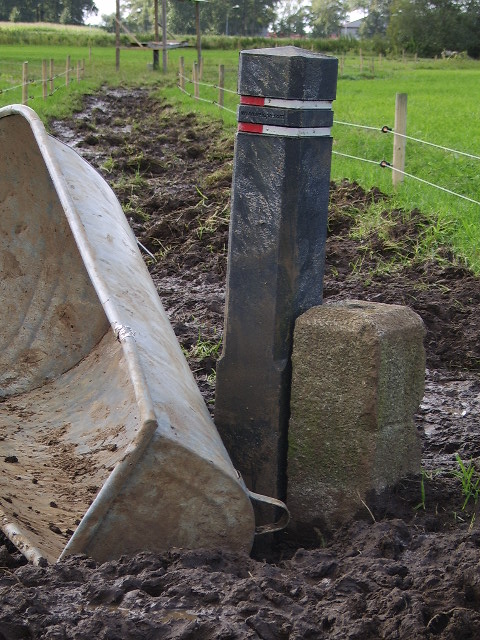
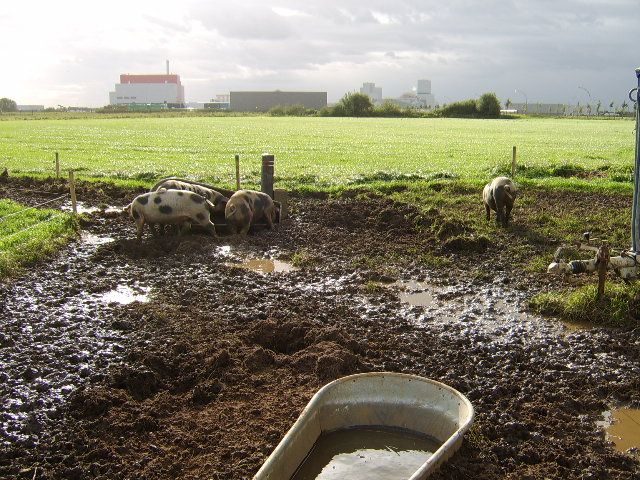
The mobile ‘farm’ is built as self contained solar artist-in-residence (see earlier blog) with an upstairs sea container as a living unit and a downstairs working shed, now in use as pig barn. Looking at Coevorden’s industry on the horizon, I spent a stormy night literally located on the border between the Netherlands and Germany. Border markers run through the middle of the field. The pigs freely walk to Germany and back, with no worries about different rules and regulations. 

Their snouts are not ringed – something which still is allowed in Germany. This means they can do what they most like; digging up the soil. Their border walkway looks like a freshly ploughed field with an occasional mud pool where they dug a particularly deep hole. They spend most of the day re-doing their previous digging, if not sleeping, taking a mud bath, eating grass and being fed. 

border marker

Pigs have bad vision but have extremely good ears. Bom keeps an ear on me when they all go for an afternoon nap. Piled on top of each other they lightly sleep. If one moves it takes a while with small talk oink’s before they sleep again. I try to be silent but a click of the camera is enough for Bom’s ear to raise. It stays alertly horizontal and a subsequent oink wakes up all for a new digging round.

Sus domestica Alie; Bunte Bentheimers

I am living with Alie, Rinus, Anna and Bom today. I am assistant-farmer for 24 hours. This means I have the responsibility for the care and well-being of four ‘Bunte Bentheimer’ pigs. This breed is known to be very social but also a bit slower in growth and with a bit fattier meat. Such meat is not in fashion at the moment. The breed almost disappeared. 

Alie, Rinus, Anna and Bom are part of the art project “The year of the pig” of Elles Kiers and Sjef Meijman which connects visual and culinary art with animal husbandry (see also tomorrow’s Volkskrant). The industrial production of meat – and food in general – is more and more seen problematic. Pig production takes place behind closed doors and hygienic corridors. The confined and artificial circumstances alters their natural behaviour. Today’s livestock industry is a complex story with many different points of view. To make rearing pigs visible, such as is done here, is a guarantee for debate. 

Alie

 Nearby farmers came to visit. Afraid of contamination they were extremely careful. And angry. For the difference in what they have to comply with and take into account in contrast to the simple way in which the pigs are held here. Vegetarians have been angry too. For the fact that these pigs are reared to be eaten. Rinus – the gentle red-haired male – is most likely the first candidate being the larger of the two men.

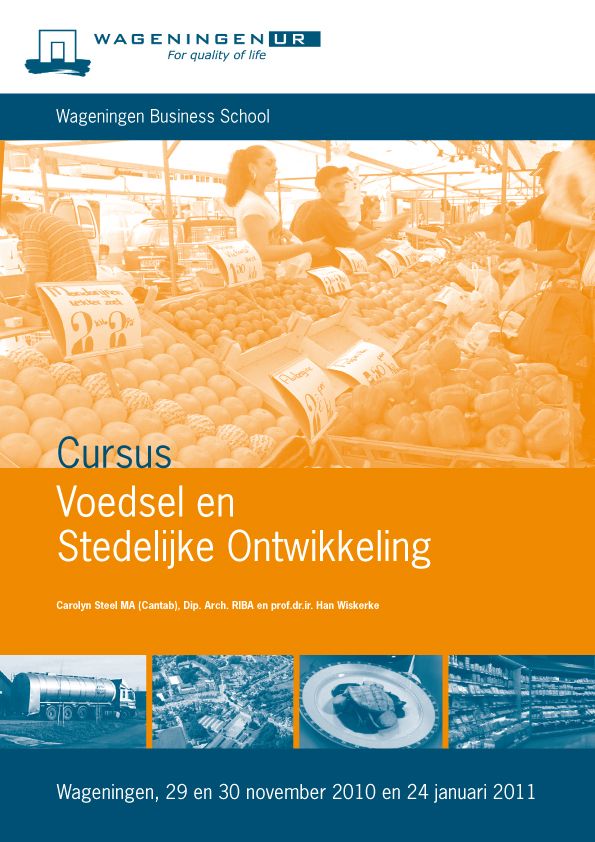
Cursus ‘Voedsel en Stedelijke Ontwikkeling’

Op 29 en 30 november 2010 en 24 januari 2011 verzorgen Carolyn Steel en ik voor Wageningen Business School een cursus over de relatie tussen voedsel en stedelijke ontwikkeling. Deze cursus is toegankelijk voor een breed publiek: beleidsmakers, architecten, landschapsarchitecten, stedelijk ontwerpers, eco-ontwerpers, docenten en mensen die in de landbouw, voedingsmiddelen- of gezondheidsindustrie werken. Daarnaast is iedereen die geïnteresseerd is in duurzame (stedelijke) ontwikkeling van harte welkom.

De aanleiding voor deze cursus is gelegen in de trend van bevolkingsgroei en voortschrijdende verstedelijking en het daarmee samenhangende spectrum aan sociale, economische en ecologische uitdagingen. Klimaatverandering, slinkende olie voorraden en het uitputten van natuurlijke hulpbronnen, gecombineerd met sociale kwesties als armoede, honger en obesitas, vormen de achtergrond voor complexe beleids- en planningsvraagstukken. De verbindende vraag in deze is hoe steden in de toekomst te voeden op een rechtvaardige en duurzame manier.

Als de toekomst inderdaad verstedelijkt is, moeten we dringend (her)definiëren wat dit inhoudt. Huidige aannames over verstedelijking, ontstaan in een tijd die voornamelijk ruraal was, zijn verouderd. We hebben een nieuwe visie nodig op steden en de relatie die zij hebben met het platteland dat hen moet voeden. Als wijzelf en onze toekomstige generaties “goed” willen kunnen leven, moeten we nieuwe inzichten ontwikkelen met betrekking tot wonen, ontwerpen en samenwerkingsverbanden. Hoe we dat moeten doen, is de kern van deze cursus.

Deze cursus is gebaseerd op en geïnspireerd door het boek Hungry City van Carolyn Steel. Hierin analyseert ze stedelijke ontwikkeling vanuit het perspectief van voedsel. Voedsel is de verbindende factor tussen tal van stedelijke uitdagingen, variërend van de ecologische footprint en klimaatverandering tot welzijn en gezondheidsvraagstukken. Door de verbinding met voedsel zichtbaar te maken, krijgen planners en beleidsmakers een middel in handen om hun aanpak te herdefiniëren en deze meer toe te spitsen op een duurzame stedelijke en rurale ontwikkeling. Cursisten leren door dit perspectief de relatie te zien tussen voedsel en verschillende publieke domeinen. Door deze relatie te begrijpen, wordt inzicht verkregen in de kwaliteit van beleid, in de samenhang van beleidsterreinen en in de verbanden tussen lokale en globale kwesties. Cursisten leren werken in multi-disciplinaire teams, waarbij voedsel als gemeenschappelijke taal en verbindende factor gebruikt.

Klik op de volgende links om je in te schrijven of om de cursusfolder te downloaden.