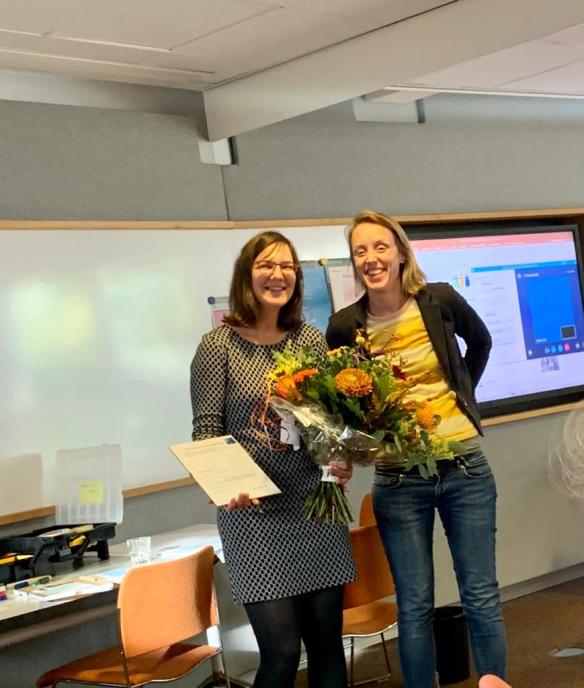
On Tuesday the 29th of October, Lucie Sovová, PhD student at the Rural Sociology Group, won an honourable distinction from the Storm-van der Chijs Fund. The objective of this fund is to encourage and support Wageningen University female PhD students to pursue their study and career in science.
The RSO chair group nominated Lucie, and soon found out that she was awarded the honourable distinction. As head of the jury Prof dr ir Arnold Bregt stated that Lucie “bridges urban gardening and alternative food networks. In her work on Central and Eastern Europe, she questions framing informal food economies as remnants of the socialist era. She shows how they are not necessarily “inferior” to, but merely coexisting and interacting with their market-based counterparts. Next to her academic work she is in many ways involved and contributing to NGOs in this field.”
The honourable distinction comes with 500 euros, which Lucie plans on spending by visiting a conference in Manchester.
Well, the last four months has been a whirlwind of moving houses, living out of suitcases, new climates, new friends, stroopwafel, bicycles and mind-blowing public transport (for an Australian, anyway). Having finally set up some photos on my desk, and unpacked all my boxes, I thought it was time to introduce myself to all you past, present and future RSO blog readers out there.
Moving to the Netherlands to join WUR has
been a mix of the old and the new for me. It’s been a great thrill to reconnect
with friends and colleagues from around the world who have also found their way
to Wageningen, including some fellow survivors from my PhD days in the
Geography school at the University of Sydney.
A little bit about me then…Coming from an
environmental science/development studies background, it was in Sydney that I
discovered my love for the discipline of Geography (how does a geographer end
up in a sociology group you may ask? More on that later). There, I pursued a PhD
thesis project working with small farmers in Maharashtra, India who were being
enrolled in potato contract farming schemes by agribusiness firms.
It was through this work that I developed
my ongoing interest in what is known as ‘the Agrarian Question’, which connects
to old debates about agrarian change and rural development going all the way
back to Karl Marx himself, implicating Lenin, Karl
Kautsky, and Alexander
Chayanov along the way, before being renewed and applied to current
agrarian and rural development problems by my contemporary intellectual heroes
including Henry Bernstein, Harriet Friedmann, Michael Watts and Jan Douwe van
der Ploeg. My time in India also triggered a life-long love affair with the
country (not to mention the humble potato…).
That interest has since taking me to Indonesia
(working with smallholder coffee farmers engaged in global value chains), Myanmar (working on a
large-scale rural poverty, food and nutrition security, and livelihoods
project), and back to India (studying the links between land and livelihoods).
My own take on rural development in South and Southeast Asia is that we need
approaches that bridge the structural insights of agrarian political economy
with a ‘people-first’ approach that explicitly acknowledges the agency of rural
people.
My ongoing task then has been to break down
unhelpful dualisms by attempting to construct a political economy of everyday
livelihoods in South and Southeast Asia. If you’re interested, you can find a
list of my publications here. I’d love to hear from any students interested
in pursuing a thesis on any of these topics!
Back to the new about moving to WUR. Well,
while I’ve always looked to Wageningen as a place I’d love to work, I never
quite saw myself joining a sociology group! Of course, there is a lot of
overlap between geography and sociology, and you can find us geographers
infiltrating all sorts of university departments all over the world.
One challenge I’m looking forward to is
learning about the different frameworks and conceptual approaches that my
colleagues at WUR apply to these common themes of sustainability, justice, equity
and transformation in global food systems, while also getting my head around
the teaching program! This academic year, you’ll be able to find me teaching
into RSO34806 (Transforming
Food Systems), RSO21806
(Origin Food), and RSO20806
(Agricultural and Rural Development). I’m excited to meet all the students
studying these courses!
Finally, with my lovely partner, Katharine
(who is actually a sociologist, and an amazing one at that!), we have a
project investigating social, organisational and technological change in the
global hops industry. I have to say, this involves the most enjoyable fieldwork
I’ve been a part of. If you are interested in craft beer, the sociology of
agricultural, and talking with hop farmers we
are currently looking for one or two thesis students to work on this topic.
As winter approaches, I am starting to miss
the sun and surf of Sydney a little bit. However, the cosy houses, the numerous
Wageningen pubs, day trips to Den Haag, my clumsy attempts at learning Dutch,
and my wonderful new colleagues more than make up for it. Thanks to everyone
for the warm welcome so far, and I’m looking forward to all that is ahead in
RSO!
Are you interested in the politics and governance of community and allotment gardening ? How these gardens can become more inclusive? And what lessons gardeners in Berlin and Warsaw can exchange?
The research project “Integration von Kleingärten und Gemeinschaftsgärten in Warschau und Berlin” seeks a German speaking research assistant.
We are looking for a person with:
– German language (spoken and written).
– Research interest in the topic of urban gardening;
– Training and experience with qualitative research methods
– Knowledge about Berlin allotment and community gardens’ and/or administrative situation and structure;
Project duration December 2019 – March 2021
November/December 2019 – Kick off. Interviewing gardeners, the city administration, city dwellers and other persons related to the topic – in Berlin (December and January)
May 2020 – Focus Groups in Warsaw and Berlin, a visit of Berliners to Warsaw
September 2020 – VISIS workshops on challenges and opportunities of this integration.
March 2021 – final meeting in Warsaw
The rest of the time is for research, reading, meeting with the project team, writing and meetings in gardens (action research).
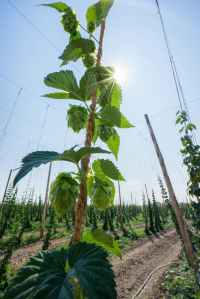
With the rapid expansion of the craft beer sector globally, the organization of hop production is changing in producing countries. We seek one or two MSc students to conduct a primarily qualitative study on how interrelated social, economic and ecological dynamics shape sustainability outcomes (broadly conceived) in a rapidly expanding and changing industry. Potential topics of focus include the role of plant breeding and new varieties, trade-offs between cooperative vs competitive relationships, and how changing beer markets are influencing how people produce, sell and use hops. Potential frameworks include STS, Assemblage Theory, Global Value Chain Analysis and Political Economy. Students may choose to complete fieldwork and data collection in one of the target countries of New Zealand, UK, Belgium, US, and Germany.
Photo by ELEVATE on Pexels.com
Pre-requisites:
You have some training in qualitative methods and critical social theory
You have a keen interest in the sociology of agriculture, food systems, sustainability, food politics and/or foodscapes
You are willing to develop fieldwork-based methodologies
You have completed at least two social sciences courses, preferably with RSO
Er is een forse toename in het aantal netwerken en pioniers op gebied van innovatieve agri-food systemen. Ze ontstaan vanuit de agrarische produktiekant en ook vanuit de consumentenkant en willen een alternatief bieden voor de dominante voedsel- en landbouwpraktijk. Ze richten zich vaak op de lokale context, werken integraal met aandacht voor biodiversiteit, koolstof vastlegging, betrekken van burgers en een gezonde leefomgeving. Voorbeelden zijn Heerenboeren, Community Supported Agriculture, Food Forests, Agro-ecological agriculture, bodemboeren en toekomstboeren. Bij veel van dit soort innovatieve agri-food systemen wordt uitgegaan van agro-ecologische principes.
De verschillende initiatieven ontwikkelen zich tot grotere netwerken die de ambitie hebben om te komen tot een gezamenlijke beweging. Wellicht met een gezamenlijk loket en/of steunpunt om zo aanspreekpunt te kunnen zijn voor beleid, onderzoek en andere partijen.
Om een goede strategie en aanpak te ontwikkelen voor het creëren van een sterke beweging met impact is het van belang de verschillende initiatieven en hun onderliggende waarden en principes goed in beeld te brengen.
We zoeken studenten die interesse hebben mee te werken aan deze ontwikkeling van de vernieuwende landbouwbeweging.
Onderwerpen van een thesis of stage project kunnen zijn:
In beeld brengen van de initiatieven en netwerken
In beeld brengen van de onderliggende visie/principes van de verschillende initiatieven en initiatiefnemers
In beeld brengen aan welke maatschappelijke uitdagingen initiatiefnemers een bijdrage willen leveren.
Strategie en aanpak ontwikkelen om de impact van deze vernieuwende initiatieven meer bekend te maken en breder ingang te laten vinden en bruggen te slaan met meer reguliere vormen van landbouw produktie.