Sustainable food planning conference – reminder & update

As mentioned in my blog of 28 August 2009 the Association of European Schools of Planning (AESOP), the International Studygroup on Multiple Use of Land (ISOMUL) and the Rural Sociology Group are hosting the first European Sustainable Food Planning conference. The conference will take place at De Kemphaan in the city of Almere in the Netherlands on 9 and 10 October 2009. It is still possible to register for this conference. If you are interested to participate in this conference, please apply by e-mail to corine.diepeveen@wur.nl. Costs for participation are € 100,- (incl. drinks, lunches and diner).

City estate De Kemphaan

Since the first announcement a couple of weeks ago, the conference programme has changed slightly. Below you can find the most recent version of the programme:

Day 1 – Generating ideas, exchanging experiences and comparing perspectives

09.00 – 09.30

Welcome and coffee/tea

09.30 – 09.45 Food and planning: an introduction to the conference Prof. Kevin Morgan (Professor of Governance & Development, Cardiff University, UK)
09.45 – 10.00 Including food and agriculture in urban planning: the Almere approach Mr. Henk Mulder (director urban planning Almere)
10.00 – 11.00

Session 1: Setting the scene

10.00 – 10.30 An integrated and territorial perspective on food studies, policy and planning Prof. Han Wiskerke (Chair of Rural Sociology – Wageningen University, Netherlands)
10.30 – 11.00 Feeding the city: practices, challenges and lessons from developing countries Mr. Henk de Zeeuw (director of the RUAF Foundation)
11.00 – 11.30

Coffee/tea break

11.30 – 13.00

Session 2: Theoretical perspectives and academic issues

11.30 – 12.00 Reconnecting consumers and producers:  dynamics, diversity and potentials of alternative food networks Prof. Gianluca Brunori (Professor of Agriculture Economics – Pisa University, Italy)
12.00 – 12.30 Urban food and public spaces: planning for security and sustainability Dr. Roberta Sonnino (Lecturer in Environmental Planning – Cardiff University, UK)
12.30 – 13.00 Food and the city: the links between food, public health and sustainable urban development Dr. Martin Caraher (Reader in Food & Health Policies – City University London, UK)
13.00 – 14.00

Lunch break

14.00 – 15.30

Session 3: Food planning practices and policies

14.00 – 14.30 Food and agriculture in Europe’s peri-urban regions Mrs. Dwarshuis (President of Peri-Urban Regions Platform Europe – PURPLE)  
14.30 – 14.50 The practice of food planning in New York city Dr. Nevin Cohen (Associate Professor in Urban Studies – New School for Liberal Arts, New York)
14.50 – 15.10 The practice of food planning in New York state Mr. Bob Lewis (senior planner New York State)
15.10 – 15.30 Amsterdam’s food strategy (“Proeftuin Amsterdam”) Mr. Bart Pijnenburg MSc (Programme manager Proeftuin Amsterdam)
15.30 – 16.00

Coffee/tea break

16.00 – 18.00 Excursion to City Farm Almere Tineke van den Berg (urban farmer)
19.30 – 22.30

Diner (Restaurant De Kemphaan – Almere)

Day 2 – Towards an agenda for sustainable food planning

09.00 – 09.30

Welcome and coffee/tea

09.30 – 10.00 Including food in planning studies and planning practices: experiences from the USA Prof. Jerry Kaufman (Professor Emeritus of Urban and Regional Planning – University of Wisconsin-Madison, USA)
10.00 – 10.45 Issues, topics, themes for a sustainable food planning agenda (plenary inventory) Moderated by Prof. Arnold van der Valk (Chair of Land Use Planning – Wageningen University, NL)
10.45 – 11.15

Coffee/tea break

11.15 – 12.45 Developing the building blocks for a sustainable food planning agenda (parallel working sessions)
12.45 – 14.00

Lunch break

14.00 – 14.45 Plenary presentation of and discussion about results of parallel working sessions Moderated by Prof. Terry Marsden (Professor of Environmental Planning – Cardiff University, UK)
14.45 – 15.00 Sustainable food planning in Europe: concluding reflection and look ahead Prof. Kevin Morgan (Professor of Governance & Development, Cardiff University, UK)
15.00

Coffee & tea / end of conference


Sustainable food planning conference

AESOP logoOn 9 and 10 October 2009 the first Sustainable Food Planning Conference will be held. This conference is an initiative of the AESOP (Association of European Schools of Planning), the ISOMUL (International Studygroup On Multiple Use of Land) and the Rural Sociology Group of Wageningen University.

The sustainable food planning conference is organized to examine the role of food in urban and regional planning. Although political, societal and academic interests in food and the city are rapidly increasing, food largely remains a stranger to the field of urban and regional planning, spatial planning policies and planning studies. Recently the American Planning Association launched its Policy Guide on Community and Regional Food Planning. Inspired by this policy guide, this conference seeks to explore ways in which food can and should be incorporated in planning practices, policies and research and develop strategies for enhancing sustainable food planning in Europe. The character of the conference is primarily agenda-setting by establishing a network of planning practitioners, policymakers and agrifood and planning scholars in Europe and beyond.

.

Restaurant and meeting centre De Kemphaan (source: http://www.restaurantdekemphaan.nl/content/ons_bedrijf)

Restaurant and meeting centre De Kemphaan (source: http://www.restaurantdekemphaan.nl/content/ons_bedrijf)

The conference will take place at De Kemphaan in the city of Almere in the Netherlands. If you are interested to participate in this conference, please apply by e-mail to corine.diepeveen@wur.nl. Costs for participation are € 100,- (incl. drinks, lunches and diner). The number of participants is limited to 50 persons. For more information have a look at the conference programme below:


Day 1 – Generating ideas, exchanging experiences and comparing perspectives

09.00 – 09.30

Welcome and coffee/tea

09.30 – 09.45 Food and planning: an introduction to the conference Prof. Kevin Morgan (Professor of Governance & Development, Cardiff University, UK)
09.45 – 10.00 Including food and agriculture in urban planning: the Almere approach Mr. Henk Mulder (Almere municipality – director urban development and planning) 
10.00 – 10.30 An integrated and territorial perspective on food studies, policy and planning Prof. Han Wiskerke (Chair of Rural Sociology – Wageningen University, NL)
10.30 – 11.00

Coffee/tea break

11.00 – 12.00

Session 1: Agri-food policy issues

11.00 – 11.30 Food and agriculture in Europe’s peri-urban regions Mrs. Dwarshuis (President of Peri-Urban Regions Platform Europe – PURPLE)
11.30 – 12.00 Feeding the city: practices, challenges and lessons from developing countries Mr. Henk de Zeeuw (director RUAF foundation)
12.00 – 13.00

Session 2: Urban food planning practices

12.00 – 12.20 The practice of food planning in New York City Dr. Nevin Cohen (Associate Professor in Urban Studies at the New School for Liberal Arts, New York
12.20 – 12.40 The practice of food planning in New York State Mr. Bob Lewis (Senior Planner New York State)
12.40 – 13.00 Amsterdam’s food strategy (“Proeftuin Amsterdam) Mr. Bart Pijnenburg(Programme manager Proeftuin Amsterdam)
13.00 – 14.00

Lunch break

14.00 – 15.30

Session 3: Theoretical perspectives and academic issues

14.00 – 14.30 Reconnecting consumers and producers:  dynamics, diversity and potentials of alternative food networks Prof. Gianluca Brunori (Professor of Agriculture Economics – Pisa University, Italy)
14.30 – 15.00 Urban Food and Public Spaces: Planning for Security and Sustainability Dr. Roberta Sonnino (Lecturer in Environmental Planning – Cardiff University, UK)
15.00 – 15.30 Food and the city: the links between food, public health and sustainable urban development Dr. Martin Caraher (Reader in Food & Health Policies, City University London, UK)
15.30 – 16.00

Coffee/tea break

16.00 – 18.00 Excursion to City Farm Almere Tineke van den Berg (urban farmer)
19.30 – 22.30

Drinks & Diner

Day 2 – Towards an agenda for sustainable food planning

09.00 – 09.30

Welcome and coffee/tea

09.30 – 10.00 Including food in planning studies and planning practices: experiences from the USA Prof. Jerry Kaufman (Professor Emeritus of Urban and Regional Planning – University of Wisconsin-Madison, USA)
10.00 – 10.45 Issues, topics, themes for a sustainable food planning agenda (plenary inventory) Moderated by Prof. Arnold van der Valk (Professor of Land Use Planning – Wageningen University, The Netherlands)
10.45 – 11.15

Coffee/tea break

11.15 – 12.45 Developing the building blocks for a sustainable food planning agenda (parallel working sessions)
12.45 – 14.00

Lunch break

14.00 – 14.45 Plenary presentation of and discussion about results of parallel working sessions Moderated by Prof. Terry Marsden (Professor of Environmental Policy – Cardiff University, UK)
14.45 – 15.00 Sustainable food planning in Europe: concluding reflection and look ahead Prof. Kevin Morgan (Professor of Governance & Development, Cardiff University, UK)
15.00

Coffee & tea / end of conference

Rural development driven by unfolding rural webs

Today the main outcomes of the EU-funded project ETUDE were presented by our colleagues Jan Douwe van der Ploeg (scientific coordinator of ETUDE), Rudolf van Broekhuizen (project-coordinator) and Henk Oostindie (senior researcher).  Main finding is that neither policy, nor markets or grass root rural development activities are by itself decisive for successful rural development, but the web of different and increasingly interlinked networks. Or as Jan Douwe van der Ploeg states:

Successful rural development is rooted in a myriad of encounters, transactions, interactions and networks that link people, resources, activities and markets. (Source: E-magazine by British Publisher, pp. 64-65). 

Van der Ploeg & Marsden (in ‘Some Final Reflections’, the concluding chapter in the book ‘Unfolding webs’ , p 227) refer to these rural web as emerging counter-structures: 

because rural development processes (that are grounded upon and resulting from this web) are essentially transitional: they represent a major shift that takes many years to occur and which proceeds through changing conditions of invisibility and confusion. Visibility, coherence and comprehension only occur during, and as an effect of, this transition. We also refer to the rural web as a counter-structure because it increasingly helps to deal with complexity (especially Chapter 8 of this Volume), creating simultaneously new patterns of coherence. All this relates to the contested nature of rural development: what might be highly meaningful in terms of the rural web, might be insignificant or even ludicrous at the level of the dominant structure. What we are beginning to conceptually explain here, therefore, are the particular dynamic qualities (both new coherences and contestations) of web formation. These are, indeed, built out of the seeming contradiction between creating counter-structures to prevailing conditions, at the same time as re-creating new coherences out of these very deviations and ruptures.

The project has come to a closure. The findings and recommendations will soon be published in a second book. Earlier publications, such as the chapters of the first book ‘Unfolding webs’, edited by Jan Douwe van der Ploeg & Terry Marsden and published by Royal Van Gorcum, and deliverables (e.g. case study reports) can be downloaded at the ETUDE-website.

For more information on the outcomes you can contact one of the colleagues.

Food and the city

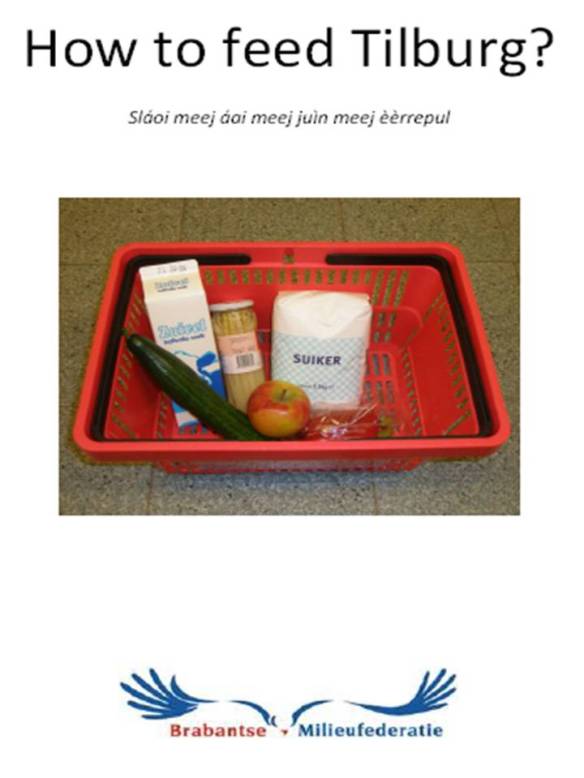
Cover "How to feed Tilburg"In the past two months a group of 5 Master students of Wageningen University carried out an exploratory study on food consumption in the city of Tilburg. This study was commissioned by the Environmental Federation of the province of Brabant (BMF). Tilburg has the ambition to become a climate neutral city in 2045, yet the issue of food is lacking in the city’s climate programme. Given the fact that approximately 40% of the urban citizen’s ecological footprint is related to food and that food production and transport make up a significant portion of a city’s CO2 emission, it will be impossible to become a climate neutral city without including a food strategy in the city’s climate programme. For this reason the BMF asked this group of students to calculate/estimate Tilburg’s total food consumption and to give a first impression of the food miles and food transport related CO2 emission of several food products (e.g. apple, sugar, sweet pepper, asparagus, milk, cucumber) for different outlets (e.g. a supermarket, a greengrocer, an organic supermarket and a farm shop). The food miles and related CO2 emissions were calculated on the basis of the products that were sold at each outlet end of March/beginning of April this year, so they only represent the situation at that moment in time. On Wednesday April 22 the group presented their findings.

Some findings I found interesting and/or intriguing: Continue reading

Balancing between multiple realites

By Marlies Meijer, MSc-student combining Land Use Planning and Rural Sociology

“Only when we travel, and meet strangers, do we recognise other ways of being human” (Patsy Healey in Collaborative Planning, after Latour).

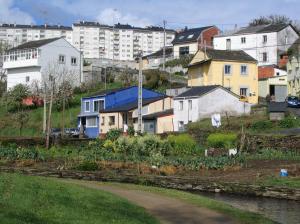
city - countryside transition in galicia

city - countryside transition in galicia

So here I am, travelling (or balancing) between land use planning and rural sociology, my Dutch planning knowledge and the Galician rural reality, between reading in Gallego, speaking in Castellano, writing in English and chatting in Dutch, between the Spanish working hours and my Dutch empty stomach.

As many students I wanted to stay abroad for a long period of time during my MSc. For students in rural sociology this is probably a logical highlight of their studies; students in land use planning leave their country less frequently. I wanted to go anyway. Since my interest in rural dynamics and policy making processes, contact with the RSO group was established quickly, together with the possibility to go to Galicia, Northern Spain.

Back in the Netherlands, I was aware of the Dutch context of my education so far. Most examples provided are Dutch, or could be placed in the planning Dutch context. I wanted to broaden my scope, go somewhere where policy making is less evident and face the effect of a different cultural context, but also to experience a real rural area. Now I find it hard to let the familiar Dutch context go and to explain what I exactly do study in the Netherlands (something like geography, people making plans and rural development) and what my research is about (even more vague). Multi-faceted policy, focussed on the spatial environment, does not exist here, as it exists in the Netherlands. So I keep on balancing, and exploring and let myself be surprised every day by the Galician way of doing.

Marlies also has a personal blog (in Dutch):  http://marliesengalicia.blogspot.com/