
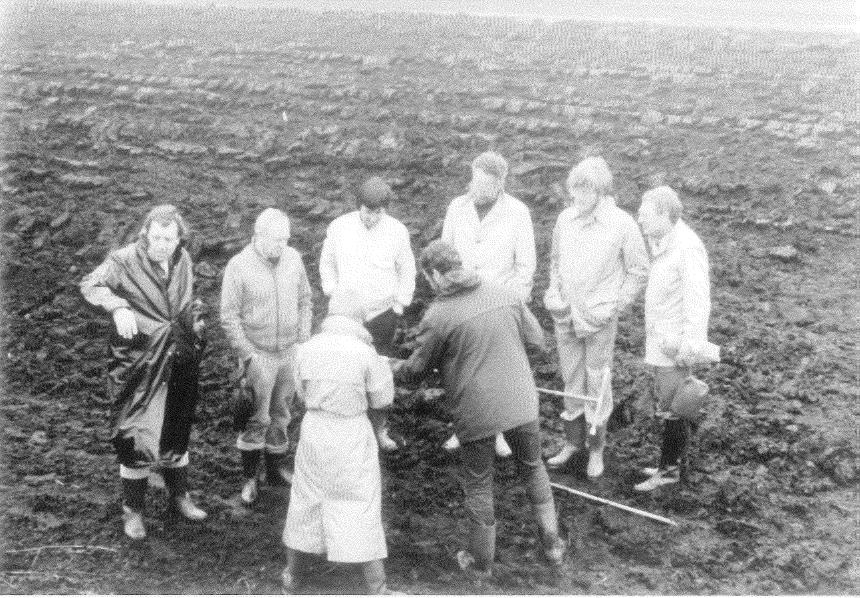
By Anton Schuurman, Rural and Environmental History
The fame of the chair group Rural History brought me in 1978 to Wageningen. The Wageningen history group was at that time different from all the others history groups in the Netherlands – it was doing social science history, history as a social science with the methods of the social sciences with as its most characteristic feature the use of quantitative methods and statistics. It is still the message of our group: ‘We apply comparative historical methods to better understand long-term patterns of interdependence between people, institutions and environments. Our empirical work builds on a combination of qualitative sources and large statistical datasets, which we construct from historical archives across the globe.’ – it reads on our internet page. Although nowadays part of the section Economics of the Social Sciences Group – perhaps partly due to the fact that the heirs of Hofstee seem to have lost interest in doing quantitative work – , the chair group owned its existence to the tenacity of the same Hofstee (as so many of the social sciences chairs in Wageningen do) who succeeded finally in 1956 to lure Slicher van Bath away from Groningen to Wageningen.
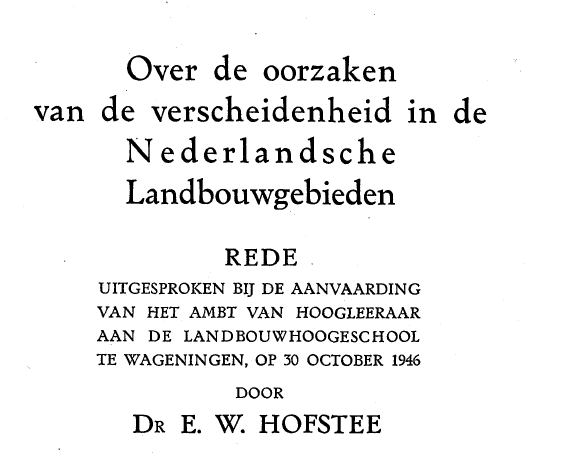
Hofstee was a history-orientated sociologist (well, social geographer), as was explained earlier in these blogs, who later named his own way of doing sociology: encompassing sociology (differentiële sociologie – see blog 5. In blog 5 the English translation is differential sociology. I prefer encompassing sociology – a term from Charles Tilly (Tilly, 1984; Schuurman, 1996), which in my view better captures Hofstee’s intention, although I suspect that Hofstee himself saw the title as a reference to La vocation actuelle de la sociologie. Vers la sociologie différentielle (1957) by Georges Gurvitch).
Hofstee’s work played a large role in our work at RHi– he was our favourite scape goat. As all the sociologist he thought that the world had only changed in the 19th century – the famous process of modernisation, urbanisation and industrialisation. Before that – it were the Middle Ages, people working since time immemorial by the sweat of one’s brow. How wrong he was, how wrong the sociologist are. Slicher revealed the process of proto-industrialisation in Overijssel in the eighteenth century; Roessingh, using Chayanov far before Jan Douwe rediscovered him, demonstrated how the farmers on the Veluwe adapted their farming practices in their search for security; Van der Woude showed that the nuclear family was the default family in seventeenth- and eighteenth-century Holland, Bieleman revealed the many changes in agriculture in Drenthe instead of the eternal rye cultivation (“eeuwige roggebouw”). I could go on. The sociologists made us feel pretty smart.
I have to confess that my attitude to Hofstee was a bit different. Of course, he was a sociologist and prejudice-ridden, but for my work on the material culture of the Dutch countryside I was inspired by his encompassing sociology. I admired and admire his three-volume book Differentiële sociologie. It can still be used, maybe especially by global sociologists. Hofstee was my hero next to Elias, Bourdieu, Benjamin and Giedeon. But I was also influenced by other Wageningen sociologists – most of all by Rien Munters who had written his book Rising and declining cultural goods (Stijgende en dalende cultuurgoederen) (Munters, 1977). He claimed that in a real open society goods would diffuse in every social direction – but, in fact, even in the famous open society of the seventies he found just one rising good: rolling one’s own tobacco. In the nineteenth century countryside I also found just one: the sewing machine.
Later Munters had an even larger influence on me by letting me join the Giddens-circle, where I read together with Gert Spaargaren, Peter Oosterveer, Jan van Tatenhove, Tuur Mol, Frans von Benda-Beckmann and many others, contemporary sociologists from Giddens to Baumann, Urry and Elden-Vass. The historian I became, I became because of Wageningen and of the Wageningen sociology group.
PS When I may do a public appeal: Sociology was so much more than Hofstee. I would like to read stories about or from his staff -members – Nooij, Kooy, De Ru, Benvenutti, Van der Ban, Munters, Wichers and many others – who wrote sometimes books that did become classics and who taught and influenced generations of sociologists. I remember Piet Holleman who not only made all the maps for the sociology group, but also for us; Corry Rothuizen who was at the department sociology when Hofstee worked there, and who is still working for Environmental Policy; Henk van Espelo who made the cartophoot-map that is still to see in the Leeuwenborch – there certainly will be other person who could write about them. I personally have less knowledge of the non-Western sociology group, but I would love to hear, e.g., a story on Rudy van Lier, direct colleague of Hofstee, as non-Western sociologist, but so different from him.
- Munters, Q. J. (1977). Stijgende en dalende cultuurgoederen. De “open” samenleving ter discussie. Alphen aan den Rijn 1977 Samsom.
- Schuurman, Anton. (1996). Mensen maken verschil. Sociale theorie, historische sociologie en geschiedenis. Tijdschrift voor Sociale Geschiedenis, 22(2), 168-205.
- Tilly, Charles. (1984). Big structures, large processes, huge comparisons. New York 1984 Russell sage foundation.

 Rural Sociology Wageningen University