
During the International event of Science Shops in Europe, The Inspiration days 2012, an award will be given to the author of the best Science Shop report. The Wageningen Science Shop nominated 3 projects from Wageningen University. Lise Alix, completed the Master International Development Studies at Wageningen University with a thesis research on an allotment park in Ede at Rural Sociology commissioned by the Science Shop of Wageningen University. Lise Alix is one of the nominees. Her thesis is in Dutch and called “Zo tuinieren zij dus“ (That is how they garden), but has an English Summary. The thesis was examined as excellent. The research by Lise was part of a larger project on ‘Tuinenpark Koekelt’ (allotmentpark De Koekelt), see the project site for more information. The final Science Shop report “Welkom op Tuinenpark De Koekelt” is largely based on the nominated thesis. Below a clip of the allotmentpark ‘De Koekelt’:
Category Archives: Rural Development
New regional Network Participand will use international knowledge
P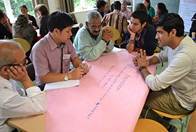 articipand is an initiative of COS Gelderland and OIKOS to organise (inter)national students, migrants, organisaties and companies in a network on international sustainable development. The network wants to give support, stimulate interaction and exhange knowledge between people to enhance better projects and products. The Science Shop in Wageningen has published a report about the need and possibilities for such a network. This report is based on research of the master students Robin Bukenya and Franziska Nath, supervised by Communication Studies and Rural Sociology. An ACT group has made suggestions how to organize this network. Continue reading
Students invited for the course ‘A Global sense of place’
For whom?
We invite all master students interested in sustainable development, spatial development, community building, place-based policy, rural socio-logy and anthropology for this course.

What?
This course gives an overview of place-based approaches in development. A relational place-based approach is key to the understanding of interrelated rural and urban transformation processes and sustainable development. Places are considered as contingent but in time and space differentiated outcomes of three interrelated, unbounded, transformative processes: political-economic, ecological and social-cultural.
We will have discussions about:
• Sense of place
• Places as sites of negotiation and power struggles
• The constitution of identities, subjectivities and difference.
• Politics of place.
Why should you follow this course?
• Interesting international guest lectures (if enough students attend the course)
• Inter-disciplinary approach
• Urban and rural cases
• Interactive discussions in small groups
Some practical information:
Course code: RSO 55306; ECTS: 6, When: Period 2;
Lectures and Workshops on: Monday-, Tuesday-, Thursday- mornings.
Interested? For more information on the course see the detailed Course outline RSO-55306 (2012-2013) final
Food4all – about right to food, sustainable family farming and agro-ecology
 With Food4all Otherwise and Boerengroep offer a critical perspective to food security and sustainable farming next to the yearly Food4you festival. Food4all starts on Thursday 11 October with a lecture on Land grabs and the right to food, next an expert panel on Feeding the world on Friday 12 October, a regional farmers market on Saturday and it ends with the Dutch premiere of the film ‘Crops in the Future’ on Tuesday 16 October. Food4all is organized in colaboration with ILEIA and SOS Faim (Belgium).
Celebrate food and farming in Wageningen, the Netherlands! Food4all is a festival that takes you on a journey through sustainable family farming, agro-ecology and the right to food. The Food4All festival is a critical supplement to the “Food4you festival”. The festival seeks to provide a critical perspective on global food security, and give voice sustainable alternatives.
Look at http://grassrootsscience.nl/ for the programme.
Feeding the world sustainable – agroecology v industrial agriculture
Feeding the world in a sustainable way is vehemently debated these days. In international fora the debate is not just about how to increase food production to feed the world’s growing population but also whether increasing food production is adressing the key issue of the relation between poverty and hunger. Increasing food production is not a neutral matter. Although some voices like to put it that way to sustain their claim that ‘facts’ show that their solution is the only right one. A solution is never neutral just because of the combination of technological and institutional means and the social and environmental impact it has. This is not new at all all. The impact of the (first) Green Revolution has been heavely disputed and this socalled neutralness of technology has been key issue in the massive techology and innovation studies of last decades. One cannot simply ignore the wider impact of technological fixes in the debate about how to provide the world’s population in a sustainable way.
In an editorial Eric Holt-Gimenez, Executive Director of Food First / Institute for Food and Development Policy (www.foodfirst.org) in response to a recent study in Nature has added a contribution to this ongoing debate. He argues that there is a difference between between producing more food and ending hunger. Read his editorial at on what kind of agriculture can best solve the problem of the growing number of hungry people: agroecology or conventional industrial agriculture at http://www.agriculturesnetwork.org/magazines/global/farmer-organisations/opinion-eric-holt-gimenez or at Nourshing the planet (the weblog of the Worldwatch Institute). One can also see video of a lecture on Food movements, agroecology, and the future of food and farming.
The Christensen Fund made an interesting infographics evaluating the major differences between agroecology and industrial agriculture:


