Turkish and Kurdish studies have been moving in important directions in the past decade. Studies of the importance of space and placemaking in Kurdish issue (Gambetti and Jongerden 2015) have been complemented by sustained engagements with material culture, nature, and environments in Kurdistan, as well as how they are central to colonial practices, state violence, and resistance. Today, from the study of ruins and ruination in burial sites and ghosts and, therefore, the interaction between the material and the symbolic, one can learn from anthropological and historical studies of how forests and forest fires, water and rivers, mountains, and animals have been entangled with power and resistance in Kurdistan (See Adalet 2022, Bozcali 2020, Biner 2019, Çaylı 2021, Oguz 2021, Suni 2023).
The scholarly debates in Ottoman /Kurdish studies regarding the Armenian and Kurdish issues from late 19th century onwards, reveals that the national question is usually viewed as a product of competing nationalisms— that is, political ideologies built around conceptions of communal belonging and statehood. The scholarship on sectarianism in the Arab Middle East, too, despite critical work in the last decade, has been dominated by rather ahistorical and primordial assumptions concerning the relationship between religion, modernity and politics in the Ottoman imperial and (post-Ottoman) colonial contexts.
The conflicts over the land and the environment spark all across Turkey as many local communities oppose large scale development projects, often supported by the state. Yet in the Kurdish inhabited areas of Turkey, the end of the Turkish-Kurdish peace process heavily limited possibilities of action for activists seeking to implement their ideas of ecology and autonomy. However, even in such a hostile environment many of our interlocutors adhere to the strategy of “building a new world in the shell of the old” and are seeking to build up more sustainable structures.
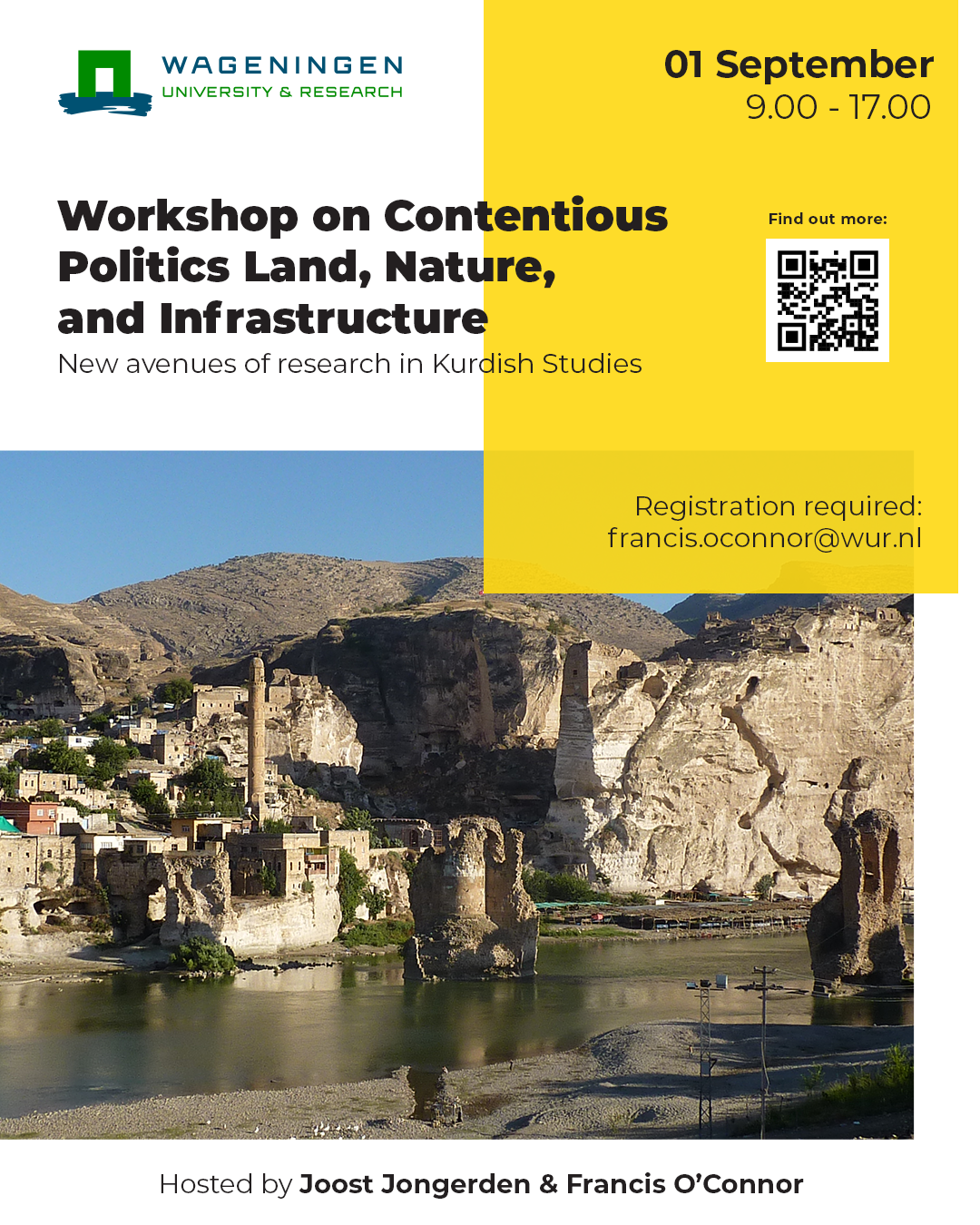
Hosted by the Rural Sociology Group, Wageningen University and Research, September 1, 2023
In Kurdistan occupations and demonstrations by landless workers and peasants demanding land reform have taken place on a large scale since the middle of the 20th century. In more recent years, this contestation over land has overlapped with the rise of environmental activism. The workshop Contentious Politics in Kurdish Studies: Land, Nature, and Infrastructure addresses a number of theoretical debates and questions related to land.
Affiliations of the participants
Kamuran Akin is an independent researcher who recently defended his PhD at the Institut für Europäische Ethnology, Humboldt Universität zu Berlin.
Seda Altuğ is a lecturer at the Atatürk Institute for Modern Turkish History at Boğaziçi University, Istanbul.
Aysegul Aslan is a Ph.D. candidate in geography at Fırat University, Turkey, and a visiting fellow at the Environmental Policy Group at Wageningen University, the Netherlands
Eray Çaylı is a professor of Human Geography with a Focus on Violence and Security in the Anthropocene, Hamburg University, Germany
Pinar Dinc is a researcher at the Centre for Advanced Middle Eastern Studies at Lund University.
Ayhan Işık is a Postdoctoral Researcher at Centre de Recherche Mondes Modernes et Contemporains, Université libre de Bruxelles.
Adnan Mirhanoğlu is a researcher in the Department of Earth and Environmental Sciences at KU Leuven, Belgium.
Zeynep Oguz is a lecturer in Social Anthropology at the University of Edinburgh.
Murat Öztürk is associate professor at the Department of Economics at Kırklareli University in Turkey.
Marcin Skupiński is a Ph.D. candidate at Warsaw University, Poland.
Necmettin Türk is a PhD Candidate in the Working Group “Critical Geographies of Global Inequalities” at the Institute of Geography, Hamburg University, Germany.
Filyra Vlastou-Dimopoulou is a Ph.D. candidate in Human Geography (NTUA & Paris 1 Panthéon-Sorbonne University.
Dobrosława Wiktor-Mach is professor of Economics, Cracow University, Poland.
Organizers
Joost Jongerden – Associate professor at the Rural Sociology Group, Wageningen University, the Netherlands joost.jongerden@wur.nl
Francis O’Connor – is a Marie Curie Skłodowska Post-Doctoral Fellow in Rural Sociology at Wageningen University in the Netherlands. Francis.oconnor@wur.nl
Merissa Gavin, Master’s Student, International Development Studies at Wageningen University
My daily ‘commute‘ Beyond the methods and ethics of data collection, something we were taught in fieldwork preparation is that the field is full of surprises. Often you arrive to a reality much different to what your a priori desk research may lead you to expect.
I came to Huelva expecting to observe and participate with Jornaleras de Huelva en Lucha (JHL), a self-organised feminist and anti-racist group of day labourers in the strawberry industry. My intention, in the best-case scenario, was to live and work alongside the fruit harvesters. Failing this, I was willing to accept visiting where the workers lived, hanging out with them after work and joining unionist action organised by JHL. However, due to the delicacy of immigrant workers’ statuses and the protectionist front of employers, this avenue proved unviable. Employers commonly provide accommodation on site and they are reluctant to facilitate external interactions. In place of JHL, the entry point for my research has been Asociación Nueva Ciudadanía por la Interculturalidad (ASNUCI). ASUNCI is an association that offers its members hostel beds, internet connection and hygiene services, all of which are in high demand amongst workers not housed by their employers, but instead living in roadside settlements without electricity or water.


 Rural Sociology Wageningen University