The history of Dutch potato breeding (1888-2018): from hobby to industry

On the 15th of May 2019 Jan van Loon defended his PhD thesis about the history of Dutch potato breeding. This thesis was written in Dutch (see thesis cover below). Over the past two years we (Jan and his supervisors) have been working on a paper in English, summarizing the main findings of his thesis (which is over 400 pages). This was quite a challenging endeavor, but we are pleased that the paper was accepted by Potato Research and was published online this week as an open access article.

Abstract of the paper
The Netherlands has a world-leading position in potato breeding, but little is known about the factors that led to this success. This paper analyses the factors that have influenced the development of potato breeding in the Netherlands. This study is based on research of the grey and scientific literature and interviews with various representatives from the Dutch potato breeding sector. We distinguish four periods: (i) Before 1888, no potato breeding in the Netherlands existed whereas in other countries first crosses occurred. (ii) 1888–1940, more individuals started breeding out of interest and hobby to overcome the commonly observed degeneration of potato. (iii) 1940–1967 the emergence of a corporate set up of breeding by private companies collaborating with small breeders. (iv) 1967–present, towards full-fledged breeding industry supported by the new Seeds and Planting Materials Act (ZPW) in 1967 including the breeders’ rights. Many factors including cultural practices, diseases, and market that determine the strategy of breeding have been analyzed. The development is most of all ‘crop driven’ to maintain the level of production. But it was also ‘export driven’ leading to the development of an export-oriented seed potato sector. The conclusion is that three elements were dominant in the development of a strong potato breeding sector: (1) the broad cooperation among all players in the potato chain, (2) the design of the institutional infrastructure, and (3) the remuneration of the breeding work through legislation regarding plant breeders’ rights. The study ends with an outlook on future trends, one of them leading from an open to a more closed business culture.
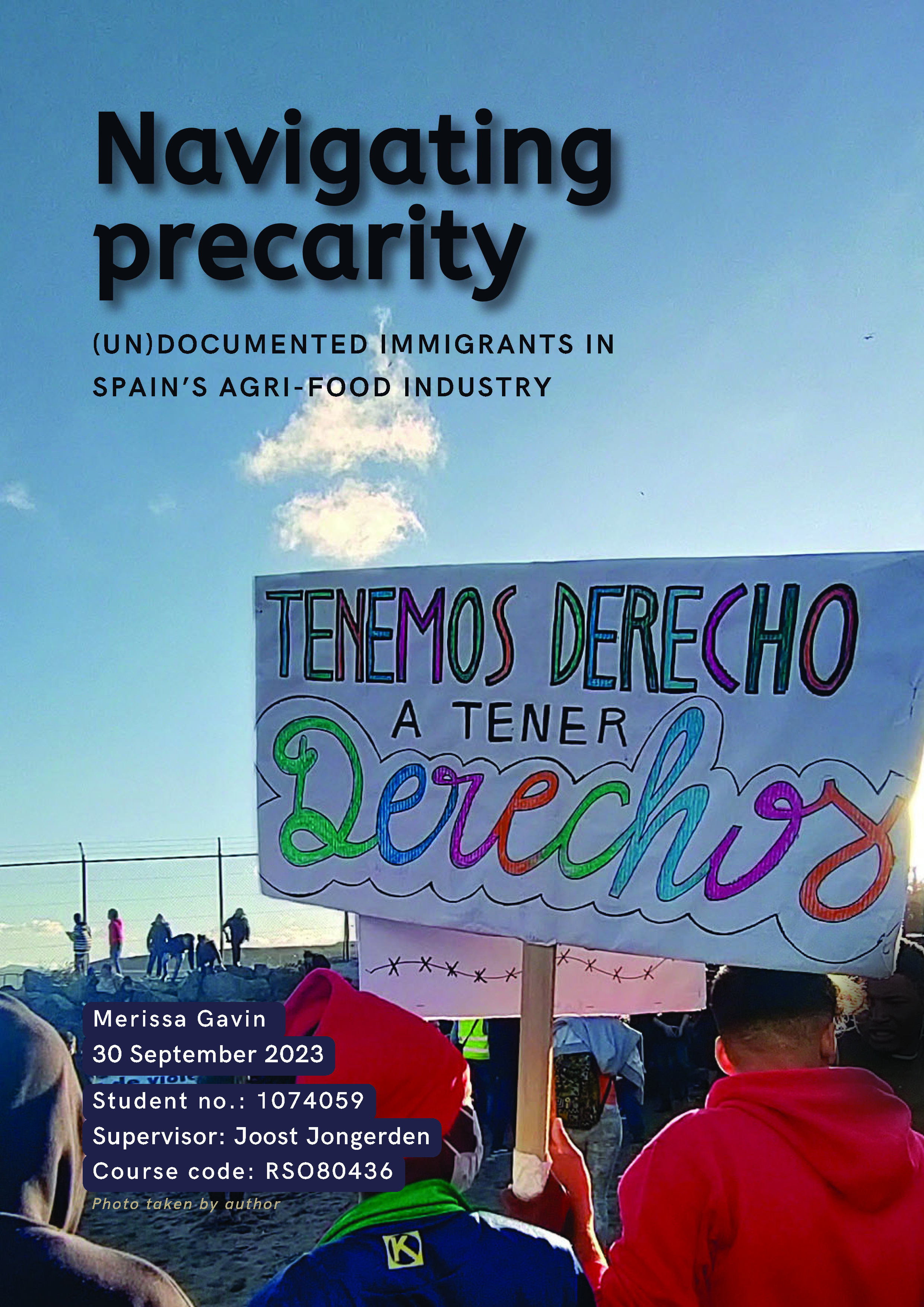
Navigating Precarity:  (Un)documented immigrants in Spain’s agri-food industry

In the master thesis “Navigating Precarity:  (Un)documented immigrants in Spain’s agri-food industry” Merissa Gavin discusses the strategies employed by immigrants in navigating precarity from the perspective of the immigrants themselves and new forms of being political are being created. The main question that guided her research was: “How do undocumented immigrant workers in Spain’s agri-food industry engage in claim-making and claim-living to navigate precarity?”

Over the last two decades, immigrant workers have become a structural element of Spain’s agri-food industry. Arriving to Spain undocumented, immigrant workers have few options other than the exploitative working conditions of the agricultural sector. The present research centres on the precarity of these workers, highlighting the multitude of ways they navigate vulnerability and uncertainty. This research is important, firstly, to raise the voice of undocumented immigrant workers and demonstrate how they exercise agency in everyday activities. Secondly, to investigate the socio-spatial conditions that facilitate, or obstruct, the emergence of a collective political being.

Continue reading

Struggling to find struggles: developing a research on social movements of Florence

Cristiano Bartolini

I began my MSc research thesis in June 2021, at the end of the second pandemic wave, which forced the world (back) inside, into our homes. I was frustrated and upset that I would probably not be able to conduct research beyond Europe’s borders – or outside my own room, even. At the start of my master’s, I was looking forward to the thesis, quite naively romanticising, in fact, picturing myself as a young researcher in the middle of rural fields, maybe in Latin America, living near native communities that struggle for social and human rights. After the pandemic hit, I had to surrender this idea and recalibrate my research expectations. I refocused my research aims and decided to start a study on social movements in Florence, my hometown.

I had never really thought of researching in a city: during my studies, I had unconsciously neglected its potential to enact a real change in society. The urban context, to me, was a negative environment from which good changes could not emerge. As various authors argue, the city is the centre of capitalistic life, it is the producer of huge economic surpluses, always looking for new outlets to absorb this endless profit that it constantly generates, and this, eventually, brings a lot of socio-economic problems to residents. Let me explain this with an example that ultimately becomes the background of my research.

Continue reading

Thesis opportunity in Galicia (NW Spain) with the Post-Growth Innovation Lab at the University of Vigo

Commons, or commonly managed land, seem to be a relic of the past. The enclosure of the commons and concomitant rise of modern agriculture and capitalism have received much attention in academic literature. However, in Galicia, an autonomous region in the Northwest of Spain, a quarter of land is still managed as commons, typically referred to as ‘montes vecinales en mano común’. This way of land management means that land cannot be divided, owned individually, traded, or sold but is rather decided over by the people living in the parroquia or parish. The intricate link of household economies to the common lands, materializing through for example the grazing of animals in the commons or the harvesting of toxo (a nitrogen-rich shrub) to turn into fertilizer, was violently put to an end by the dictatorial state that usurped common lands between 1937 and 1989 to afforest them according to principles of industrial forestry. The rupture of household, rural economies is linked to substantial changes in these spaces, most notably, a significant drop in the rural population from 71.8% in 1950 to 14.3% in 2000 (Seijo 2005). The State’s forestry program was incredibly ambitious, planting five and a half million hectares of forest in the period between 1940 and 2006 (Vadella, 2016) with Galicia being a particular area of interest for the State’s reforestation program (Picos, 2017). After the Franco dictatorship ended, lands were returned to communities yet the processes and reasons for the devolution are contested and context-specific. Some communities never received their lands back, some received fractured parcels, some lands were filled with monocultures of eucalyptus and pine, while others house public facilities like schools and hospitals. About 3,000 montes vecinales en mano común exist throughout Galicia and each is shaped by a particular historical and situated process, allowing us to explore the cracks, resistances, and adaptations that have shaped the Galician commons becoming what they are today and what they could be tomorrow.

Thesis projects can be formulated around the following:

  1. Chronicling diverse economic practices over time in a historical perspective. People’s physical presence in the commons has changed over time, in line with modernization and economic ‘development’. Using qualitative methods such as interviews, these changes can be studied to learn about how commoning changed over time, what this meant for rural livelihoods, and commoners’ subjectivities.
  2. Exploring current configurations of diverse economic practices in the monte and how these came to be. Here students can examine how the commoning community has come to be, how initiatives have arisen in the commons, and how diverse economic practices have taken shape and relate to human flourishing.
  3. Futuring and imaginaries. Here we consider the futures commoners imagine or aspire to. Through qualitative research methods, this part of the project considers the meanings people ascribe to the commons and what commoning could look like in the future. We ask what role the commons have in human well-being as imagined by commoners but also by other actors like policymakers, scientists, and research centers.

The research takes place in connection to a PhD study by Noortje Keurhorst (University of Vigo). She will also be the local supervisor for this research.  For fieldwork a good command of Spanish and/or Galician is useful.  

MID, MOA or MDR students interested can send an e-mail to joost.jongerden@wur.nl

Researching in Zapatista Communities: Listen more, ask less

Beatriz Lopes Cerqueira, Master’s Student, Environmental Sciences – Environmental Policy at Wageningen University

For my MSc thesis research, I decided to travel to the home of one of my special interests, the Zapatista movement, which has been fighting with and for the dignity of the indigenous peoples of Chiapas, Mexico, and learn their particular views and practices towards Nature, natural resources and the preservation of the environment.

The relationship established between the Zapatistas and me followed what I believe to be the fundamental properties of emotional relations(hips) – those based on the mutual exchange of ideas and feelings, trust, and respect. For me, these kinds of connections require a careful management of our thoughts and feelings as emotional beings and the ways in which these are interchanged. Thus, for my research with the Zapatistas, I engaged in a long and complex process of analysing and evaluating the best way to create a relationship based on reciprocity and trust. Later on, I tried to apply these reflections in my own research process. Which methods and methodology would allow me to build trust with the Zapatistas, to conduct research without blindly extracting their knowledge? Which would be the best tools for telling the story of the Zapatistas’ ecological consciousness and the values, emotions and worldmaking processes that make up their cosmovision? For academic research, I believe that methodological choice(s) are the most important foundation for a steady and lasting relationship.

When I started to think about my fieldwork, I decided to do exploratory work in Oventik, one of the Zapatistas’ autonomous centres, in the highlands of Chiapas, before beginning.

Continue reading