
In recent years several ‘apps’ have been developed in order to help people exchange both tangible items such as materials or food, and intangible issues such as knowledge and information. Examples are ‘nextdoor’, created to exchange news and other information between neighbours, ‘peerby’, designed to help people lend each other tools and utensils, and ‘thuisafgehaald’, a website facilitating people to cook for others in their neighbourhood. Besides offering practical solutions to ‘use the power, the knowledge and the stock of the masses’, such applications are also often viewed in terms of social cohesion and strengthening neighbourhoods.
 Continue reading
Food growing practices in rural Hungary – vlog about MSc thesis by Zsolt Varga
Zsolt Varga, student Master of Development and Rural Innovation, made a video blog about his MSc-thesis research to what extend people in rural Hungary still grow their own food.
Sacks of hope: Sack Gardening in Kibera slum (Kenya) as sustainable place-shaping
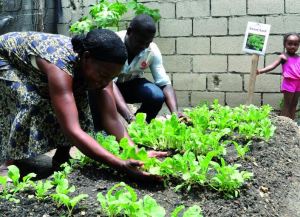 By Merel Scheltema – Msc. Urban Environmental Management, specialisation in Spatial planning, WUR.
I propose that an investment in quality public space, through urban agriculture and multi-functional land use, can improve the access of people to basic needs. According to the UN habitat executive Director of Joan Clos i Matheu public spaces are therefore a vital asset. The quality of public spaces affects the quality of private spaces and the city as a whole. A ‘good’ public space is part of the solution to create ‘healthy’ cities, by revitalizing the environment, economic development and fostering social capital. The concept of ‘sustainable place-shaping’, answers this call for healthy public spaces. It is a holistic approach to strengthen collective agency, participation and leadership of people who engage in places.
In my essay for the RSO course ‘A global sense of Place’, I applied the SUSPLACE framework, developed by the Rural Sociology Group to investigate: how urban agriculture as an investment in public space contributes positively to sustainable place-shaping. I studied this by examining urban sack farming in the Kibera slum of Nairobi, the largest Slum in Africa. I reason that urban gardening offers basic needs as well as improves social capital, environmental quality and economic opportunities. Continue reading
Podcast – civil society participation global governance of food security
As part of the perfect storm seminar series at the University of Edinburgh, Dr Jessica Duncan gave a seminar about civil society participation in the global governance of food security on the 26th of January. ‘The Perfect Storm Scholars‘ interviewed her afterwards and posted a podcast that resulted of this interview on their blog.

As part of the perfect storm seminar series (see poster), Dr Jessica Duncan, Assistant Professor in Rural Sociology at Wageningen University, The Netherlands, gave a seminar about civil society participation in the global governance of food security on the 26th of January at the University of Edinburgh.
She kindly made the time to talk to me about her seminar and research when she was in Edinburgh. You can find the result of this conversation in a podcast. Click HERE to listen to it.
Podcast structure
We talk about her seminar and research until around 24:40 min. From that point onwards we discuss the practical dynamics of undertaking empirical research in general, and specifically on global governance. At 30:00 min Dr. Duncan shares her views on interdisciplinary research.
Podcast notes:
You can find out more about Jessica’s research in her latest book: Global Food Security Governance: Civil society engagement in the reformed Committee…
View original post 229 more words
The Tiny House Movement: A progressive movement or a reactive defense of place?
Isabelle van Acquoy wrote an essay on the Tiny House Movement for the course RSO-55306 A Global Sense of Place. Is the Tiny House Movement a progressive movement reaching out or a reactive sense of place, she asked herself? Below a condensed version of her essay.
The Tiny House Movement is an upcoming ‘social and architectural trend that advocates living simply in small spaces’ (Anson, 2014). A tiny house is on average between 10 and 40 square meters and is originally a mobile house, however they exist in different sizes and shapes. The movement became booming in the United States as a result of the housing market crash in 2007 and 2008 in which a lot of people lost their homes due to the inability to pay their enormous mortgages. Quite recently, the movement also became of interest in the Netherlands where different pioneers are experimenting with this alternative way of housing and living. Continue reading

