
During the International event of Science Shops in Europe, The Inspiration days 2012, an award will be given to the author of the best Science Shop report. The Wageningen Science Shop nominated 3 projects from Wageningen University. Lise Alix, completed the Master International Development Studies at Wageningen University with a thesis research on an allotment park in Ede at Rural Sociology commissioned by the Science Shop of Wageningen University. Lise Alix is one of the nominees. Her thesis is in Dutch and called “Zo tuinieren zij dus“ (That is how they garden), but has an English Summary. The thesis was examined as excellent. The research by Lise was part of a larger project on ‘Tuinenpark Koekelt’ (allotmentpark De Koekelt), see the project site for more information. The final Science Shop report “Welkom op Tuinenpark De Koekelt” is largely based on the nominated thesis. Below a clip of the allotmentpark ‘De Koekelt’:
New regional Network Participand will use international knowledge
P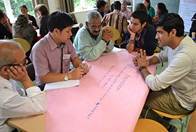 articipand is an initiative of COS Gelderland and OIKOS to organise (inter)national students, migrants, organisaties and companies in a network on international sustainable development. The network wants to give support, stimulate interaction and exhange knowledge between people to enhance better projects and products. The Science Shop in Wageningen has published a report about the need and possibilities for such a network. This report is based on research of the master students Robin Bukenya and Franziska Nath, supervised by Communication Studies and Rural Sociology. An ACT group has made suggestions how to organize this network. Continue reading
Rhetorical devices in feeding the world
Recently there were two food events here, a university run Food4you series of events and a series organised by critical student organisations Boerengroep and Otherwise called Food for All. The very different approaches to food are captured in their titles. The latter series finished yesterday on World Food Day with the Dutch premiere of the film Crops for the Future. An instructive film about agroecology practices and food sovereignty from all over the world. Examples from the field were backed up with interviews with the Special Rapporteur on the Right to Food , with an author of the Agriculture at a Crossroads report and others. The message; we urgently need to move to another paradigm, the coming century is one of biology/diversity instead of chemistry. Still, it seems that the protagonists of a gone-by era are capable of organising a stage for themselves, the PR machine of Louise Fresco seems overheated. What are their rhetorical devices? Continue reading
Students invited for the course ‘A Global sense of place’
For whom?
We invite all master students interested in sustainable development, spatial development, community building, place-based policy, rural socio-logy and anthropology for this course.

What?
This course gives an overview of place-based approaches in development. A relational place-based approach is key to the understanding of interrelated rural and urban transformation processes and sustainable development. Places are considered as contingent but in time and space differentiated outcomes of three interrelated, unbounded, transformative processes: political-economic, ecological and social-cultural.
We will have discussions about:
• Sense of place
• Places as sites of negotiation and power struggles
• The constitution of identities, subjectivities and difference.
• Politics of place.
Why should you follow this course?
• Interesting international guest lectures (if enough students attend the course)
• Inter-disciplinary approach
• Urban and rural cases
• Interactive discussions in small groups
Some practical information:
Course code: RSO 55306; ECTS: 6, When: Period 2;
Lectures and Workshops on: Monday-, Tuesday-, Thursday- mornings.
Interested? For more information on the course see the detailed Course outline RSO-55306 (2012-2013) final
Interested in multidisciplinarity and traditional food?
 Rural Sociology has been participating in an intensive programme on Micro-organisms and Traditional Food since last year. In the beginning of this year the first students experienced this programme by spending 2 weeks in Rumania; see the experiences of Cho-Ye Yuen, Hylke Sibtsen and Rineke Boonen. During these intensive weeks, you follow lectures by various scholars from around Europe focusing on both social and microbiological sciences, you work on group assignments and go on excursions. This time the IP takes place in Ghent from 4 to 15 February 2013.
If you are a Master student at Wageningen University and would like to join this programme, please contact Els Hegger for more information. To get a better idea of the programme, our colleague Petra Derkzen blogged about her experience last year during four different days; first, second, third and fourth.

