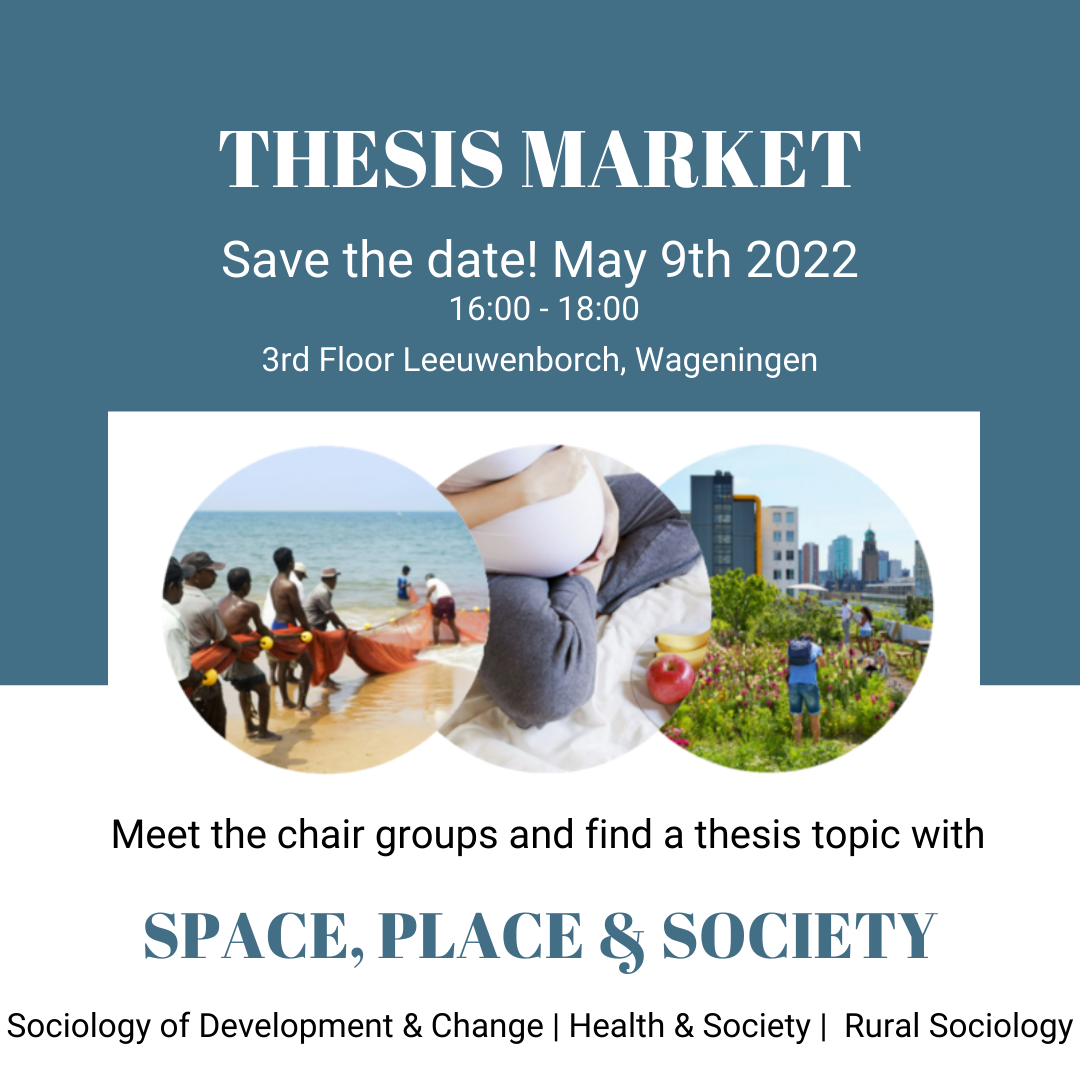
Webinar 5: A Just Future for the Global Countryside? by Michael Woods @WoodsZzp

A Just Future for the Global Countryside? by prof. Michael Woods, Aberystwyth University, Thursday March 31, 2022, 12.00-13.30 (CET).

The talk is part of the Rural Sociology 75th Anniversary webinar series ‘Looking back, Looking Forward: Setting a future agenda for rural sociology’. Watch recordings of the webinars series at Rural Sociology Youtube channel.

The event will be streamed by Teams. Email to mark.vicol@wur.nl to register yourself.

Thesis opportunity: Urban guerrillas in the countryside? The case of the M-19 in Colombia.

The M-19 was an insurgent group active in Colombia from 1974-1990. It has recently enjoyed a brief moment of fame for careful viewers of the popular Netflix series Narcos, where it was rather simplisticallydepicted as being in cahoots with narco-traffickers. The movement is popularly understood as an urban movement and the M-19 did in fact emerge from middle class university environments in big cities like Calí and Bogota. It also carried out audacious symbolic attacks and innovative forms of communication with the Colombian population (for e.g. broadcasting its announcements on TV at half time during televised matches of the Colombian football team) in cities. What is less well known about the movement is that it also had an extensive and dynamic rural armed campaign in the south of the country. Although, smaller in number than better known groups like FARC, it achieved notable military successes by seizing regional cities and operating forms of rebel governance by providing schools, operating courts to punish criminals and re-distributing locally needed goods like wellingtons and tools.

The literature in conflict studies has emphasised how difficult it is for idealistic urban middle classes to win the support of often poorly educated and politically passive peasants. Indeed, the physical unsuitability of ‘soft’ city kids in adjusting to the hardship of rural life is often cited as a further obstacle to revolutionary movements’ success. For students interested in conflict studies, social movements and rebel governance, this is the chance to look at one of Latin America’s lesser known and often misunderstood movements. More broadly it will give students a chance to conduct research on mobilisation across the urban-rural divide.

Extensive data on the M-19’s mobilisation in Caquetá in southern Colombia is available in the National Center for Historical Memory digital archives. Students will learn about archival research, the analysis of primary sources and the coding of qualitative data. Using this data and secondary literature, students would analyse the way in which the M-19 overcame the disadvantages of its urban back ground to launch a rural guerrilla campaign. All the documents are in Spanish, so unfortunately the project is only suitable for Spanish speakers.

If you are interested in working on armed movements and can speak Spanish, please contact francis.oconnor@wur.nl

Stage Algemene Rekenkamer

Bij de Algemene Rekenkamer (AR) zijn we opzoek naar een enthousiaste en leergierige stagiair. Vind jij het leuk om een kijkje te nemen binnen de overheid en wil je graag meer leren over onafhankelijk onderzoek en de AR? Dan zijn wij op zoek naar jou!

Elke derde woensdag van mei is het verantwoordingsdag (ook wel gehaktdag genoemd) en publiceren wij ons verantwoordingsonderzoek (VO). In het VO onderzoeken wij of de ministers ons belastinggeld zinnig, zuinig en zorgvuldig hebben uitgegeven. Het team waar jij stage gaat lopen doet dit voor het Ministerie van Buitenlande Zaken en Buitenlandse Handel en Ontwikkelingssamenwerking.

Wat ga je doen?

Nu denk je vast, dit gaat alleen maar over geld? Zeker niet! Wij kijken naast het geld ook naar het beleid dat deze ministers uitvoeren. Denk daarbij aan onderwerpen zoals: opvang van vluchtelingen in de regio, gedetineerde beleid in het buitenland en de reisadviezen van Buitenlandse Zaken. Waar jij aan gaat meewerken is het VO van 2022. De onderwerpen hiervan staan nog niet vast. Wat wel zeker is, is dat jij volop mee gaat onderzoeken, op gesprek gaat bij ministeries en leert hoe je een rapport moet schrijven. Onze rapporten gaan naar de Tweede Kamer, maar zijn ook openbaar zodat ook iedereen die geïnteresseerd is kan lezen hoe hun belastinggeld wordt uitgegeven. Daar doen wij ons werk voor.

Wie zoeken wij?

We zoeken iemand met affiniteit met ontwikkelingssamenwerking. Bij voorkeur van de Master opleiding International Development (MID) of Development and Rural Innovation (MDR). De kandidaat beheerst het Nederlands goed.

Meer informatie

De stage is voor de periode van september 2022 tot februari 2023, maar we zijn flexibel. Lijkt je dit wat of wil je nog meer weten, neem dan een kijkje op de site https://www.rekenkamer.nl/. Of neem contact op met Maxime Veenhoven: m.veenhoven@rekenkamer.nl.

75th Anniversary: 55) Research at the Rural Sociology Group: The Spatial Dimension of Insurgent-Civilian Relations: Routinised Insurgent Space

Francis O’Connor

I was born in the 1980s, in the bucolic countryside of west Limerick where I  enjoyed an idyllic and happy childhood, completely distant from the conflict which wracked the north of Ireland during the so called “Troubles”. Nevertheless, as an admittedly very precocious child, through overheard snippets of adult conversations, impertinent questions, partially understood news headlines, the occasional drama of IRA arms dumps found in the local area and the half-earnest choruses of “Up the Ra”[1] that permeated the Irish social life of my childhood, I recognised the presence of an unspoken something. A something which did not interfere in any way with my childhood priorities of playing hurling and avoiding the hard jobs on our family farm, but as I grew up and read more about Irish politics and what had been happening on the island, it remained a something that engendered a curiosity in me. How was it possible that an armed Republican group, the Irish National Liberation Army carried out Ireland’s biggest ever robbery (21 million euro in today’s terms) in 1978, at the other side of my small parish? Within my childhood cycling radius, where in my experience literally nothing ever happened.  Even now the Mullaghareirk Mountains of my home, are a disorientating maze of narrow roads, high hedgerows, bog, woods and scrubland, in 1978 they would have been completely unknowable to an armed unit of Socialist Republicans from the North. Without local knowledge and assistance, would such an ambitious robbery have ever succeeded? Were the people of my childhood, someway complicit in supporting the violence, incessantly critiqued by the political mainstream in Ireland? Why would people like me and mine, safely ensconced in the rhythms our rural lives get unnecessarily involved in a violent campaign that resulted in hundreds and thousands of deaths? Was it ideology, a sense of obligation or guilt, hatred, fear, ignorance or mere happenstance? This unresolved, half-forgotten line of questioning lay dormant through my formative years.

Half-forgotten that is, until I began university in 2003, at the hysteric heights of the “War on Terror”, where terrorism and support for terrorism saturated all political debate and infiltrated our university discussions and seminars. This reawakened my latent interest on what support for political violence comprises. It led me to take every available course and seminar on civil wars and political violence, to do a Masters on Middle East politics and eventually brought me to Italy to a PhD on the relationship between the PKK and its supporters at the European University Institute in Florence. Under the guidance of Professor Donatella della Porta, one of the world’s leading social movement scholars, I found myself immersed in a vibrant conceptual and theoretical universe. One shaped by the ongoing debate centred on the ground-breaking Dynamics of Contention (2003) by Doug McAdam, Sydney Tarrow and Charles Tilly which argued for a broad approach to the study of a spectrum of contentious politics according to its constituent mechanisms. A spectrum which ranged from episodes such as riots to full blown insurgencies. 

This debate had stimulated a parallel blossoming of social movement research on violence, expanding beyond its foundational pillars of political opportunity structures, resource mobilization and framing to incorporate a relational focus emphasising the dynamic and contingent elements of violent social change. One which argued it was less the inherent characteristics of movements that determined their success or failures, but rather how movements interacted with political institutions, political adversaries and allies that provided a better explanation of political outcomes.  This new wave of research also addressed the criticism that social movement studies had been the empirical preserve of western liberal societies by also incorporating research on global violent and non-violent movements. And since then, I have found myself drawing from this rich theoretical spring of contentious politics and social movements to better understand why civilians support armed movements. An intellectual reservoir which has emboldened me to take a critical stance on much of the rationalist and structuralist approaches which have dominated the study of conflict. After a few twists and post-doctoral turns through Italy, Denmark and Germany, and extremely satisfying diversions to work and publish on lone actor radicalisation, anti-austerity protest, referendums and pro-independence movements, I arrived at the RSO with a new project, that addresses the spatial dynamics of armed groups’ interactions with their supportive constituencies.

The Spatial Dimension of Insurgent-Civilian Relations: Routinised Insurgent Space

In mid-2021, my book Understanding Insurgency: Popular Support for the PKK in Turkey (Cambridge University Press) based on the findings of my PhD research was published. During the many years it took to finally publish the book, and in light of the increasingly hostile research environment in Turkey, I decided to attempt developing a comparative research agenda, to see if the PKK’s determination to maintain the active support and approval of its constituency was an outlier and if other groups were similarly minded. Through a series of chance encounters, I came into contact with the M-19, an armed group which was active in Colombia from the 1970s until 1990.  I set about learning Spanish and in 2018 conducted fieldwork with former supporters and veteran members of the M-19 in Bogota.

 Reflecting upon the interviews I conducted with both the PKK and the M-19, it became clear that the relationship between the insurgents and supporters was not simply a relational dynamic, but one which took place in specific spaces. Encounters between insurgents and civilians were rarely random, they occurred in specific places at specific times. Armed M-19 operatives boarded buses packed with workers to engage in revolutionary propaganda before disembarking and disappearing into early morning rush hour. In the 1990s the PKK organised revolutionary picnics on the outskirts of Istanbul to recruit youngsters. The PKK transformed funerals from instances of private grief and loss, to occasions of revolutionary defiance. The M-19 actually built neighbourhoods for the rural displaced on the margins of Colombia’s rapidly expanding cities. Interviewed insurgents were explicit in how they strategically tailored their encounters to create favourable interactions which reflected positively on the movement. In certain neighbourhoods (or spaces in a conceptual sense) they promoted Kurdish or Colombian nationalism, in others they emphasised traditional socialist objectives. What do revolutionary courts in Kurdistan, the distribution of wellington boots and milk, the ritualised burying of the dead and the organisation of daily life in prison have in common? I argue that they are all forms of Routinised Insurgent Space (RIS).

RIS can be understood as the way insurgent movements deliberately engineer or appropriate existing social spaces to facilitate interactions with supportive constituencies. RIS contains functional and symbolic logics: it embeds armed groups in their immediate spatial environments allowing them access to local resources, but it is also a means of consolidating political legitimacy. From the perspective of the constituency, RIS renders interactions with armed actors safer and more predictable and can potentially lead to a form of joint habitus regarding political identity and behavioural norms. Although the types of RIS implemented are expressions of insurgent movements’ strategy, they are reciprocally constituted and shaped by local civilian agency which can resist or alter them.  My project focuses initially on four distinct forms of RIS: Insurgent Policing & Courts, Insurgent Service Provision, Insurgent Prison Mobilisation and Insurgent Funerals. A rigorous literature analysis and suggested that these four forms are not ideologically specific and recur across almost all types of insurgent mobilisation to greater or lesser extents.

As a comparative project, it of course strives to identify similarities and differences between the cases, but it also focuses on within-case variation. How do forms of RIS vary from urban to rural areas and even across wealthier and poorer neighbourhoods? In contrast to the flourishing rebel governance approach, it also attempts to track how these forms of incipient governance evolve over time rather than focusing on insurgent institutions once they are already established. It tracks efforts to create forms of RIS from their earliest incarnations, analysing why their success varies. In terms of data, the project will make use of interview data with former insurgents and their constituency. A key milestone in the project will be the hosting of a workshop at the RSO in September 2022 titled: The Margins of Insurgent Control: Spaces of Governance.  It is specifically designed to merge the relevant literatures from contentious politics and social movements, social geography anthropology and rebel governance with an explicit focus on the nature of the data used to study armed movements.

O’Connor, Francis. 2021. Understanding Insurgency: Popular Support for the PKK in Turkey. Cambridge: Cambridge University Press.


[1] “Up the Ra” is short for Up the IRA. In Irish, one would express support for somebody or something by shouting for example Gailimh Abú meaning “come on Galway”. In Hiberno-English, abú has been directly translated as up, leading to  the use of ”up something or other” as a common phrase. Up the Ra is a phrase which has to a certain extent escaped its original political connotations and has found its way into sports chants, drunken tomfoolery between non politicised groups of friends and into popular songs. However, its connotations are contextually dependent and can take on a greater or lesser air of menace according to who is in earshot.

Afstuderen of stagelopen bij Boerenverstand

Boerenverstand is een adviesbureau dat op een praktische en innovatieve manier werkt aan een duurzamere landbouw: goed voor de aarde, het dier de boer en de consument! In verschillende projecten door heel Nederland werken samen met boeren aan een praktische invulling van de landbouw van de toekomst. Kringlooplandbouw loopt hier als een rode draad door heen.

Stage- en afstudeermogelijkheden
Met een stage of afstudeeropdracht bij Boerenverstand ga je aan de slag in een groot netwerk binnen de Nederlandse landbouw. Van beleid en voorlopende boeren tot zuivelverwerkers en toeleveranciers. Momenteel kunnen we opdrachten bieden binnen de volgende onderwerpen:

  • Kritische prestatie-indicatoren – Wat is duurzame landbouw? Hoe maak je dat meetbaar? En wat verwachten we dan precies van de boerenbedrijven? Voor de landbouw is het belangrijk dat de overheid duidelijke lange termijndoelen stelt en dat er ook nog een goed verdienmodel mogelijk blijft. Boerenverstand is al een tijd bezig (op landelijk niveau met LNV, maar ook praktisch in gebieden met boeren zelf) om deze landbouwprestaties meetbaar te maken d.m.v. kritische prestatie-indicatoren. Hier ligt nog veel ontwikkelwerk, zowel in het opstellen van een landelijk, door LNV gedragen systeem als het praktisch uitvoeren en testen van de KPI’s in verschillende gebieden en sectoren. Lees meer.
  • Gebiedsgerichte aanpak – Het nieuwe kabinet geeft de gebiedsgerichte aanpak een belangrijke rol in haar beleid. Maar wat betekend dat precies? Hoe vertaal je dat naar de praktijk? Hoe moet zo’n proces eruitzien en wat kunnen we hierbij leren vanuit het verleden? Dit is namelijk niet nieuw! In de jaren 90 heeft minister van Aartsen hier al over nagedacht en zogenaamde milieucoöperaties in het leven geroepen. Waar is de kennis en ervaring van toen gebleven en wat kunnen we daar nu van leren?
  • Rantsoenen – Melkveehouders zijn dagelijks bezig met het voeren van de koeien. De samenstelling van het rantsoen bepaald voor een groot gedeelte de prestaties van de veestapel, de economische resultaten van de boer en het resultaat in de Kringloopwijzer. Voor melkveehouders is het zaak om het rantsoen zo optimaal mogelijk af te stemmen op de behoefte van de koe, met de beschikbare middelen. Boerenverstand probeert melkveehouders op een praktische manier ondersteuning te geven, zodat zij zelf de touwtjes in handen hebben. Boerenverstand bied je de mogelijkheid om mee te werken en denken aan de ontwikkeling van een online rantsoentool, achtergrondkennis en de relatie met een optimaal bouwplan. Voor meer informatie zie: www.mijnrantsoenwijzer.nl
  • Duurzame akkerbouw – Als we het in Nederland over de verduurzaming van de landbouw hebben gaat het vaak over stikstof en de melkveehouderij. Maar wat zijn de belangrijkste duurzaamheidsopgaven voor de akkerbouw? Welke ontwikkelingen kunnen we de komende jaren verwachten vanuit zowel landelijk beleid als vanuit de EU? En wat betekent dit voor het boerenerf? Lees meer.
  • Samenwerking akkerbouw-veehouderij – In een systeem van Kringlooplandbouw werken veehouders en akkerbouwers nauw met elkaar samen. De veehouder beschikt over waardevolle mest en de akkerbouwer teelt verschillende voedergewassen die geschikt zijn om aan koeien te voeren. Door een goede samenwerking kunnen beide partijen hun voordeel hiermee behalen. Wat zijn de grootste uitdagingen voor een dergelijke samenwerking? Waar valt het makkelijkste winst te behalen?
  • Ammoniak verminderen met vakmanschap – Stikstof is een belangrijk thema binnen de landbouw en zeker binnen de melkveehouderij. De ammoniakuitstoot en depositie van koeien is op meerdere manieren te verminderen. Naast technische oplossingen, zoals aangepaste stalvloeren en luchtwassers, valt er door het management te verbeteren ook veel winst te behalen. Denk aan het eiwit in het rantsoen verlagen en het toepassen van meer weidegang. Maar hoe bewijs je dat deze maatregelen hetzelfde of zelfs een beter effect kunnen behalen dan technische oplossingen? Lees meer.

Mocht je hiernaast zelf een idee voor een afstudeer- of stageopdracht hebben die je uit wil voeren binnen een dynamische en vooruitstrevende organisatie, dan horen wij dat graag!

Geïnteresseerd? Neem contact op met Bart Housmans, via bart@boerenverstand.nl