
Bettina Bock
Once upon a time.
It is almost 44 years since my first research project; it considered the position of women in non-academic positions at the University of Nijmegen. More studies into gender and professions followed; in academia and public service, as well as technical and assumedly masculine occupations such as woodwork and firefighters, and eventually farming.
Women farmers stole my heart – first in Italy and later in the Netherlands when working on my PhD on the role of women in rural development practice and policy. They were so creative and courageous, developing new business activities and conquering a position in a sector in desperate need of transition but often so stubbornly holding on to conventions. In this case, the conventional image and success formula of the male farmer running his farm as a modern business striving to increase production and growth, with the farmwife offering assistance. In the early 90s, some women stood up against these beliefs – men being the head of the farms and farming as regular businesses interested in increasing production and profit. There were women pioneers innovating agriculture by initiating a new model and paradigm of farm diversification and multifunctionality. They introduced new income-generating activities and created new markets with direct communication between producers and consumers. In doing so, these women farmers and their partners developed new knowledge and skills and adapted their agricultural production methods, with less monocultural and more environmentally friendly production methods. Hence, women significantly contributed to the continuity of farming financially through such new business activities, others by gaining off-farm income. Initially, the turn towards diversification and multifunctionality met a lot of criticism and suspicion by mainstream farmers and the farm union – this was not real farming anymore, they said. Or this meant the end of agriculture as a real business and profession. As a result, many women farmers downplayed their activities as hobbies or downplayed the importance of their money. In time, however, the success of these new businesses became evident, and multifunctional agriculture became formally recognised even by the farm unions.
In academia, the role of women in multifunctional farming was cherished in two ways: first as a proof of long due empowerment and recognition of the vital role of women in agriculture; second as one of the elements of the transition of farming, with multifunctionality, high-quality production and direct marketing as the way forward, and thirdly as proof of the sustainability of family farming. Studies into gender relations in agriculture confirmed the presence of more equal gender relations on farms engaged in diversified productions and novel production methods. The situation is quite different in most production-oriented farms that remained conventional also in terms of gender relations. The political interest in women farmers diminished over time, at least at the national level. The EU continued to call attention to the position of rural women, stressing their vulnerability and the importance of strengthening their position in farming and rural areas. However, gender agriculture and rural development did not figure prominently in public, political or academic debates for a long time – in Europe. In international development debates, this was quite different, and gender remained a prominent issue and target of policymakers, donors and academics. Women were presented as important actors, able to enhance production and warrant food security, yet needing support to overcome traditions and realise their potential. Maybe, the global South was again ahead of the North when it came to gender debates – as they were when research into gender and agriculture took place in Europe in the seventies.
Most recently, the interest in gender and rural development seems to be reawakening also in Europe. Looking into a recently published HORIZON, the EU expresses high hopes for women’s engagement in innovations. They expect women to ensure the future of agriculture and rural areas and significantly contribute to climate change mitigation and, hence, our future. It is interesting to see that women who figured in agricultural and rural policies so far, mainly as a vulnerable group, become suddenly framed as our saviours. However, as the EU calls for ways to boost women’s innovations, women are still expected to need a hand to realise their potential, with many hurdles arising from what we may best identify as institutionalised sexism.
What does that mean for academics like me who have fallen for these amazing women who experiment with new ideas, innovate new products and methods, and institutions? Should we worry about their instrumentalisation, as some warn us (reference)? I always have difficulty with that argument – because are we instrumentalised if we choose to do what needs to be done? Do we not all carry the responsibility to be instruments in the realisation of a better world? And is women’s agency to innovate against all odds not in itself transforming structures, identities and relations, self-empowering? Is innovation, hence, not their instrument of empowerment? Yes, they deserve more respect, reward, and support. What they do is valuable and critical, and we need to ensure their engagement has an impact.
In my view, it is not up to me as a researcher to protect women from instrumentalisation. However, I can be of more assistance when understanding what drives, enables and hinders them and where change is essential to realise their potential. The transformation of gender relations is part and parcel of that process, be it explicitly or implicitly. We should also not forget that women do not necessarily view their actions as individual or independent; farm women often feel part of the family business, and many collaborate with others and men. The latter does not make gender equality less relevant yet nuances women’s interest in gender transformation. And what about the kind of innovations in which women engage? Many are novel, of course, but not all are about agroecology or climate change. Or that might not be the leading motive. Women’s primary reason is often to assure the business’s profitability, and not all they do is good for the environment. Does that mean we should then not support their initiatives and engagement in innovation? Do women only as saviours deserve support? The right of agenda-setting is another matter to consider. Which issues should politics and science address, and when are women ‘invited’ to join? Even formulating the question is awkward as, of course, women have the right to set the agenda. Reality is more complex. Generally, interest groups are involved in such negotiations, and as studies report time and again, women farmers are hardly represented in farm organisations.
Intriguing questions that are difficult to answer. As an academic, I might argue that my first task is to understand how innovations emerge when ‘female’ agency fights traditional structures, irrespective of their motive. On a more personal note, I believe it is our responsibility as scientists, policymakers, and practitioners to choose which innovations to support, whether promoted by men or women. In today’s world, it is irresponsible to support innovations that add to the problem of climate change and social injustice.
Some suggestions for overviews of rural gender literature
- Asztalos Morell I. and BB. Bock (2008) (eds), Gender regimes, citizen participation and rural restructuring, Elsevier: Rural Sociology and Development Series, pp. 3-30
- Bock B.B. and S. Shortall (2006) (eds), Rural Gender Relations: Issues and case- studies, Oxfordshire: CABI
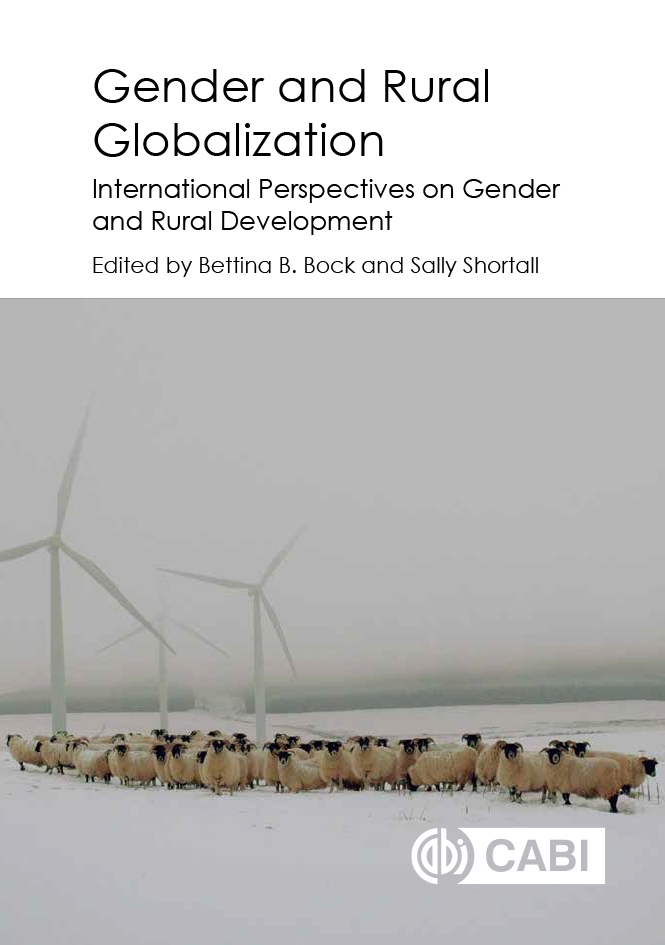
- Bock, B.B. and S. Shortall (2017) (eds), Gender and rural globalisation: international perspectives on gender and rural development, Oxfordshire: CABI
- Bock, B.B. and M. van der Burg (2017), Gender and international development, in B.B. Bock and S. Shortall (eds) Gender and rural globalisation: international perspectives on gender and rural development, Oxfordshire: CABI
- Bock B.B. (2016), The Rural, in: I. van der Tuin (ed.), MacMillan Interdisciplinary Handbooks: Gender, volume 2: Nature, MacMillan, 199-216
- Cornwall, A. , E. Harrison and A. Whitehead (2007) (eds),. Gender myths and feminist fables: the struggle for interpretive power. Gender and Development, 38(1998) (special issue)
- Mohanty, C.T. (2003), Feminism without borders; decolonizing theory, practicing solidarity, Durham & London: Duke University Press (reprint from 1984)
- Pini B., B. Brandth and J. Little (2015) (eds). Feminisms and Ruralities. London: Lexington Book
- Plas van der L. and M. Fonte (1994) (eds). Rural gender studies in Europe. Assen: van Gorcum
- Sachs C. (2019) (ed.), Gender, agriculture and agrarian transformations, changing relations in Africa, Latin America and Asia: London: Routlegde, Taylor & Francis Group
- Shortall S. and B.B. Bock (2015) (eds) Rural, gender and policy; Rural women in Europe: the impact of place and culture on gender mainstreaming the European Rural Development Programme; Gender, Place and Culture, 22(5), special issue


 Rural Sociology Wageningen University