CONVIVIALITY: a virtual, open-access conference

Join us for CONVIVIALITY

October 4-9, 2021

Have you heard there is an exciting all-virtual, all-free, all-asynchronous experimental conference taking place October 4-9, 2021, organized by Wageningen University and Massey University Political Ecology Research Centre?

CONVIVIALITY brings us together to ask, “How can we live – not at the expense of others?”  Together, we will explore predicaments of agriculture, biodiversity, and conservation with a focus on the ways humans, animals, plants, and broader ecologies attempt to live and thrive together.

Panels, such as:

Cultivation Beyond Productivism | Indigeneity and Decolonization | Extraction, Labour, Ecologies

Botanical Relations | Multispecies Relations |Ideologies, Tools, and Advocacy |Convivial Placemaking

Highlights

(see the full program):

A traditional Maori welcome: the conference opens with a livemihi whakatau, including a kōrero/word performance on Monday 4th October at 9:00 AM NZST (or Sunday October 3rd at 22:00 PM UCT+2 / CEST). The video will be available to watch on the site afterward. https://massey.zoom.us/j/3573384756 

6 keynote provocations from scholars, indigenous practitioners, and farmers from around the world share what is urgent about building convivial worlds! For example, indigenous cultivator Pounamu Skelton tells us how Maori wisdom infuses her approach to agroecology,  https://www.youtube.com/watch?v=w9HUIp0FC64, while Maywa Montenegro de Wit relates the latest scholarship and mobilization critical of the upcoming UN Food Systems Summit, Annu Jalais considers convivial politics of water, and Bram Buscher reflects on the promises and limits of entanglement.

Accessible content to watch at your convenience! Each day will focus on a theme and 1-2 panels of research presentations, with commentary from scholar discussants. Each panel has a unique comments section for participants to engage in with written, video, and audio submissions, which will continue through the conference and following weekend.

Making an international distanced conference ‘convivial’? In a time of pandemic and unprecedented demands on our time and attention, the asynchronous, virtual format means that your engagement can be as flexible or immersive as you can accommodate at this time. We view the experimental format as a proof of concept toward reimagining academic mobility, emissions, accessibility, and connection. The model rests on dynamic engagement: attendees are asked to watch presentations and engage creatively, with written comments, while audio and video interventions are possibilities, as well.

We hope you join us!

Serena Stein and Sita Venkateswar, Co-convenors

Serena S. Stein

Postdoctoral Researcher

Wageningen University & Research

The Netherlands
75th Anniversary: 41) Trapped!

By Paul Swagemakers, Department of Applied Economics, Public Economics and Political Economy, Complutense University of Madrid

A long time ago, in the 1990s, a friend of mine told me he was going to Wageningen to check out what one could study there. Forestry was among his interests. I came along with him and Wageningen sparked my interest too, as I saw numerous possibilities. I chose a course in rural development studies. I initially intended to follow it just for one year only, thinking it would widen my scope, and teach me about the world’s cultures and economic development, before I would decide what to do and study next.

Once started, I was trapped. I learned to analyse rural development issues: I choose a trajectory that taught me how the study of the heterogeneous social configurations and functional relationships between ‘man’ and nature could help combat rural marginalisation and spirals of economic decline and to identify and help develop departure points for sustainable rural development. I learned how pride and collective ideals among rural dwellers shaped their farming practices and how these were embedded in the wider institutional context of markets and policies. I learned that these external factors are often perceived as the drivers for economic development and that this often brought externalised costs. In the classes I learnt about a, now very well-known, example that illustrated this: to sustain the Dutch animal husbandry, a surface many times that of the Netherlands was (and still is) in use for feed production, including former tropical rain forests now used for soy bean production. Apart from realizing that these forests were lost, I asked myself what happened to the people who used to live in, and from, these former rain forests? And I asked myself what can Dutch farmers do to become less dependent on external inputs, and reduce their negative impact on nature elsewhere? At that time in Wageningen, I learned how neo-liberal economic theory advocates reducing the role of government and policies, and sees markets as the most efficient way to regulate supply and demand and to optimise the allocation of resources. I also learned that the revenues, split up in chunks of value added in the food chain, are highly unequally distributed among the participants in the value chain. I was taught about some innovative governance mechanisms that were emerging in those years, called environmental cooperatives. I wondered what I could learn from the farmers in this movement, and got a job helping analyse how new social configurations and relationships could result in the protection and conservation of the environment, studying the dynamics at the farm level in relation to support from markets and policies.

Over the years I learned how many farmers value and manage their land and herd in ways that differ from the dictums of economic theory that teach one to maximise production and minimise costs, and how many of them attempt to gain a living from what otherwise would often be abandoned because of lack of investment and respect: our environment. I also learned that many values produced at farms are poorly valorised in the food chain.

Triggered by this continuous manifestation of abandonment and disrespect, I continue to study where best to invest, and what to respect. This path has led me to a PhD in Social Sciences at Wageningen University, to several lecturing and researching posts at the University of Vigo, and, currently, to a position as assistant professor at the School of Political Sciences and Sociology of the Complutense University of Madrid. So much for just a year’s study! I am afraid, I am permanently trapped.

Related publications:

Swagemakers, P., Schermer, M., Domínguez García, M.D., Milone, M., Ventura, F. 2021. To what extent do brands contribute to sustainability transition in agricultural production practices? Lessons from three European case studies. Ecological Economics 189: 107197, https://doi.org/10.1016/j.ecolecon.2021.107179

Swagemakers, P., Domínguez García, M.D., Milone, P., Ventura, F., Wiskerke, J.S.C. 2019. Exploring cooperative place-based approaches to restorative agriculture. Journal of Rural Studies 68: 191-199, https://doi.org/10.1016/j.jrurstud.2018.12.003

Swagemakers, P., Domínguez García, M.D.., Torres, A., Oostindie, H., Groot, J.C.J. 2017. A values-based approach to exploring synergies between livestock farming and landscape conservation in Galicia (Spain). Sustainability 9 (11): 1987, https://doi.org/10.3390/su9111987

Swagemakers, P., Wiskerke, J.S.C., 2011. Revitalizing ecological capital. Danish Journal of Geography 111 (2): 149-167, https://doi.org/10.1080/00167223.2011.10669530

Swagemakers, P., Wiskerke, J.S.C., Van der Ploeg, J.D., 2009. Linking birds, fields and farmers. Journal of Environmental Management 90: 185-192, https://doi.org/10.1016/j.jenvman.2008.11.020

75th Anniversary: 40) Registration open for PhD Course on Agrarian and Food Citizenship

The PhD course Agrarian and Food Citizenship gives participants an opportunity to intensively engage with some of the major debates about the democratization of our agricultural and food practices, so that they can continue to explore and expand these debates in their own research. The main analytical lens to this democratization of agriculture and food practices in this course is that of citizenship. The course is organized as an one-week intensive discussion seminar.

Each session in this course will have its own set of required readings, which include both foundational literature and new research perspectives on agricultural and food citizenship. Completing these readings is necessary for all students to contribute to discussion during the seminar meeting. These readings will require a substantial time commitment outside of the meeting hours, so participants will need to budget time accordingly in order to fully participate in the course.

Click the link below for more information and registration:

https://www.wur.nl/en/activity/Agrarian-and-Food-Citizenship-3-ECTS.htm

75th Anniversary: 39) Protesting Farmers

In our previous blog, we wrote that to understand the overall evolution of farmer protests around the nitrogen crisis, Jaap Frouws’ doctoral dissertation Mest en Macht (Manure and Power, 1994) is highly relevant.  Among others, his work provides a an important entry point into the history and the crisis of farmers’ representation and cooptation in agricultural policies in the Netherlands.  

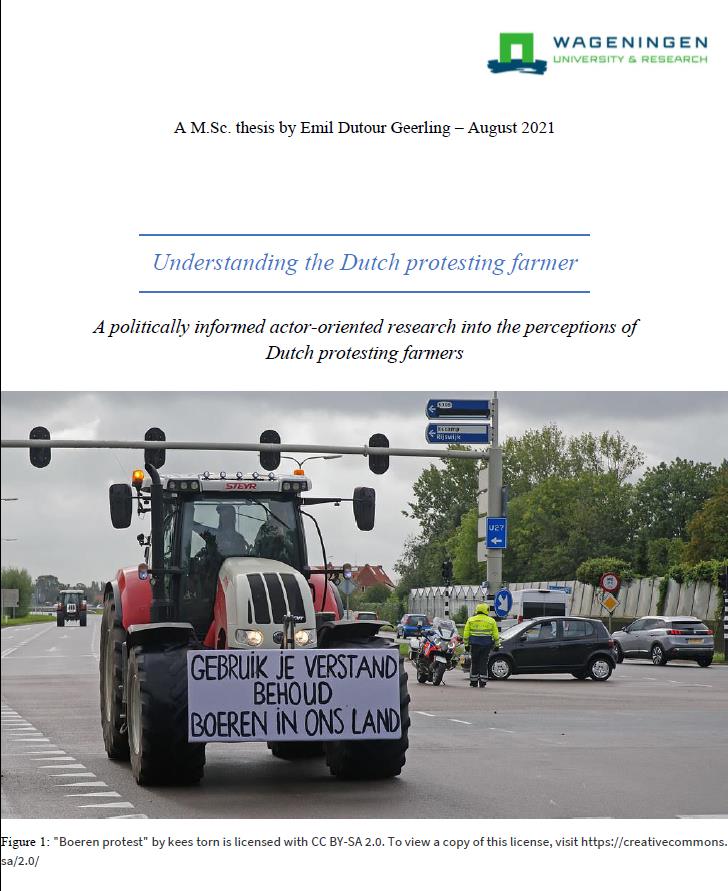
Master student Emil Dutour Geerling delved into this question of representation in his recently defended thesis on the contemporary farmers’ protests. At the time Jaap Frouws did his important work on the politics of the manure crisis in the 1990s, the first cracks had become visible in the bulwark of farmers’ representation. Today, almost three decades later, the landscape of representation has changed dramatically. The long-time alliance between national farmers organizations, political parties and the ministry of agriculture, has become history.  Feeling under- or not-represented, and, importantly, not heard, discontented farmers established a defense force. This Farmers Defense Force was able to mobilize thousands of farmers, who were prepared to take a more confrontational approach, blocking highways and retail distribution centers, and converged on provincial government buildings.

In his work, Dutour-Geerling explains the form the protests take from the crisis in representation. Yet, he explains the cause of these protests in terms of a crisis of accumulation.  Many of the protesting farmers have built their business strategy on the idea of continuous growth, yet the new nitrogen and phosphate regulations make this business strategy untenable.

This crisis of representation and crisis of accumulation creates a ‘biographical disruption’: the future that farmers perceived for themselves and their farms is not feasible anymore. This asks for a reconsideration of their idea of farming, and their self-perception as farmers. Changing their farming strategy is, if possible at all, costly; the rethinking of their farmers’ identity painful. This explains the fierceness of the protests.

Emil Dutour Geerling. 2021. Understanding the Dutch protesting farmer: A politically informed actor-oriented research into the perceptions of Dutch protesting farmers, Master Thesis Rural Sociology in partial fulfilment of the degree of Master of Science in International Development Studies at Wageningen University, the Netherlands

Book Review: States of Dispossession

States of Dispossession is a book about protracted violence in the city and the rural surroundings of Mardin, a region in the southeast of Turkey, close to the international border with Syria. The book discusses various ways which people navigate death and injury, are haunted by memories of genocide, excavate and value its remains, and trade compassion for benefit. Biner discusses this violence and/as dispossession in daily lives settings, from the deprivation of life to the appropriation of homes, from the treasure hunting of valuable remains to dispossession through heritage making, and a range of debt creating practices, in which a variety of actors are involved, among these military, provincial governors, jinn, diggers, real estate developers, tribal leaders, and village guards. The result is a staggering picture about the ways in which property, memory and bodies are disowned in daily practices of nation-state building and neoliberal multiculturalism.

Read more here: