The state of Sitopia

The state of Sitopia. Report of the 8th AESOP Sustainable Food Planning Conference 

By Paul de Graaf, External PhD Candidate, Rural Sociology Group
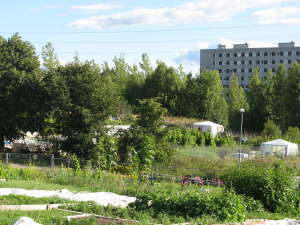
IMG_2103In the fall of 2017 the 8th AESOP Sustainable Food Planning Conference took place in Coventry,  hosted by the Center for Agroecology, Water and Resilience (CAWR). Since its inception in 2009 the Sustainable Food Planning department is one of the most active within AESOP (the Association of European Schools of Planning), indicating that food is back on the urban agenda, at least in academia. As a budding urban agriculture planner and researcher I attended the first two AESOP SFP conferences (Almere, 2009 and Brighton, 2010). Both were exciting meetings where pioneers from Europe and America – not only planners but also initiators, activists and scientists from other disciplines and people like Carolyn Steele (architect and writer of the seminal book Hungry City) – came together to discuss the then relatively new theme. I went to Coventry curious to see how the discussion has developed since those days and what is the state of affairs in the field in international perspective.

Continue reading

From hunger to obesity – MSc-thesis by Sonia Zaharia

By Sonia Zaharia, MSc-student Organic Agriculture.

Many low-income countries deliberately pursue agricultural specialization to increase yields and thereby lift their population out of hunger and poverty. Trade is supposed to offset the implied lower diversity of food production and deliver a food supply that supports the health of their population. This study challenges this assumption. I investigate the link between the prevalence of overweight and agricultural specialization. Using a fixed-effects panel regression on data from 65 low- and middle-income countries over the period 1975-2013, I find that countries in which agricultural production is more specialized have a larger share of overweight women. The positive relationship is higher in countries with lower per capita income. The correlation is not statistically different from zero for the male population, which confirms existing empirical evidence that malnourishment tends to be more frequent for women than for men. My results suggest that there are negative health implications of agricultural specialization in poor countries.

My full thesis From hunger to Obesity: agricultural specialization and obesity in low- and middle income countries can be downloaded from the WUR-Library.

Call for Papers: Evolving Agriculture and Food – Opening up Biodynamic Research

20141004_134427_AndroidCall for papers open for the 1st International Conference on Biodynamic Research

Call for Papers: Evolving Agriculture and Food – Opening up Biodynamic Research

Taking place at Goetheanum in Dornach (Switzerland), September 5th to 8th 2018

Biodynamic research is done in any agricultural field, in many places of the world using a great diversity of methods and disciplines, getting in touch with many other research areas. Taking an inter- and trans-disciplinary approach, we aim to bring together both academic research and farmer’s expertise to explore and discuss issues in biodynamic food and farming systems. The perspective taken on these issues may be from a classical scientific point of view as well as from an innovative methodical standpoint.

This new biannual event will gather academics, scholars, PhD students, graduate students, farmer-researchers and action researchers from around the world to discuss the latest and most pressing issues in biodynamic agriculture, horticulture and food, dedicating significant attention also to new and alternative researching methods.

The partners of the organizer, the Section for Agriculture at the Goetheanum, are: The Faculty of Organic Agricultural Sciences of the University of Kassel, the Research Institute of Organic Agriculture (FiBL) and Forschungsring (Research in Biodynamic Agriculture, Darmstadt, Germany).

Call for papers is open : http://www.sektion-landwirtschaft.org/veranstaltungen/biodynamic-research-conference/call-for-papers/

More information  at: www.sektion-landwirtschaft.org

Thesis Opportunity: What is inclusive when it comes to policy?

Thesis Opportunity with Rural Sociology: What is inclusive when it comes to policy?

Proposed title: Inclusive approaches to policy making: Making sense of options for food policy

Key words: policy, inclusivity, civil society, multi-actor, stakeholder, co-production

Context:  There have been increasing calls for more participation in policy making to allow for more inclusive policies. But what does this look like in practice? What models have been developed and tried? What has worked and what hasn’t? What are the implications of trying to be more inclusive. And, what does inclusivity even mean in a policy making context? The goal of this thesis is to start to answer these pressing questions and to related them to food policy.

Objective: The goal of this research is to identify and understand strategies for including people and their lived experiences, into policy making processes.

In this thesis, you will:

  • Undertake a literature review into inclusive governance (theory and practice)
  • Identify examples of inclusive governance from a broad range of sectors
  • Create a database of examples
  • Select an appropriate number of case studies to examine in greater depth
  • Collect data (including via interviews) to support description and analysis

On the basis of this, you will be expected to deliver concrete outputs.

Outputs:

  • Develop a clear research proposal building on a structured literature review and outlining clear methods for undertaking the research
  • Collect relevant literature and empirical cases to support the answering of the research question.
  • MSc thesis conforming to the criteria and quality indicators of the Rural Sociology Group.

Start date:  February or March 2018

Qualifications:

  • You are registered in one of the following MSc programmes:

MIDMHSMOA or MFQ

  • You have an interest in participatory policy making, civil society, food security and food sovereignty
  • You have some knowledge about theories of change
  • You have completed at least 2 RSO courses (or relevant social science courses)

Supervisor: Dr Jessica Duncan (RSO)

If you are interested, please email Jessica Duncan (jessica.duncan@wur.nl ) with a short letter of motivation.


The @MSCActions project @SUSPLACE_ITN published two video’s

The @MSCActions project on sustainable place-shaping (@SUSPLACE_ITN), funded by the EU-commission and coordinated by the Rural Sociology Group (@RuralSociologyW), has published two video’s.

The first video explains sustainable place-shaping in theory and practice, the second introduces the training and networking. The video’s are produced by the Early Stage Researchers themselves as part of their training. Watch below or go to the You tube SUSPLACE playlist of the Rural Sociology Group.