Open access to special issue: Soy production in South America

FoodGovernance's avatarFood Governance

FJPS 42_5-6 Cover.indd
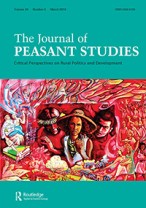
The Journal of Peasant Studies has just published a new Special Issues: Soy production in South America: Globalization and New Agroindustrial Landscapes. The Guest editors are Gustavo de L. T. Oliveira and Susanna B. Hecht.

The entire collection (15 articles) is freely available for a limited time!

Summary of the Issue:

Soy in South America constitutes one of the most spectacular booms of agroindustrial commodity production in the world. It is the pinnacle of modernist agroindustrial practices, serving as a key nexus in food-feed-fuel production that underpins the agribusiness-conservationist discourse of “land sparing” through intensification. Yet soy production is implicated in multiple problems beyond deforestation, ranging from pesticide drift and contamination, social exclusion and conflicts in frontier zones, concentration of wealth and income among the largest landowners and corporations. This volume explores in depth the complex dynamics of soy production from its diverse social settings to its transnational connections, examining…

View original post 52 more words

Jessica Duncan awarded Excellent Education prize 2016

Jessica Duncan has been awarded the Excellent Education Prize for the two courses:

Congratulations!

Agroecology in Movement: bridging science, practice, movement — April 25, 2016

On the 25th of April the Wageningen University will host the event “AGROECOLOGY – bridging science, practice, movement. With key speakers Pablo Tittonell and Irene Maria Cardoso. Moreover there will be dance, local food, music and much more! AGROECOLOGY – bridging science, … Continue reading →

via 25 April: Agroecology in Movement: bridging science, practice, movement — Boerengroep (Farmers Foundation)

PhD Defence: Knowledge Production, Agriculture and Commons: The Case of Generation Challenge Programme

On Monday the 18th Soutrik Basu of the Rural Sociology Group will defend his PhD dissertation entitled “Knowledge Production, Agriculture and Commons: the Case of Generation Challenge Programme” in the Aula of Wageningen University. The defence will start at 13.30hrs on monday the 18th of April.


Knowledge Production, Agriculture and Commons: The Case of Generation Challenge Programme

The discourse on knowledge production is in constant transformation: on the one hand, there is the emergence of instrumental knowledge production based on scientific utility and socio-economic relevance and marked by property regimes, while on the other hand, there is another form of knowledge production based on cooperation, communication and the sharing of knowledge often entitled the open-source production or commons-based peer production (CBPP) mode. Both these trends are reflected partially or in full measure within the agrarian knowledge production programme called Generation Challenge Programme (GCP) of the Consultative Group of International Agricultural Research (CGIAR). GCP is an international knowledge production platform that aims to use plant genetic diversity to develop technologies to support plant breeders in developing countries. This research aims at understanding the dynamics of the knowledge production in the GCP drought-tolerant rice research network in Indian context to reflect on the ways in which its knowledge production evolves and the implications of this for agrarian knowledge production and agrarian knowledge producing institutions. Continue reading

Possible Thesis Topics: Trends in Global Food Security Governance

We are looking for good and motivated BSc and MSc students to conduct research on the following four topics:

  • Deconstructing the discourse of evidence-based policy making.

Project: Calls for evidence-based policy making are increasing evident in global food security policy processes, and beyond. For example, the follow up and review process for the Sustainable Development Goals (SDGs) aim to be “rigorous and based on evidence, informed by country-led evaluations and data which is high-quality, accessible, timely, reliable and disaggregated” (UN General Assembly, 2015, para. 74). Behind this push for evidence-based decision making lies a set of highly political questions about what evidence is considered appropriate? How should it be selected? Why? And by whom?

This thesis project will identify and analyse calls for evidence-based policy making made in food security policy processes at the multinational level so as to better understand the political nature of evidence and the implications this has for policies and claims to knowledge and expertise. Continue reading