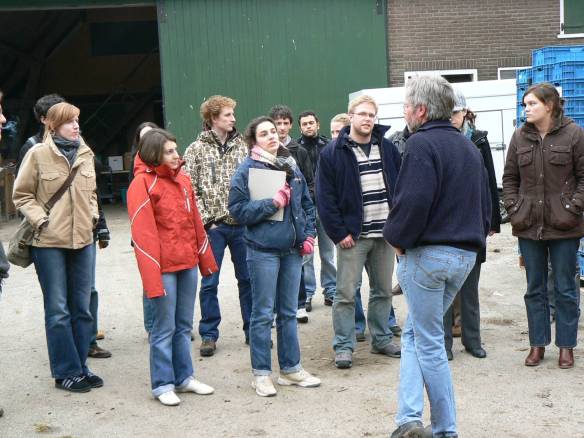
Excursions give real-world examples

Excursion 02-03-2009, Course Globalisation and Sustainability of Food Production and ConsumptionBy Zachary Daly – exchange student at Wageningen University from Guelp University, Canada.

It’s always nice to be able to actually go out and see real-world examples of what you are studying and reading about in class. During the course Globalisation and Sustainability of Food Production and Consumption we had the opportunity to visit some farms. As such it was very interesting to see and talk to two organic farmers that are involved in alternative food provisioning networks, but work in a quite different way. The first farmer, Gerrit Marsman, has a mixed farm called De Eerste with a cheese factory and home delivery service, employing about 10 persons. He was ideologically very dedicated to what he was doing, talking about the madness of the global trade in feed and food, the health problems that the use of chemicals in agriculture cause, and the problem of a short-term and money-oriented economy leading to financial crisis. The second farmer, Rene de Lange, appeared to be less ideological motivated and more pragmatic. His family owns has a brand new farm with milking sheep in national park De Weerribben, a protected landscape of high cultural and natural value. A high milk production per sheep is important to him and his wife, as well as a hygiene-proof processing unit to make cheese, yoghurt, and ‘feta’. They market their products under the label of Weerribben Schapenzuivel (sheep dairy), through a wholesaler, to organic food shops all over The Netherlands, and even for export.

A Future for Food

Cover page of the 'Future for Food' report Gradually more countries are developing a more holistic policy approach to food. Today I came across a report entitled A Future for Food: Adressing public health, sustainability and equity from paddock to plate, written by Australia’s Public Health Association (PHAA). In this report the PHAA states that Australia is in urgent need of an integrated food policy and calls on public bodies (such as governmental departments and the education sector), private parties (such as the food industry) and the voluntary sector (e.g. community based organisations) to realise this integrated approach to food. The strength of this report is its focus on food as a multi-dimensional policy domain; i.e. a food policy should not solely focus on nutrition but should also include a broad approach to public health as well as issues of environmental quality and social inequalities. What I particularly like in this report is the aim to involve the education sector in a national integrated food policy: “to ensure basic food literacy and skills education is available in all schools in Australia, as well as being available via community-based education initiatives“. Teaching children about the many aspects of food could be, I believe,  a very fruitful strategy to prevent a significant increase in food related health, environmental and social problems in the near future. In that respect it would be interesting to learn from countries, states or cities that have adopted an integrated approach to food policy, including involvement of the education sector, in the (recent) past.

Urban agriculture blogs

http://www.buildinggreen.com/auth/article.cfm/2009/1/29/Growing-Food-Locally-Integrating-Agriculture-Into-the-Built-Environment/

City Farm Chicago

Urban agriculture, city farming  or in Dutch ‘stadslandbouw‘ is getting more and more into the spotlight. Even though not new, it’s getting new significance and seem to be a growing phenomenon worldwide. One of the ways to keep in touch with new iniatives around the world is to take a RRS-feed on a blog, as I recently discovered myself.  Interesting blogs are e.g. City Farming News, covering news on worldwide initiatives with photo’s and video’s, and the  Dutch ‘Stadslandbouwblog‘ initiated by ‘Eetbaar Rotterdam‘ covering iniatives in and around Rotterdam but also from far away.

Collective approach to farmer marketing – recommendations

Dutch Initiative Van Eigen ErfRecently our rural sociology group finished an European research project on collective farmers marketing initiatives. The COFAMI project identified a broad set of enabling and limiting factors to explain the emergence of and dynamics within farmers’ driven collective action and developed a methodology to assess their impacts on different types of territorial capital assets. Empirial material from Italy, Germany, Latvia, Austria, Czech Republic, Switzerland and The Netherlands covers collective farmers initiatives in fields as high quality food production, provision of new rural goods and services and region branding. A summary of recommendations, reports and other project material can be downloaded from www.cofami.org.

Fordhall Community Land Initiative – Shropshire (UK)

By Sophie Hopkins – Fordhall Community Land Initiative in the rural county of Shropshire, England, is a pioneering venture in land acquisition and rural development (an example of Community Land Trust). 

Community Supported Agriculture
The project is an Industrial and Provident Society (‘run by the community, for the community’)  which was established to save 140 acres of land that had been organically farmed since WWII. Fordhall Farm (the family business) is today famous  for its meats, but was also the first place to produce yoghurt in UK. It uses the traditional method of foggage  farming, leaving grass-fed cattle outdoors all year. The family had been farming the land for generations but only as tenants, so when faced with eviction and development threats in 2004 the brother and  sister team (aged 19 and 21 respectively), and many others, decided to fight to secure the land. Working with local to global supporters and with the concept of Community Supported Agriculture, they devised a method to involve people in the food production chain, whilst still maintaining ownership of the farming practices. Continue reading