Urban Ag

Concern about our food, the quality, the exploitation of farmers and workers in the production chain and how it affects our health has induced conscious and political consumerism. But making a statement with the wallet supporting sustainable production might only be the first step. Once food conscious is awakened, it is a small step to grow your own food. Probably also fuelled by the recession, the demand for seeds has skyrocketed recently. The Washington Post (19-6) comments that

“After years in the doldrums, the consumer demand for vegetable seeds has abruptly climbed at a rate even industry veterans have never seen.”

Growing your own food is rapidly becoming a trend as part of an urban agriculture movement. There is a continuous emergence of new initiatives. For example, initiatives which somebody called “Gleaning social networks”; groups who harvest from public places and private places. Wild edibles, such as nuts, berries, fallen fruit, mushrooms and herbs are collected, sometimes to be distributed among the poor. In LA, 120.000 pounds of fruit was harvested within the city last year. Recently Amsterdam was mapped for its wild edibles.

Another type of urban agriculture initiative is “peer-to-peer agriculture”, initiatives which are about sharing land, tools and other resources for more efficient use. For example, how to find an allotment if there are waiting lists? Through internet people can search for pieces of land or gardens which might be (partly) used by someone willing to grow food.

With the rise of more and more urban agriculture initiatives and local food production, new farmers are born each day. These examples show that our idea of what a farm is will soon need serious reconsideration.
Job opening – Assistant/Associate Professor in Food Sociology

Job description

As assistant/associate professor you will teach and coordinate Bachelor and Master courses for the Bachelor and Master programme International Development Studies (specialization Sociology of Development) and for the Master programme Food Technology (specialization Gastronomy), and supervise Bachelor and Master thesis research for these programmes. You will undertake independent research and coordinate international research projects, specifically focusing on food production and provision in metropolitan regions and its importance for sustainable regional development as well as its significance for issues of public health, rural and regional employment, environmental quality and urban-rural relationships. If you qualify for an associate professorship you are expected to coordinate the Rural Sociology Group’s research theme “Dynamics and sustainability of regional food networks”. Other aspects of the job include project acquisition, training and supervision of PhD students and participation in various research and/or education committees. Continue reading

Four corners Indian country

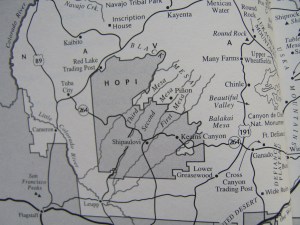
Since Saturday I am staying in Keams Canyon, in the Hopi Reservation in Arizona. For the last ten years, Cornelia Flora has been doing research and extension work with a colleague from Arizona State University, Matt Livingston and organizations at the Reservation. This visit therefore includes some meetings on current projects.

Hopi Indians are a pueblo tribe living in 13 villages located on the 2472320 acres (just over a million hectares) of the Hopi Reservation in north-central Arizona. With their ancestors coming from the south, they are sometimes categorized under as Anasazi; southern based tribes sharing a coming language root.  However, we learned in the Archeology Museum in Blending, Utah, that this is a name taken over into English from Navajo. In Navajo (themselves coming from north) it means something like ‘ancient enemy’. A more correct way to talk about the different tribes that came from the south, therefore, is Ancestral Puebloans. The Hopi Reservation is surrounded by the Navajo Reservation and there is an Apache Reservation nearby.

STA71894The Hopi villages are mostly located on three peninsular “mesas” that are the southwestern “fingers” of Black Mesa, high ridges elevated around a 1000 meters above the Canyon land plateaus. The Hopis are the oldest continuous inhabitants of northern Arizona; some of their ancestors may have lived in the region as early as A.D. 700 (Linford 2005).


“I never saw so much empty land”, I remarked to Matt in the car yesterday. Indeed, books talk about this desert land as some of the most desolate country in the United States. “It might seem empty to you” Matt replied, “but it is not for the Hopi”. It might not seem ‘productive’ in any Western economic sense, but this land represents many things for them. “There can be trails or holy places where their shrines live”. And, “their cattle graze here and they cultivate their indigenous ground races maize” Matt explained. In such an extensive way that it is hardly visible for the eye! With approx 300 millimeters rainfall a year and no rivers in the neighborhood they are adapted to their circumstances, quite different from the Dutch wetlands….

Hopi CookbookOne of the projects is centered around Hopi food. The aim of the project is to help communities to understand Hopi traditional food, to collect best practices about growing and gathering food as well as to appreciate the spiritual aspect of food. It is an awareness raising project, helping people realize what they already know. One of the result so far has been a Hopi traditional cook book and follow up activities are now planned, such as intergenerational cooking workshops.

First in time, first in right

For opposite reasons as why we created our “Waterschappen” in the Netherlands, there are Water Laws in the Western States of the US. In the states where I have been the last couple of days, Colorado, Utah and Arizona rainfall is pretty scarce. On our field excursion as part of the Changing Lands, Changing Hands conference, our guides tried to explain the extremely complicated water rights system of Colorado. Fortunately, somebody already told me over diner. “You don’t own the water that rains down on your land” my diner partner had said. Eehh?

It means that you cannot put a well on your land or use creek, river or lake water running on or near your land. You can only use water if you have water rights. Water rights are connected to ditches dug by the first settlers in 1860, and to Ditch companies who manage them. Those who claimed first, have more senior rights. The right equals to a share in the company; a certain quantity of water, measured in acre-feet (literally an acre of land with a foot water on top). In years of drought, those who claimed last will not receive any water, only for those with senior rights, the tap will be opened. Not all farm land has water rights, those who farm without, are known as the dry land farmers, usually farming wheat and/or cattle.

Right can be traded separately from the land. Each new development (housing, offices, malls) needs to have water rights too. Water rights are therefore sometimes more worth than the land itself. And it even happens that, in years of drought, it is more profitable for farmers to lease the water rights to a city or county than to farm. 

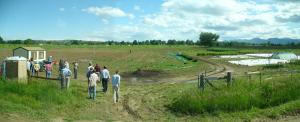
The Boulder county, one of the counties near Denver has a very progressive land use policy in place ever since 1978, an exception to the rule. This county is active to facilitate a new generation of farmers, such as those willing to start farming vegetables for farmers markets on small plots. We visited one such farmers association, which started two years ago. The land, including the water rights needed, is owned by the Boulder county which leases it to them against reduced prices. Otherwise this enterprise – and to many a dream – would not be possible.

colorado growers association 2 

(picture of Bart Eleveld Oregon State University)


Localising food in context; Marshall county

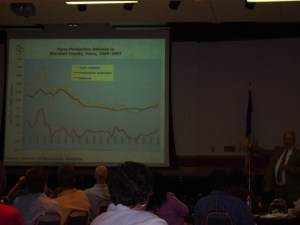
“Over the past four years momentum has grown for sustainable agriculture” Angie Nelson said as part of the introduction to the meeting for interested people in the County of Marshall to start joining forces for localizing the food economy. The meeting was held in the Community College in Marshalltown and it was entitled ‘Finding Food in Marshall County’. It is one out of three meetings during the summer to build partnership and engagement for establishing a local food infrastructure. Invited speaker Ken Meter of Crossroads Research Center gave a very revealing overview of Marshall county, Iowa and US food economy through lots of figures and tables (see also his website for more details). Marshall county is one of the 99 counties of Iowa, with 39.000 residents and 928 farms on a total of 92.856 farms in Iowa (2007).

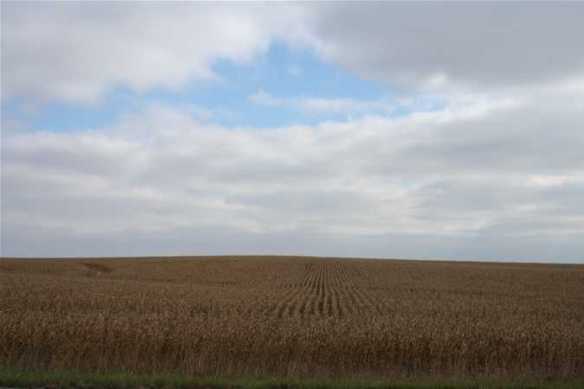
STA71628He convincingly showed how bankrupt the current monoculture commodities agro-industry is and how, corrected for inflation, there is no progress in farm income since 1969. The main commodities in Marshall county and Iowa in general are corn, soybean and hog production.
From census data, Ken showed that for Marshall county the total farming income was 175 million dollar, with 171 million dollar going to costs, leaving 4 million dollars income from farming, a positive figure because of a good year 2007, in 2002 it would have been negative. Other income (rents) counted for 11 million dollar. However, the biggest income source was subsidies, with 80% of the farmers receiving 18 million of farm subsidies in 2007. He also estimated that as much as 90 million dollar of the 104 million dollar Marshall county consumers spend on food is going to food from outside the county, bought in one of the 5 big groceries which have 49% market share nationally (Wall Mart as market leader). In total, he estimated that 166 million dollar is leaving the county each year through the current system of placeless production and consumption. He questioned why farmers are given subsidies to keep on farming while money leeks out of the community to the big corporations that are in the middle; the farm input industry and the retail industry and made a plea for localizing the food economy.

It is not the first time while being here that the strong emphasis on ‘local’ and on ‘community’ as part of the solution towards sustainable forms of agriculture strikes me. However, driving around in this state and looking at these figures, you get a sense of the overwhelming dominance of this industrial agro-food system, the vastness of its scale and the high level of vertical chain integration. In the heart of rural America, food production is an anonymous business with land purely as one of the production factors rather than as a meaningful connection to people and food. In constructing the practice and discourse of sustainable agriculture, therefore, scale matters a lot in this context. A more sustainable agriculture here also means a more humane agriculture, a more humane scale, through which people are able to relate to the food they eat. Only 43 acre (13 farms) is registered in use for producing vegetables together with 25 acre of farm orchards. No doubt there is grown a bit more than this in gardens and small unregistered farms but there seems to be room for locally grown fresh produce in Marshall County and Iowa without amounting to the size of one single agro-food industry farm, let alone ‘threatening’ the industry as a whole.cornfield iowa