PhD position: Knowledge brokerage to promote sustainable food consumption and production

In January 2011 the project ‘FOODLINKS’ (Knowledge brokerage to promote sustainable food consumption and production: linking scientists, policymakers and civil society organizations) will start. This project is funded by the European Commission and will be carried out by a consortium of 14 partners (universities, regional and local governments and civil society organizations) from 9 European countries. The overall project aims at developing and experimenting with new ways of linking research to policy-making in the field of sustainable food consumption and production. FOODLINKS will be coordinated by Prof. Han Wiskerke and Dr. Bettina Bock of the Rural Sociology Group of Wageningen University.

Job description

Within the FOODLINKS project we are looking for a a PhD candidate who is interested in issues of science-society dialogue, science-policy collaboration and social learning in the field of sustainable production and consumption. The PhD candidate will combine the writing of a PhD thesis with hands-on participation in a EC-funded project and contribution to project deliverables. 

Within the overall FOODLINKS project,  the PhD project monitors and evaluates the processes of social learning taking place in three Communities of Practice that are established as part of the project. In these Communities of Practice researchers, policymakers and civil society organization exchange knowledge and experiences and commonly define new research questions in the field of short food supply chains, sustainable public food procurement and urban food strategies. The PhD project will evaluate the knowledge brokerage activities and processes of social learning that are taking place in the Communities of Practice as well as in the project as a whole. 

Requirements

  • A Master degree in sociology, communication science or innovation studies.
  • Knowledge of relevant theoretical concepts in science and technology studies, science-society dialogue and science-policy collaboration, such as boundary work, knowledge brokerage, multi-stakeholder participation and social learning.
  • Knowledge of and experience with monitoring and evaluating processes of (social) learning.
  • Some knowledge of or interest in agro-food research and issues of sustainable food production and consumption. 
  • Good analytical and writing skills.
  • Fluent in English
  • Willing to travel as the project will include frequent meetings within Europe.

 Appointment conditions

A PhD position for a period of 18 months, extended with another 30 months upon favourable evaluation. Gross salary will increase from € 2042 per month in the first year up to € 2612 per month in the last year based on a full-time appointment (38 hours per week). In addition, we offer a holiday bonus of 8% and an end-of-the-year bonus of 8.3% of your annual salary. 

 Additional information

Additional information about the vacancy can be obtained from:

  • Prof. dr. ir J.S.C. Wiskerke, Chair of Rural Sociology, Telephone number: +31 317 482679/4507 and
  • Dr. Ir B.B. Bock, Associate Professor Rural Sociology, Telephone number: +31 317 483275/4507 

Additional information about the FOODLINKS project can obtained through this link. The PhD position is mainly related to Work Packages (WPs) 2, 6 and 7 of FOODLINKS.

Additional information about the organisation can be obtained through one of the following:

Interested? Apply now via www.jobsat.wur.nl before November 8th 2010 (Vacancy number: SSG-RSO-0005).

PUREFOOD research and training network

The Rural Sociology Group has been granted the coordination of a Marie Curie Initial Training Network  entitled ‘Urban, peri-urban and regional food dynamics: toward an integrated and territorial approach to food (PUREFOOD)’ funded by the European Commission’s Seventh Framework PEOPLE program. The PUREFOOD research and training programme aims to reduce the enormous knowledge and skills deficit that is negatively affecting the capacity to design and deliver appropriate political and developmental solutions in the crucial supra-disciplinary fields of food security, public food procurement, public health and sustainable urban and regional development. Hence, the objective of PUREFOOD is to train a pool of 12 early-stage researchers (ESRs) in the socio-economic and socio-spatial dynamics of the (peri-)urban and regional foodscape. The research and training program will therefore provide knowledge and innovation for the Commission’s aim to deal with economic, social and environmental policies in “mutually reinforcing ways” which reflects the core of the Lisbon and Gothenburg agenda’s call for integrated solutions towards economic prosperity, social cohesion and environmental sustainability. The PUREFOOD network is centred around food as an integrated and territorial mode of governance and studies the emergence of the (peri-)urban foodscape as an alternative (as opposed to a globalised) geography of food, including the ways in which, and the extent to which, sustainability aspects generally considered to be intrinsic to the alternative food geography are incorporated by the more conventional food companies.

The PUREFOOD Initial Training Network consists of 7  university partners who will each host one or more ESRs:

  1. Wageningen University Rural Sociology Group (The Netherlands)
  2. Cardiff University School of City and Regional Planning (United Kingdom)
  3. Pisa University Department of Agronomy and Agro-ecosystem Management (Italy)
  4. Latvia University Faculty of Social Sciences (Latvia)
  5. City University London Centre for Food Policy (United Kingdom)
  6. Federal University of Rio Grande do Sul Postgraduate Program in Rural Development (Brazil)
  7. Makerere University School of Public Health Department of Community Health and Behavioural Sciences (Uganda)

In addition to these universities as full consortium partners, the PUREFOOD network consists of 8 associated partners, a combination of private firms, public authorities and civil society organisations:

  1. Peri-Urban Regions Platform Europe (PURPLE)
  2. Sustainable Agriculture Initiative (SAI) Platform
  3. Sodexo UK
  4. Willem&Drees
  5. Slow Food Study Center
  6. Stroom Den Haag
  7. Sustain – the alliance for better food and farming
  8. Tukums municipality

The associated partners will contribute to the PUREFOOD training program by contributing to courses, participating in Communities of Practice and by hosting ESRs for a secondment. The active involvement of these associated partners is also of great importance for safeguarding the practical applicability of scientific research in the commercial, public as well as civic realm and for the dissemination of results.

The seven universities have opened (or soon will open) vacancies for 12 early-stage research positions. The launch of the vacancies has been announced on this weblog. As of now the PUREFOOD vacancy brochure with information about ESR projects, eligibility criteria, contact persons for additional information and addresses for submitting applications is available. For potential prospective ESRs an information pack has been compiled with information about the PUREFOOD research and training programme, the individual ESR projects, the timeline of the project and short descriptions of the full and associated consortium partners.

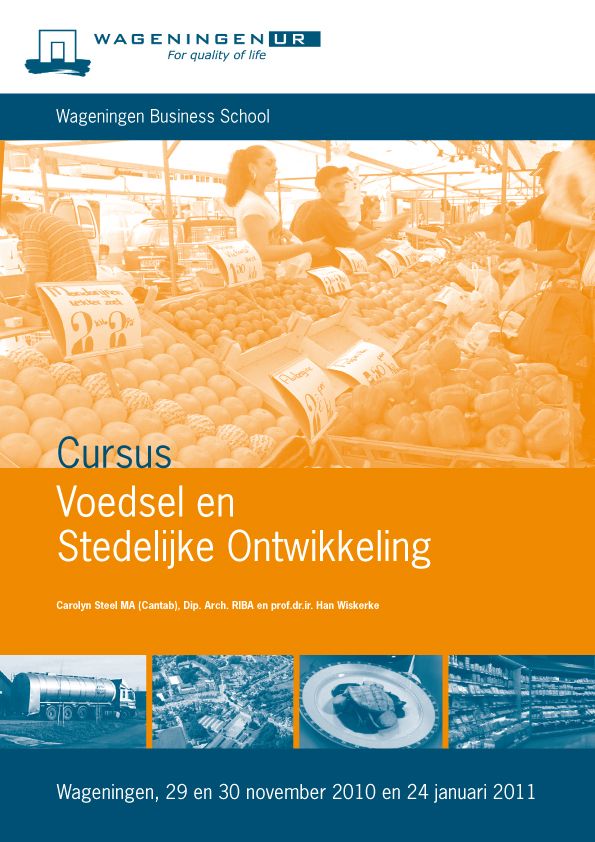
Cursus ‘Voedsel en Stedelijke Ontwikkeling’

Op 29 en 30 november 2010 en 24 januari 2011 verzorgen Carolyn Steel en ik voor Wageningen Business School een cursus over de relatie tussen voedsel en stedelijke ontwikkeling. Deze cursus is toegankelijk voor een breed publiek: beleidsmakers, architecten, landschapsarchitecten, stedelijk ontwerpers, eco-ontwerpers, docenten en mensen die in de landbouw, voedingsmiddelen- of gezondheidsindustrie werken. Daarnaast is iedereen die geïnteresseerd is in duurzame (stedelijke) ontwikkeling van harte welkom.

De aanleiding voor deze cursus is gelegen in de trend van bevolkingsgroei en voortschrijdende verstedelijking en het daarmee samenhangende spectrum aan sociale, economische en ecologische uitdagingen. Klimaatverandering, slinkende olie voorraden en het uitputten van natuurlijke hulpbronnen, gecombineerd met sociale kwesties als armoede, honger en obesitas, vormen de achtergrond voor complexe beleids- en planningsvraagstukken. De verbindende vraag in deze is hoe steden in de toekomst te voeden op een rechtvaardige en duurzame manier.

Als de toekomst inderdaad verstedelijkt is, moeten we dringend (her)definiëren wat dit inhoudt. Huidige aannames over verstedelijking, ontstaan in een tijd die voornamelijk ruraal was, zijn verouderd. We hebben een nieuwe visie nodig op steden en de relatie die zij hebben met het platteland dat hen moet voeden. Als wijzelf en onze toekomstige generaties “goed” willen kunnen leven, moeten we nieuwe inzichten ontwikkelen met betrekking tot wonen, ontwerpen en samenwerkingsverbanden. Hoe we dat moeten doen, is de kern van deze cursus.

Deze cursus is gebaseerd op en geïnspireerd door het boek Hungry City van Carolyn Steel. Hierin analyseert ze stedelijke ontwikkeling vanuit het perspectief van voedsel. Voedsel is de verbindende factor tussen tal van stedelijke uitdagingen, variërend van de ecologische footprint en klimaatverandering tot welzijn en gezondheidsvraagstukken. Door de verbinding met voedsel zichtbaar te maken, krijgen planners en beleidsmakers een middel in handen om hun aanpak te herdefiniëren en deze meer toe te spitsen op een duurzame stedelijke en rurale ontwikkeling. Cursisten leren door dit perspectief de relatie te zien tussen voedsel en verschillende publieke domeinen. Door deze relatie te begrijpen, wordt inzicht verkregen in de kwaliteit van beleid, in de samenhang van beleidsterreinen en in de verbanden tussen lokale en globale kwesties. Cursisten leren werken in multi-disciplinaire teams, waarbij voedsel als gemeenschappelijke taal en verbindende factor gebruikt.

Klik op de volgende links om je in te schrijven of om de cursusfolder te downloaden.

Second Sustainable Food Planning Conference – Reminder

As I announced in a blog on the 31st of March, the Urban Performance Group of the University of Brighton (UK) will host the second European Sustainable Food Planning Conference on 29 and 30 October 2010. Planning for sustainable food production and consumption is an increasingly important issue for planners, policymakers, designers, farmers, suppliers, activists, business and scientists alike. In the wider contexts of global climate change, a world population of 9 billion and growing, competing food production systems and diet-related public health concerns, are there new paradigms for urban and rural planning capable of supporting sustainable and equitable food systems? This conference will promote cross disciplinary discussions between active researchers and practitioners in response to this question, and related issues articulated during the first European Sustainable Food Planning Conference held in 2009 in Almere.

Working at a range of scales and with a variety of practical and theoretical models, we will review and elaborate definitions of sustainable food systems, and begin to define ways of achieving them. To this end 4 different themes have been defined as entry-points into the discussion of ‘sustainable food planning’. These are:

  1. Urban agriculture;
  2. Integrating health, environment and society;
  3. Food in urban and regional planning and design;
  4. Urban food governance

For each theme we are seeking contributions. Abstracts should be no longer than 500 words, and e-mailed to Andre Viljoen (a.viljoen@brighton.ac.uk) no later than the 31st May 2010.

For more information, see the conference website.

Second European Sustainable Food Planning Conference

As a follow-up of the first European Sustainable Food Planning Conference, which took place on 9 and 10 October 2009 in Almere (The Netherlands), the Urban Performance Group of the University of Brighton (UK) will host the second European Sustainable Food Planning Conference on 29 and 30 October 2010. Like the first one, this second conference will be held under auspices of the Association of European Schools of Planning (AESOP).

Context and aim

Planning for sustainable food production and consumption is an increasingly important issue for planners, policymakers, designers, farmers, suppliers, activists, business and scientists alike. In the wider contexts of global climate change, a world population of 9 billion and growing, competing food production systems and diet-related public health concerns, are there new paradigms for urban and rural planning capable of supporting sustainable and equitable food systems? Continue reading