Foodprint Sitopia

Foodprint logoOn Monday 3 November Stroom Den Haag (an independent centre focusing on the urban environment from the visual arts, architecture, urban planning and design) organized a small workshop as part of its program entitled ‘Foodprint – food for the city”. Foodprint takes place over the course of several years and focuses on the influence food can have on the culture, shape and functioning of the city, using The Hague as a case study. With a series of activities Stroom aims to increase people’s awareness of the value of food and to give new life to the way we view the relationship between food and the city.

The Hungry CityThe Foodprint program commenced on 25 March 2009 with a lecture by Carolyn Steel, author of the book “The Hungry City: How Food Shapes Our Lives“. In this book she gives a beautiful account of the role of food in shaping urban development. In a nutshell she shows that the size and shape of cities were directly related to the amount and kinds of food that the rural hinterland could provide. For a long time this implied that there was a food provision related barrier to urban growth. However, with the introduction of modern production, transportation, processing, preservation and storage technologies, global agriculture became the city’s hinterland and thus the ‘natural barrier’ to urban growth disappeared. According to Carolyn Steel on her blog:

“One important consequence of this was that urban authorities began to loosen their grip on the food supply, relying more and more on commercial companies to feed the urban population. That might have seemed a good idea at the time, but the result today is that we are totally reliant on trans-national corporations to feed us, who have no civic responsibility and no interests at heart other than making money. That puts them in an extremely powerful position – especially when you consider how difficult it is to feed cities as large as those we now live in.”

Carolyn Steel shows, like others have done as well from complementary and partly overlapping perspectives (e.g. Tim Lang, Michael Pollan, James Howard Kunstler), that most contemporary urban dwellers have become disconnected from and ignorant about food provision and are too a large extent, if not completely, dependent on a global industrialized food provisioning system that is intrinsically unsustainable.

The Hungry City ends with a chapter about the future, in which the author asks how we can use food as a tool for re-thinking cities and the way we live in them. For this, she introduces the term Sitopia (a word based on a combination of the Greek words Sitos, meaning food, and Topos, meaning place, hence food-place):

“The world is already shaped by food, so we may as well start using food to shape the world more positively.”

At the workshop we (i.e. Carolyn Steel, people working at Stroom Den Haag, scientists of different universities, architects, etc…) mainly discussed ideas and exchanged information about ongoing activities that are in one way or the other related to the notion of Sitopia. For me it was very interesting to exchange visions and experiences with disciplines (in particular visual arts and architecture) I normally do not interact with in education or research. And there was a shared desire to find ways to really collaborate, for instance by participating in each other’s projects. Although no concrete future plans were made, I do believe that workshops like this as well as the sustainable food planning conference I organized a month ago are the seeds of new interdisciplinary networks focusing on sustainable urban/regional foodscapes.

To learn more about Carolyn Steel’s vision on food and the city, I highly recommend her recent talk at the TED conference in Oxford.
Resistance and Autonomy in Western Mexico – local actors creating a place of their own

 By Peter R.W. Gerritsen, Department of Ecology and Natural Resources, South Coast University Centre, University of Guadalajara, Av. Independencia Nacional 151, 48900, Autlán, Jal., Mexico. Email: petergerritsen@cucsur.udg.mx

 The local effects of global processes in the Mexican countryside are well documented; describing problems related to the quality of rural producers’ life, identity and traditional practices, as well as their resource management practices. Alike initiatives all over the world,  also in western Mexico local actors joined forces to counter these problems and created ‘a place of their own’ in a globalised world, a place for their own wellbeing.

RASA - Peter Gerritsen

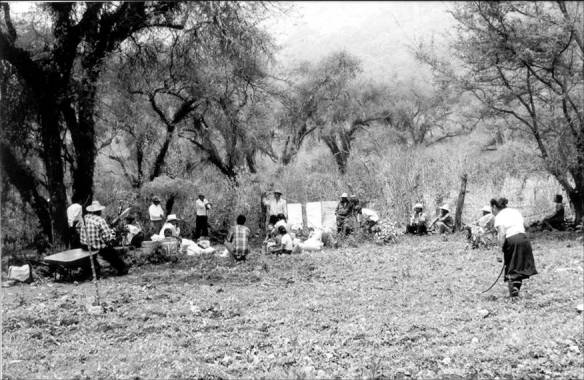
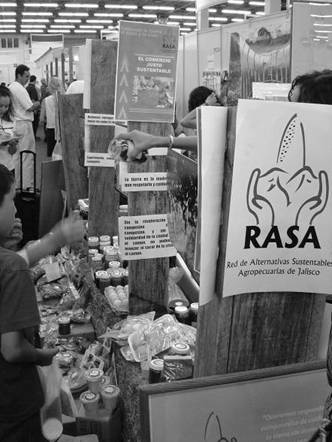
In the state of Jalisco, located in western Mexico, 20 groups of peasants and indigenous farmers, supported by professionals from non-governmental organizations and local universities, joined forces in 1999 and created the Red de Alternativas Sustentables Agropecuarias (RASA: the Network for Sustainable Agricultural Alternatives). As such, the RASA can be considered an umbrella organization for many local organized producer groups.

The RASA is also a social organization with characteristics of the so-called new social movements. New social movements have emerged since the late 1970s in the Mexican countryside, due to the problems created by global processes. The struggles that have led to their emergence originate from the demand to defend local structures and to remain control over the different domains of daily life. As such, these movements stress the need for endogenous development approaches. Closely related to the issue of specific life styles is the defense of the territory, being the place of local identity formation. It is also here, where innovative forms of resource management have emerged.

RASA 2 PGThe RASA´s main objective is strengthening a development model that aims to mitigate the local impacts of global processes and that permits the transition towards sustainable local development. In practice, the RASA organizes workshops on organic agriculture and fair trade, and organizes farmer-to-farmer meetings for sharing experiences (including political discussions on the countryside). These activities take place in the rural and peri-urban areas of Jalisco. The RASA also designs and implements new fair trade-channels, mainly in the metropolitan area of the Jalisco state capital Guadalajara. As such, the RASA´s actions are also directed at urban consumers. Finally, articulation with other social movements is actively sought for. Thus, the RASA seeks to create new room for maneuver by establishing strategic alliances with different societal actors.
The creation of local transition paths towards sustainable development, such as promoted by the RASA, is related to the issues of agency and power. These, in turn, are (often) related to resistance and autonomy. Both elements are also recognizable in the RASA experience.

To start with, the RASA has created its own socio-political space in the Jalisco countryside, which has permitted to resist to and counter the dominant rural development model in Mexico and in Jalisco that follows global tendencies. However, the RASA´s efforts must be understood as heterogeneous in nature; not all groups are involved in fair trade, but only those with a production surplus. Moreover, some groups focus more on basic grain production, while others cultivate horticultural crops. Furthermore, the RASA emerged outside the realm of governmental intervention in rural areas. In fact, it has been systematically neglected by formal institutions, as the RASA has been considered a threat to the established formal – historically-determined – political spaces in the rural arenas. Moreover, within the rural communities the RASA-members are perceived as outsiders. In this sense, the RASA conceptual approach has permitted strengthening their self-consciousness and self-organization, as well as improving their position in their communities. It has also led to the dimension of autonomy in the sustainable development model, as designed and implemented by the RASA.

Excursions Understanding Rural Development

As a part off the course Understanding Rural Development (RSO 31806) we went on a field trip to de Eemlandhoeve in Bunschoten and explored the inner-city of Utrecht. By this excursion we visited a number of interesting expressions of urban-rural relationships, from a rural and an urban perspective.

De Eemlandhoeve

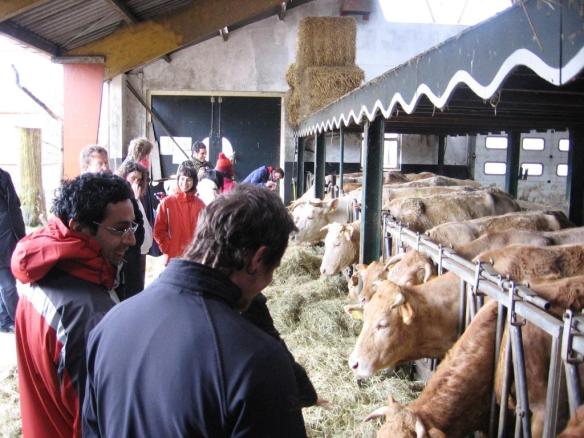
De Eemlandhoeve, owned by farmer, rural entrepreneur and philosopher Jan Huijgen, can be considered as an extreme example of a multifunctional farm enterprise. The group of Blonde d’Aquitaine’s form the centre of a rural enterprise which includes a large number of activities like a farm shop, care facilities, meeting and office facilities, an education garden and even a farmer’s cinema under construction.Blonde d'Aquitaines at the Eemlandhoeve

Next of being a multifunctional entrepreneur Jan Huijgen is a well known personality in Dutch rural development, active on a local, national, international (and maybe in the near future on a global) level. The farm residents a rural innovation centre and last October de Eemlandhoeve hosted the EEconference or Europese Eemlandconference, veelzijdig platteland.

On the excursion owner Jan Huijgen told us about his inspiration, motives and future plans with his farm. After his presentation we had an interesting discussion and were showed around the place.

Local food in the city of Utrecht

The second trip brought us to a rather different surrounding; the historical inner-city of Utrecht. On de Eemlandhoeve our focus was on the rural side of urban-rural relationships, in Utrecht we looked upon it from an urban perspective.

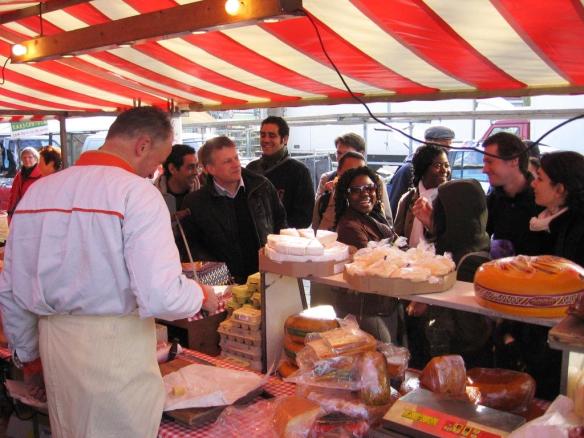
Cheese stall at the Vredenburg MarketTogether with our guide Frank Verhoeven (see his website)  we first went to the Wednesday Vredenburg Market. On this market we visited a cheese seller linked to the organization called Dutch Cheese Centre (website under construction). The stallholder told us about some typical Dutch cheeses and the trade in locally produced ones. After some tasting we set out for the traditional bakery Bakkerij Blom were owner Theo Blom showed us around and told about his bakery, traditional products and production.  

Our last stop was a visit to the five star hotel and restaurant Karel V for a number of short presentations. In the hotel our guide Frank Verhoeven started by telling us about his ‘Boerenbox’ initiative and his vision on a more locally based production and consumption. Secondly, one of the Karel V chefs explained us about the way they work with seasonal products originating solely from regional grounds and local suppliers. Lastly, Arie Bosma, one of the initiators of the campaign ‘Lekker Utregs’, told us about the initiative to reconnect the city of Utrecht with its surrounding countryside by establishing a so called Green Participation Society.

By the fieldtrips we got acquainted with several interesting expressions of urban-rural relationships, from a rural and an urban perspective. It was a nice and inspiring way of linking theory from class to reality by ‘tasting’ real life examples in ‘the field’.

Social movement and Brazil

Last week friday’s lecture in the course ‘People Policy and Resources’ discussed theory and practice of social movements. Social movements can be defined as social forms through which people:

 “coordinate and act together as collectives, respond to shifting environments and conflicts, dramatize and frame shared understandings of grievances, solidarity and visions, and challenge and influence existing political and cultural systems of authority.” (Karpantschof 2006)

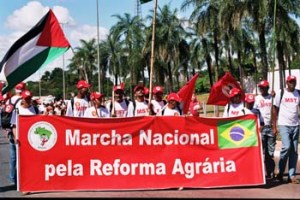
One of the examples in class was the Landless People’s Movement in Brazil (MST). As a background to this example students had to read about the history and community-making of the MST (Wolford, 2003) and about the adoption of agroecology as “the science of sustainable agriculture”  within the movement (Delgado, 2008: 563).

Thanks to the cooperation of our group with the Rural Development Post Graduate Program in Brazil, of the Federal University of Rio Grande de Sul (see earlier blogs 27 January, 13 February, 6 March) the students could also see how the movement works through part of a dvd ‘Agriculacao National de Agroecologia’. Together we watched a documentary about IL ENA, the national meeting for agroecology in Brasil which took place in 2006. The documentary clearly showed how social movements work through both practice ánd language. On the one hand the struggle for the material; actions for rights and resources. And on the other hand the struggle against dominant discourse; the construction of alternative conceptions and significations which politicizes dominant understandings and creates room for change.

Rural development in Brazil

fabio_kesslerProf. Fabio dal Soglio from the Federal University of Rio Grande de Sul (UFRGS) is currently our guest. He is one of the professors working in the Post-Graduate Programme on Rural Development (PGDR) and he has a particular interest in agro-ecology.

The  UFRGS and the PGDR-group in particular wants to extend collaboration with the Rural Sociology Group, as initiated by prof. van der Ploeg, by the exchange of staff, exchange of MSc and PhD-students and by joint research.

As part of an assignment for the MSc-course Sociology in Development, a group of MSc-students grasped the occasion and interviewed prof. Fabio dal Soglio on the Landless Workers Movement (MST) in Brazil and their struggle for land and land reforms.

mst-21Quoted from the MST-website (English edition):

 The MST is the largest social movement in Latin America with an estimated 1.5 million landless members organized in 23 out 27 states. The MST carries out long-overdue land reform in a country mired by unjust land distribution. In Brazil, 1.6% of the landowners control roughly half (46.8%) of the land on which crops could be grown. Just 3% of the population owns two-thirds of all arable lands.

Since 1985, the MST has peacefully occupied unused land where they have established cooperative farms, constructed houses, schools for children and adults and clinics, promoted indigenous cultures and a healthy and sustainable environment and gender equality. The MST has won land titles for more than 350,000 families in 2,000 settlements as a result of MST actions, and 180,000 encamped families currently await government recognition. Land occupations are rooted in the Brazilian Constitution, which says land that remains unproductive should be used for a larger social function.

 The MST’s success lies in its ability to organize and educate. Members have not only managed to secure land, therefore food security for their families, but also continue to develop a sustainable socio-economic model that offers a concrete alternative to today’s globalization that puts profits before people and humanity.