
As mentioned in previous posts, an international conference entitled ‘Agriculture in an Urbanizing Society’ will be held from 1 to 4 April 2012 in Wageningen. A whole range of different topics and research findings will be presented and discussed in 20 different working groups. The deadline for submitting abstracts was originally 20 December 2011 but the conference committees, in consultation with the working group convenors, have decided to postpone this deadline by one month. So if you are interested to present and discuss your research activities (or plans) in one of the working groups, please send your abstract to the convenor of the working group before 20 January 2012. You are kindly requested to use the abstract submission form.
Tag Archives: Urban agriculture
Conference ‘Agriculture in an Urbanizing Society’ – call for abstracts (reminder)

From 1 – 4 April 2012 a conference entitled ‘Agriculture in an Urbanizing Society: International Conference on Multifunctional Agriculture and Urban-Rural Relations‘ will take place in Wageningen. Some time ago a call for abstracts was launched. This is to inform or remind you that the deadline for submitting abstracts is 20 December 2011. Abstracts can be submitted by email to the coordinating convenor of a working group (call for abstracts for all WGs can be accessed through this link). The following working groups have been approved by the Scientific Programme Committee:
- WG1 Green care
- WG2 Agri tourism: Critcal Perspectives on Dilemmas and Opportunities
- WG3 Exploring ‘civic food networks’ and their role in enabling sustainable urban food systems
- WG4 Rural education
- WG5 Environmental services
- WG6 Economic impact at the farm level
- WG7 Business models; farm enterprise development models
- WG8 Entrepreneurial skills and competences: challenges and opportunities
- WG9 Learning for innovation – new challenges in an urbanizing world
- WG10 Regional branding; the socio-economic impact at the regional level
- WG11 Urban, peri-urban and regional planning
- WG12 Land-use transformations
- WG13 What are the challenges of future urban agriculture?
- WG14 Public food procurement
- WG15 Consumers, multifunctional agriculture and urban dynamics
- WG16 Multifunctionality, rural policy and governance
- WG17 Social exclusion and poverty in rural areas
- WG18 Migration and mobility
- WG19 Transition approaches
- WG20 Multifunctional agriculture as a coupled human-natural system
Urban Ag and Revolution
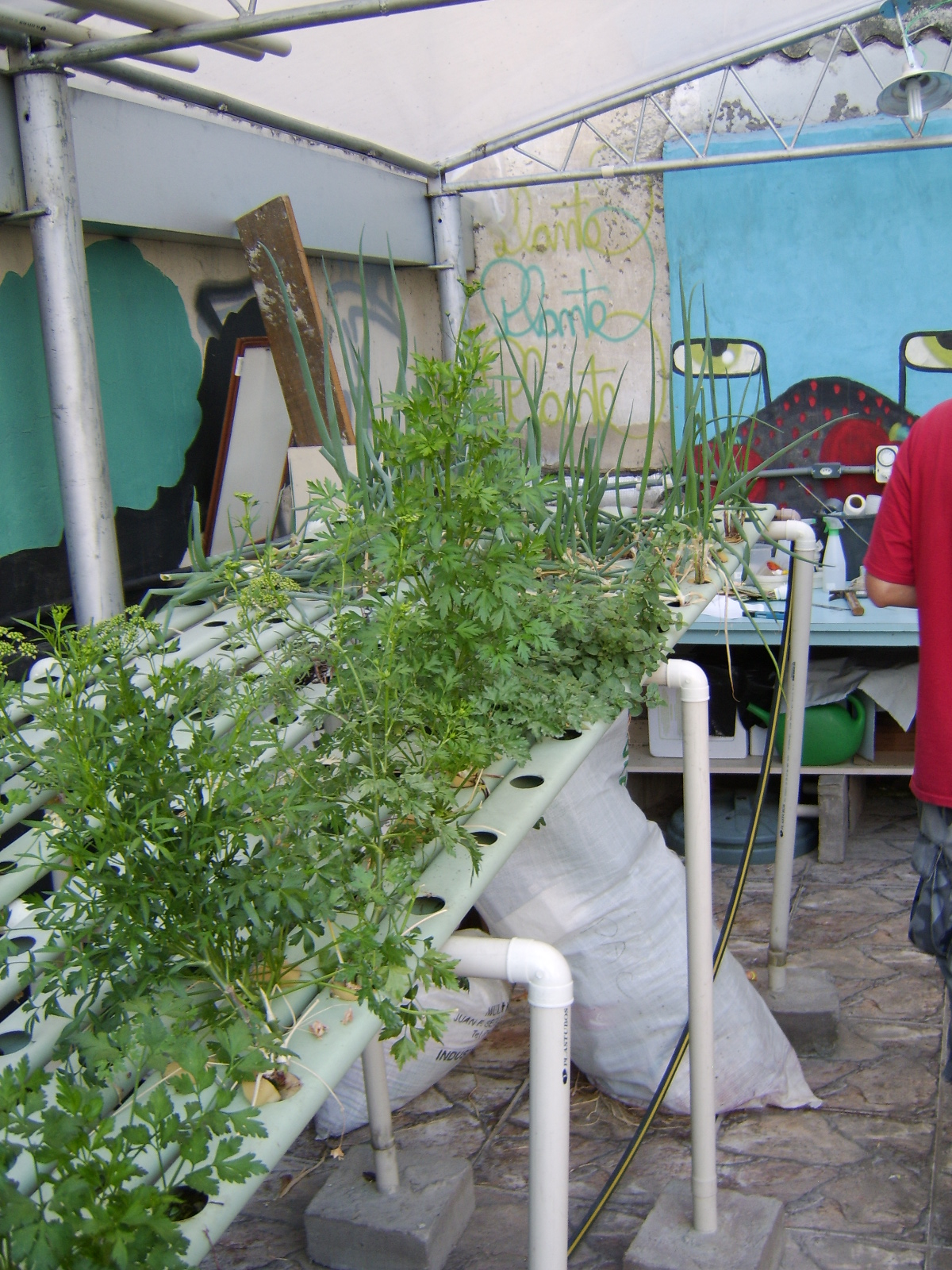 They claim to be the only example of rooftop farming in Porto Alegre. Hence, a revolutionary example in many ways. A student of last week’s class kindly offered to showed me around in Porto Alegre including unusual places such as the movement-community-cooperative COOPSUL. Right in the middle of the centre a building was squatted in 2005 related to the World Social Forum marches. The building was long-term abandoned and the movement of (somehow translated) ‘roofless’ people, the urban counterpart of the MST, asked with the squatting for the right to good housing. Their slogan; ‘Utopia e Luta’ which means Utopia and Struggle/Fight.
Against the odds, their fight was productive and they were given the right to stay in the building in 2007 under the condition that it would be a community place, open for the public. The building was turned into 42 individual apartments and community spaces for 5 separate cooperative economic activities; baking, gardening, sewing, laundry services and t-shirt printing. With the years, reality hit utopia from the inside. Tensions around individual needs and collective organisation, around leadership and running the cooperative emerged. It was originally envisaged that the people who were selected for the individual apartments would also work in the cooperative activities. This turned out to be difficult for various reasons. As a result, the 5 activities are not all running in the way it was envisaged and the rooftop farm is still very much in construction and produces for the building only.
Despite internal difficulties, the successful access to living space by squatting is still charged with a lot of symbolic energy. The movement and the building became a symbol for other urban groups and movements and the organisation is asked to assist in demonstrations and other revolutionary activities. For example today, they went out to assist MST land occupation demonstration in the face of evacuation.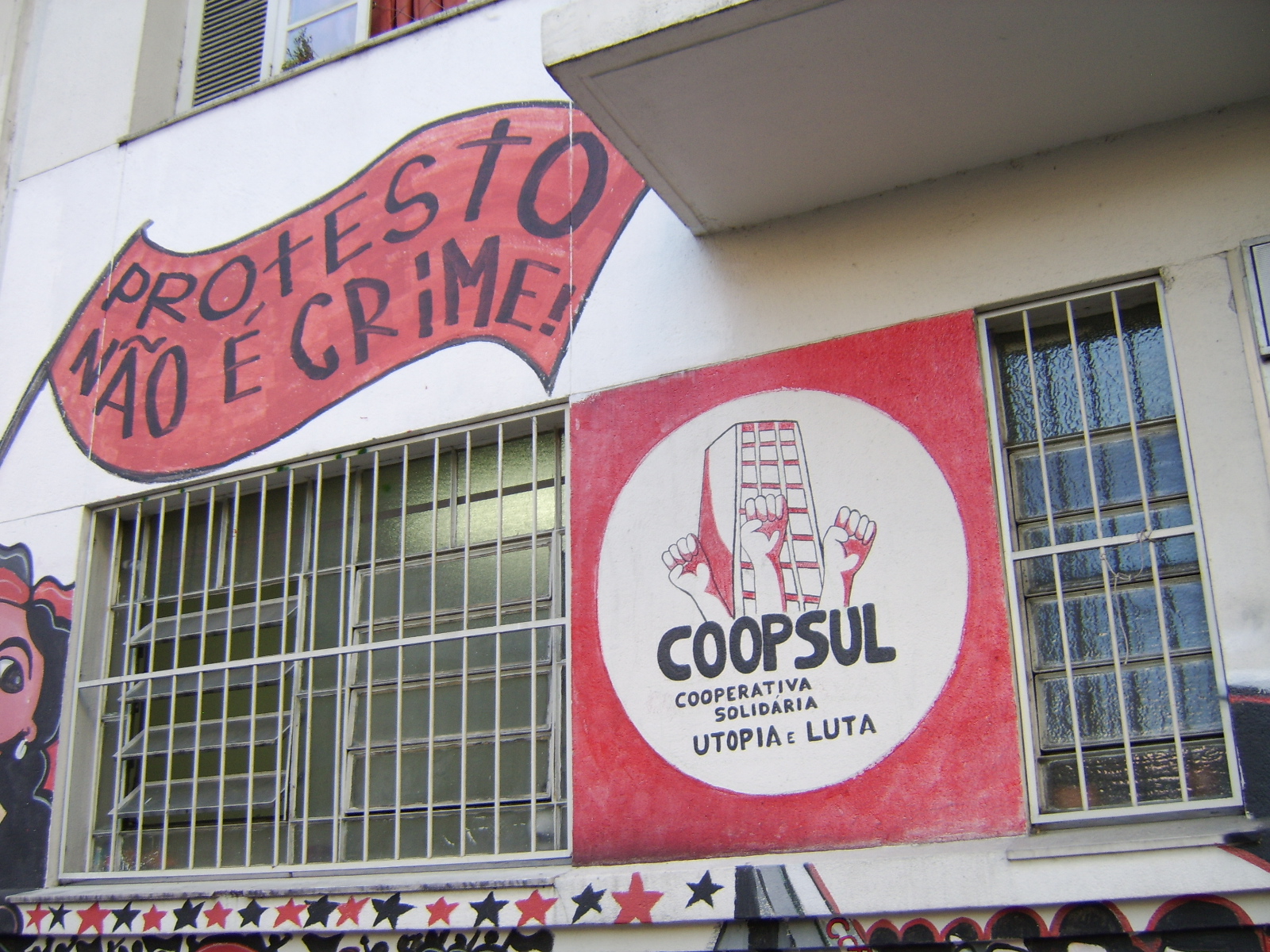
Die Produktive Stadt / Carrot City – Designing for Urban Agriculture
Carrot City is a traveling exhibit that shows how the design of buildings and cities can enable the production of food in the city. It explores the relationships between design and urban food systems as well as the impact that agricultural issues have on the design of urban spaces and buildings. The focus is on how the increasing interest in growing food within the city, supplying food locally, and food security in general, is changing urban design and built form. Carrot City showcases projects in Toronto and other Canadian and American cities, as well as relevant international examples from around the world. The exhibition contains a mix of projects that were recently completed or are currently under way, and visionary, speculative design proposals by both professional designers and students, which illustrate the potential for design that responds to food issues. The exhibit explores these issues at different scales, the city scale, the community scale, housing, rooftops and the products that make all of this possible.
Main curators of Carrot City are Mark Gorgolewski, June Komisar and Joe Nasr of Ryerson University Toronto (Canada). It has traveled to New York City, Montreal and Casablanca. Carroty City is now coming to Europe with exhibitions at the Technical University in Berlin (30 September – 30 October 2011) and the Technical University in Munich (8 – 26 November 2011). For more information about the exhibits and opening ceremonies have a look at the flyer.
Notes from the ESRS conference (3)
At the ESRS conference, currently ongoing, there are a few working groups situated around empirical and theoretical work on ” Alternative Food Networks (AFNs)” . Different studies have identified many different alternative food initiatives and networks which are situated outside the consolidated agro-industrial complex both physically and in their socio-political organisation.
The working groups show different cases from Europe and beyond in which participant involvement is being analysed. How participants of AFNs frame their involvement varies. The frames are often overtly political referring to marxist ideologies and anarchist principles or quite the opposite. The latter – no overt political statements – can be found in the cases presented by Esther Veen on two urban agricultural initiatives in the Netherlands.
Participants were extremely hesitant to frame their membership in political terms and were outright rejecting ‘ oppositional’ language. They were downplaying the significance of their membership, not prepared to place it in broader ideas of societal change, but framed it instead as a personal choice, as something nice to do and as their little contribution to make the world better.
Particularly in one case, this contrasted starkly with the initiator of that case who strongly voiced his political statements and discontent with the agro-industrial system. The audience to the presentation suggested that one of the explanatory factors could be Dutch culture which generally avoids politization but focuses on the ‘ tolerance’ of leaving you to do your thing while I do mine. Certainly, so far food has not underwent the same level of politization as is the case in Britain. But further unpacking is needed of these initiatives in order to firmly conclude at this point.
 Rural Sociology Wageningen University